
Indian Musicians
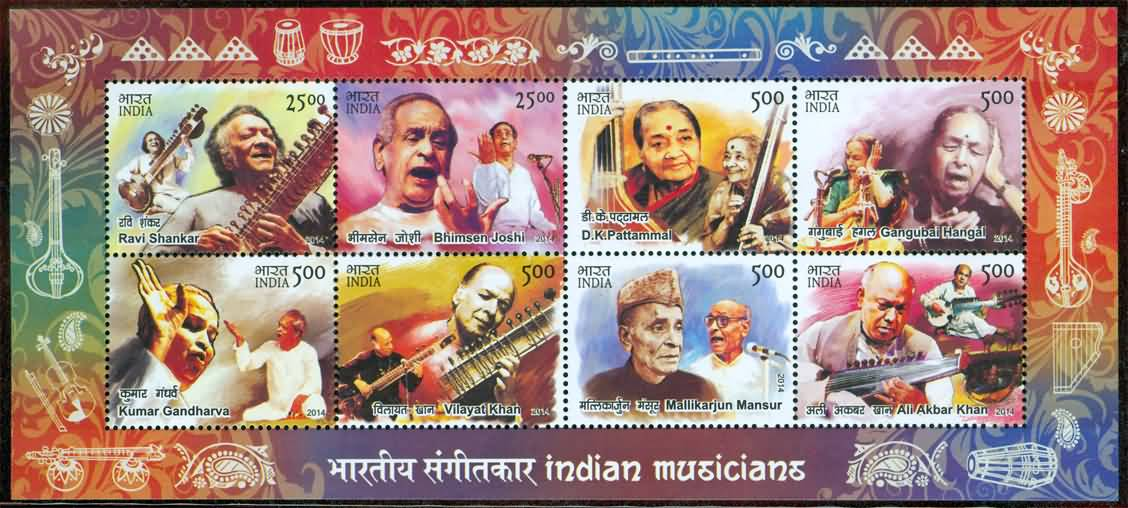
Technical Data
| Date of Issue | September 3, 2014 |
|---|---|
| Denomination | Rs. 80 |
| Quantity | 400,000 |
| Perforation | 13½ |
| Printer | Security Printing Press, Hyderabad |
| Printing Process | Wet Offset |
| Watermark | No Watermark |
| Colors | Multicolor |
| Credit (Designed By) | Ms. Nenu Gupta Sh. Sankha Samanta |
| Catalog Codes |
Michel IN BL124 Stanley Gibbons IN MS3020 |
| Themes | Famous people | Hands | Men | Musical Instruments | Musicians | Singers | Women |
Stamps in this Miniature Sheet



Introduction
Music has always been an essential part of Indian life and culture. Among its diverse musical traditions, Indian Classical Music holds a central place, deeply rooted in ragas and practiced for centuries. Its influence spans films, albums, devotional compositions and folk traditions.
Types of Indian Classical Music
Indian Classical Music broadly comprises two major traditions:
Hindustani Classical Music
- Predominantly practiced in North India
- Major forms: Khayal and Dhrupad
- Influenced significantly by Persian music, especially in instrumentation, style and raga structure
- Home to a rich lineage of Gharanas, each contributing unique styles and interpretations
Carnatic Classical Music
- Flourishes mainly in South India
- Structurally more rigorous and rhythmically intricate compared to Hindustani music
- Strong emphasis on composition, improvisation and devotional themes
Stamps on Musical Legends
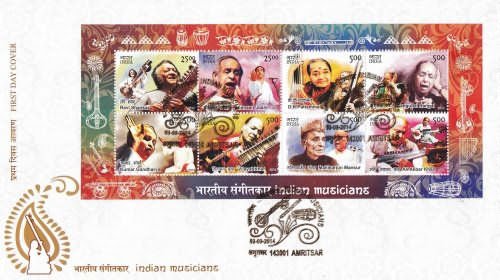
To honour legendary maestros who enriched Indian Classical Music and spread its glory across the world, India Post issued a Miniature Sheet consists of eight stamps, each dedicated to an iconic musician.
The Maestros
Ali Akbar Khan
A virtuoso of the sarod and an exponent of the Maihar gharana, Ali Akbar Khan was born on 14 April 1922 in Comilla (now in Bangladesh). He played a pivotal role in introducing Indian classical music to the West.
- Founded a music school in Calcutta (1956)
- Established the Ali Akbar College of Music in California (1967) and a branch in Basel, Switzerland
- Served as Adjunct Professor of Music, University of California
- Awarded the Padma Vibhushan (1989)
He passed away on 18 June 2009 in California.
Bhimsen Joshi
Born on 4 February 1922 in Gadag, Karnataka, Bhimsen Joshi grew up with a deep passion for music.
- First stage performance at age 19 (1941)
- Celebrated for khayal singing and devotional music
- Also contributed as a playback singer and won the National Film Award
- Known for balancing traditional purity with wider audience appeal
- Awarded Sangeet Natak Akademi Fellowship (1998) and Bharat Ratna (2008)
He died on 24 January 2011.
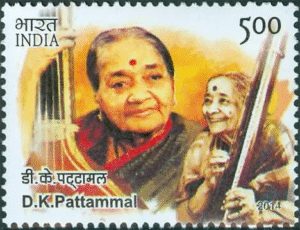
D. K. Pattammal
Damal Krishnaswamy Pattammal, born on 28 March 1919 near Kanchipuram, Tamil Nadu, was a legendary Carnatic vocalist.
- Started rigorous training at age 4
- Became the first Brahmin woman to perform on stage
- Pioneered women’s entry into singing Ragam–Tanam–Pallavi, earning the title Pallavi Pattammal
- Performed for nearly 75 years, including internationally
- Recipient of Sangeet Natak Akademi Fellowship, Padma Bhushan, and Padma Vibhushan
She passed away on 16 July 2009.
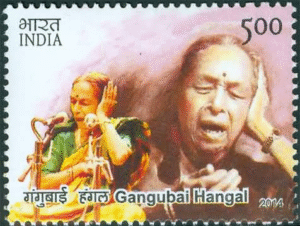
Gangubai Hangal
Born on 5 March 1913 in Dharwad, Karnataka, Gangubai Hangal was introduced to classical music by her mother, Ambabai.
- Performed at the 1924 Congress session in Belgaum at age 11
- Debuted in Mumbai in 1931 and later recorded extensively with HMV
- Featured in live broadcasts of All India Radio
- Honoured with the Tansen Award (1984), Padma Bhushan (1971), and Padma Vibhushan (2002)
She died on 21 July 2009.
Kumar Gandharva
Shivaputra Siddharamayya Komkalimath, known as Kumar Gandharva, was born on 8 April 1924 in Belgaum, Karnataka.
- Renowned for his innovative vocal style
- Experimented with nirguni bhajans, folk music and new forms of raga presentation
- Created new ragas through unique interpretations and combinations
- Deeply influenced by the folk traditions of Madhya Pradesh
- Awarded the Padma Vibhushan (1990)
He passed away on 12 January 1992.
Mallikarjun Mansur
Born on 31 December 1910 in Dharwad, Karnataka, Mallikarjun Mansur trained initially in Carnatic music before moving to Hindustani classical traditions of the Jaipur-Atrauli gharana.
- Known for mastery over rare ragas like Shuddh Nat, Asa Jogiya and Hem Nat
- Celebrated for inventive yet emotionally rich improvisations
- Authored Nanna Rasayatre, his autobiography
- Recipient of Padma Shri (1970), Padma Bhushan (1976) and Padma Vibhushan (1992)
He died on 12 September 1992.
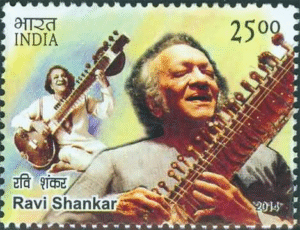
Ravi Shankar
Born on 7 April 1920 in Varanasi, the sitar maestro Ravi Shankar spent his youth touring with his brother Uday Shankar’s dance troupe.
- Trained in sitar from 1938 onwards
- Composed music for Satyajit Ray’s Apu Trilogy
- Served as Music Director at All India Radio (1949–1956)
- Gained global fame through collaborations with Yehudi Menuhin and George Harrison
- Nominated Member of Rajya Sabha (1986–1992)
- Awarded the Bharat Ratna (1999)
He died on 11 December 2012.
Vilayat Khan
Born on 28 August 1928 in Gauripur, Vilayat Khan was the son of sitar maestro Enayat Khan.
- Recorded his first disc at age 8
- One of the pioneers who introduced Indian classical music to global audiences
- Continued performing until 2004
- Though honoured with Padma Shri, Padma Bhushan and Padma Vibhushan, he declined all awards
He passed away on 13 March 2004.
First Day Cover
Leave a Comment
You must be logged in to post a comment.