Indian Parliament
Technical Data
| Date of Issue | May 13, 2002 |
|---|---|
| Denomination | Rs. 4 |
| Quantity | 3,000,000 |
| Perforation | comb 13½ |
| Printer | Calcutta Security Printers Ltd |
| Printing Process | Offset Lithography |
| Watermark | No Watermark |
| Colors | Gold |
| Credit (Designed By) | Sh. Sankha Samanta |
| Catalog Codes |
Michel IN 1902 Stamp Number IN 1954 Yvert et Tellier IN 1667 Stanley Gibbons IN 2069 WADP Numbering System - WNS IN014.02 |
| Themes | Anniversaries and Jubilees | Buildings | Government Buildings | Parliaments |
13th May 1952 marks a historic milestone in India’s democratic journey. On this day, the Parliament of India convened for the first time after the country’s first General Elections, inaugurating a new chapter as a sovereign, democratic republic.
Roots of Democracy in India
Although modern parliamentary democracy formally began in 1952, democratic traditions in India are ancient:
- Early forms of governance existed in ancient republics nearly 3000 years ago
- Institutions like Sabhas and Samities in the Vedic period reflected participatory governance
- Village assemblies continued this tradition through centuries
India’s present system evolved gradually, blending indigenous practices with modern parliamentary principles.
Evolution of Parliamentary Institutions
The growth of parliamentary democracy during British rule was shaped by continuous struggle:
- The Charter Act of 1833 marked early steps toward legislative participation
- Increasing demand from Indians led to gradual expansion of representative institutions
However, India’s Parliament was not merely copied from Britain—it developed organically on Indian soil, shaped by the freedom movement.
Constituent Assembly and Transition
A key milestone was the first meeting of the Constituent Assembly of India on 9th December 1946, a sovereign body tasked with framing the Constitution.
- After independence on Indian Independence (15 August 1947)
- And the adoption of the Constitution of India (26 January 1950)
The Assembly became the Provisional Parliament, guiding India through a crucial transition from colonial rule to full democracy.
Beginning of Parliamentary Democracy
The real democratic phase began when:
- The Lok Sabha
- And the Rajya Sabha
met for the first time in 1952. This moment symbolized:
- The culmination of India’s non-violent freedom struggle
- The beginning of governance based on universal adult franchise
Central Hall: Witness to History
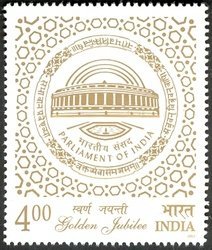
The commemorative stamp features the Central Hall of Parliament House, one of the most magnificent domed structures in the world.
This historic hall has witnessed:
- The transfer of power in 1947
- Debates that shaped the Constitution
- Joint sessions and inaugural addresses after general elections
Its inscriptions symbolize the guiding principles of parliamentary debate and democracy.
First Day Cover: A Glimpse of Ancient Democracy
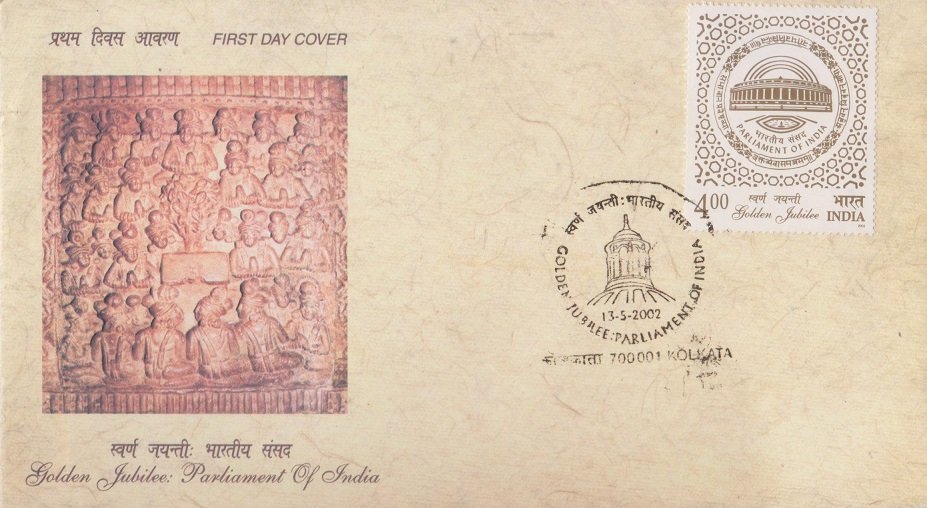
The First Day Cover depicts a pillar from the Sanchi Stupa, dating back to the 1st century BCE, illustrating an assembly of representatives—highlighting India’s ancient democratic traditions.
Legacy
The democratic experiment launched in 1952 has stood the test of time. Today, India is recognized as the world’s largest functioning democracy, with a vibrant parliamentary system.
To commemorate 50 years of this remarkable journey, India Post issued a special postage stamp, celebrating the Golden Jubilee of the Indian Parliament and its enduring role in shaping the nation.
First Day Cover