
Indian Postage Stamps – Princely States
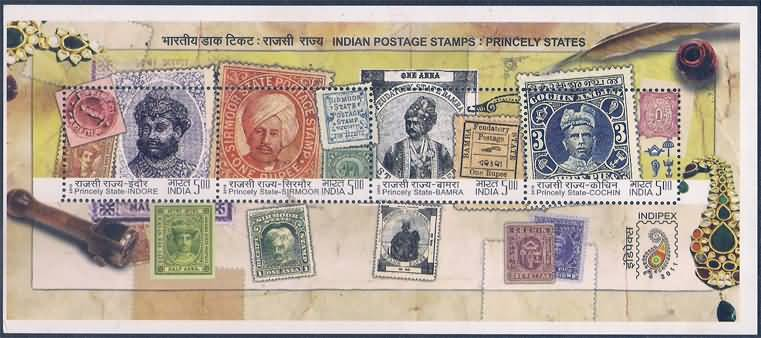
Technical Data
| Date of Issue | October 6, 2010 |
|---|---|
| Denomination | Rs. 20 |
| Quantity | 300,000 |
| Perforation | 13 |
| Printer | India Security Press, Nashik |
| Printing Process | Wet Offset |
| Watermark | No Watermark |
| Colors | Multicolor |
| Credit (Designed By) | Shri Kamleshwar Singh |
| Catalog Codes |
Michel IN BL87 Stamp Number IN 2454a Stanley Gibbons IN MS2754 |
| Themes | Elephants | Philatelic Exhibitions | Stamps |
Stamps in this Miniature Sheet
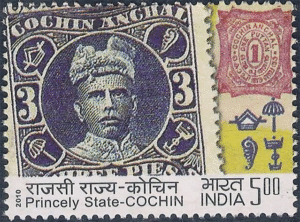
Indipex 2011
Before 1947, India comprised two distinct political entities — territories directly administered by the British and nearly 568 Princely States. These states were nominally sovereign under British paramountcy, governed by Indian rulers who exercised internal autonomy while acknowledging British suzerainty.
With the enactment of the Indian Independence Act 1947, these princely states ceased to exist as separate entities and gradually integrated into the Indian Union.
However, many of these states left behind a remarkable philatelic legacy. Their postage stamps — bearing portraits of rulers, regal insignia, and unique symbols — remain prized collectibles. Printed in varied colours and methods, often overprinted, these stamps reflected the identity and history of each state.
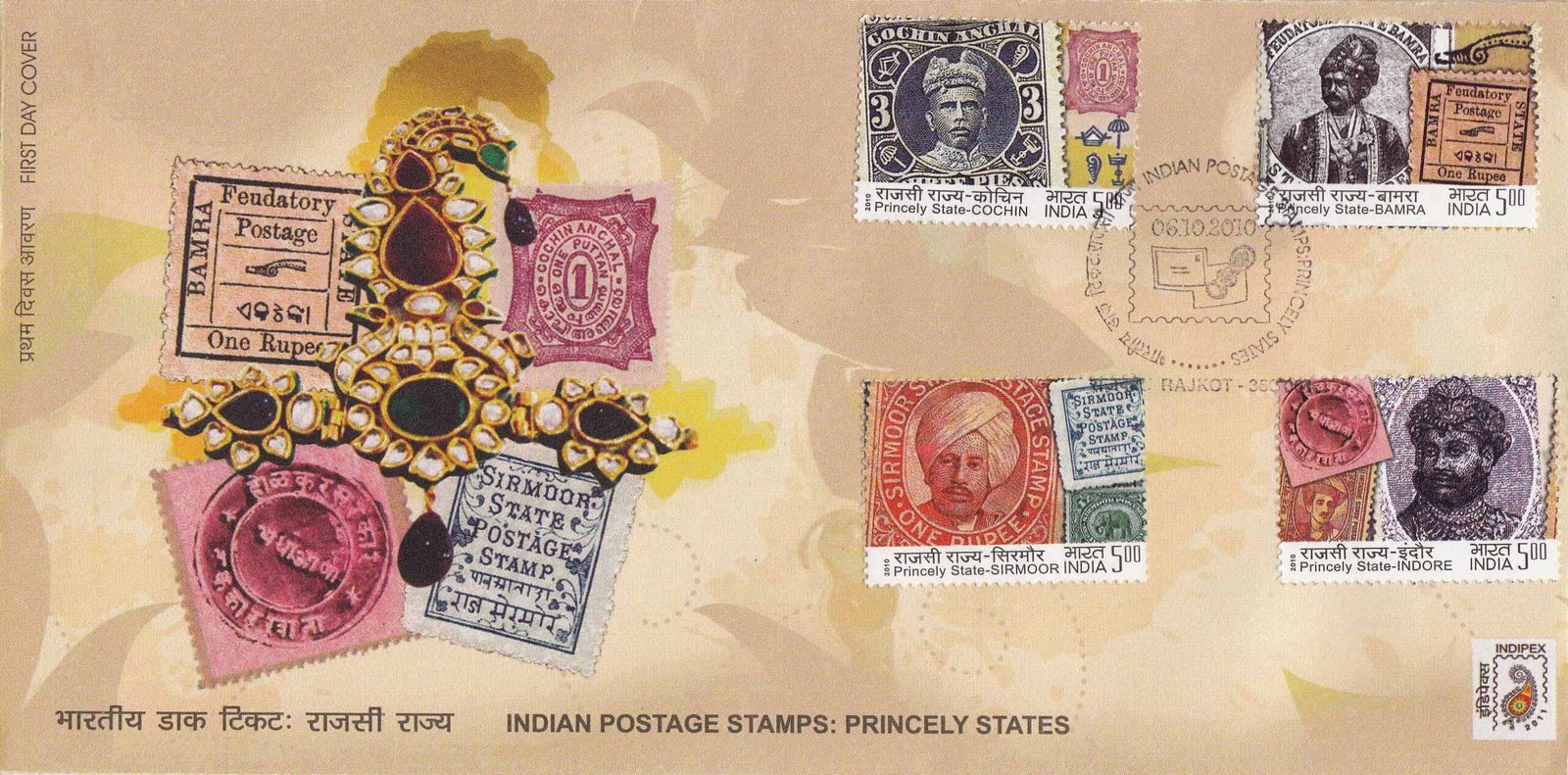
To celebrate this rich heritage, a Miniature Sheet of four commemorative postage stamps was issued during Indipex 2011 under the theme Indian Princely States, depicting stamps from Sirmaur, Indore, Bamra, and Cochin.
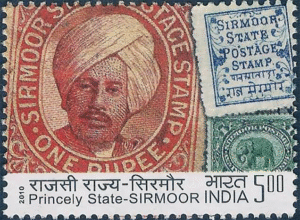
Sirmaur
Sirmaur State was founded in 1616 and was located in the present-day Sirmaur district of Himachal Pradesh. Also known as Nahan after its capital, it was ruled by Rajput chiefs who bore the title “Raja.” The state was established by Soba Rawal, later known as Raja Sobans Prakash, and its capital was founded in 1621 by Raja Karam Prakash.
The stamps of Sirmaur, issued from 1879 onwards, are often regarded as among the most attractive of the feudatory states. They were generally denominated in pies and annas.
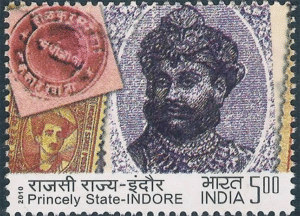
Indore
Indore State was an important princely state in Central India. Its origins trace back to Rao Nandlal Chaudhary, who established a fort near the Indreshwar temple along the Saraswati River. The settlement was originally called Indrapur, later evolving into Indore.
The state rose to prominence under the Holkars, particularly Ahilyabai Holkar, who ruled from Maheshwar and left a lasting legacy. After British intervention, the capital shifted to Indore, now part of Madhya Pradesh.
Indore issued stamps between 1885 and 1906, primarily denominated in annas, until its postal services were absorbed by the British India Post Office.
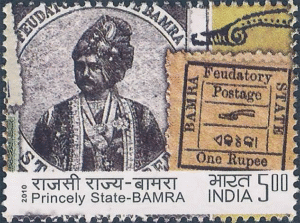
Bamra
Bamra State was one of the Oriya feudatory states, covering an area of 5,149 square kilometres, with Deogarh as its capital. According to legend, its rulers belonged to the Ganga Vanshi dynasty of Utkal and began their rule around 1602. The last ruler was Raja Bamra Bhanuganga Tribhuban Deb (1920–1947).
Bamra issued stamps from 1888 to 1894 in denominations of annas before its postal system was taken over by British India.
Cochin
Kingdom of Cochin encompassed much of present-day Thrissur district and surrounding areas of Kerala. Over centuries, it came under the influence of the Portuguese, Dutch, Mysore rulers, and finally the British.
In the 16th century, the Portuguese established Fort Emmanuel, marking early European presence. The Dutch later built Fort Williams after defeating the Portuguese in 1663. Eventually, Cochin became part of the British Empire in 1814.
Notably, Cochin was the first princely state to willingly join the Indian Union in 1947. In 1956, it merged with the Malabar district of Madras State to form the present-day state of Kerala.
Cochin issued stamps from 1892 to 1949 in denominations of pies and puttans, contributing significantly to India’s philatelic heritage.
Miniature Sheet – A Philatelic Tribute
The Miniature Sheet issued at Indipex 2011 beautifully showcases stamps from these four princely states — Sirmaur, Indore, Bamra, and Cochin. Each stamp reflects the regal imagery, cultural identity, and administrative history of its respective state.
This commemorative issue pays tribute to a fascinating chapter of India’s postal and political history, preserving the legacy of the princely states through the lens of philately.
First Day Cover
Leave a Comment
You must be logged in to post a comment.