Indian Snakes
Technical Data
| Date of Issue | November 12, 2003 |
|---|---|
| Denomination | Rs. 20 |
| Quantity | 50,000 |
| Perforation | comb13½ x 13 |
| Printer | Madras Security Printers |
| Printing Process | Offset Lithography |
| Watermark | No Watermark |
| Colors | Multicolor |
| Credit (Designed By) | Sh. Sankha Samanta |
| Catalog Codes |
Michel IN BL22 Stamp Number IN 2036a Yvert et Tellier IN BF21 Stanley Gibbons IN MS2171 WADP Numbering System - WNS IN053MS-03 |
| Themes | Animals (Fauna) | Reptiles | Snakes |
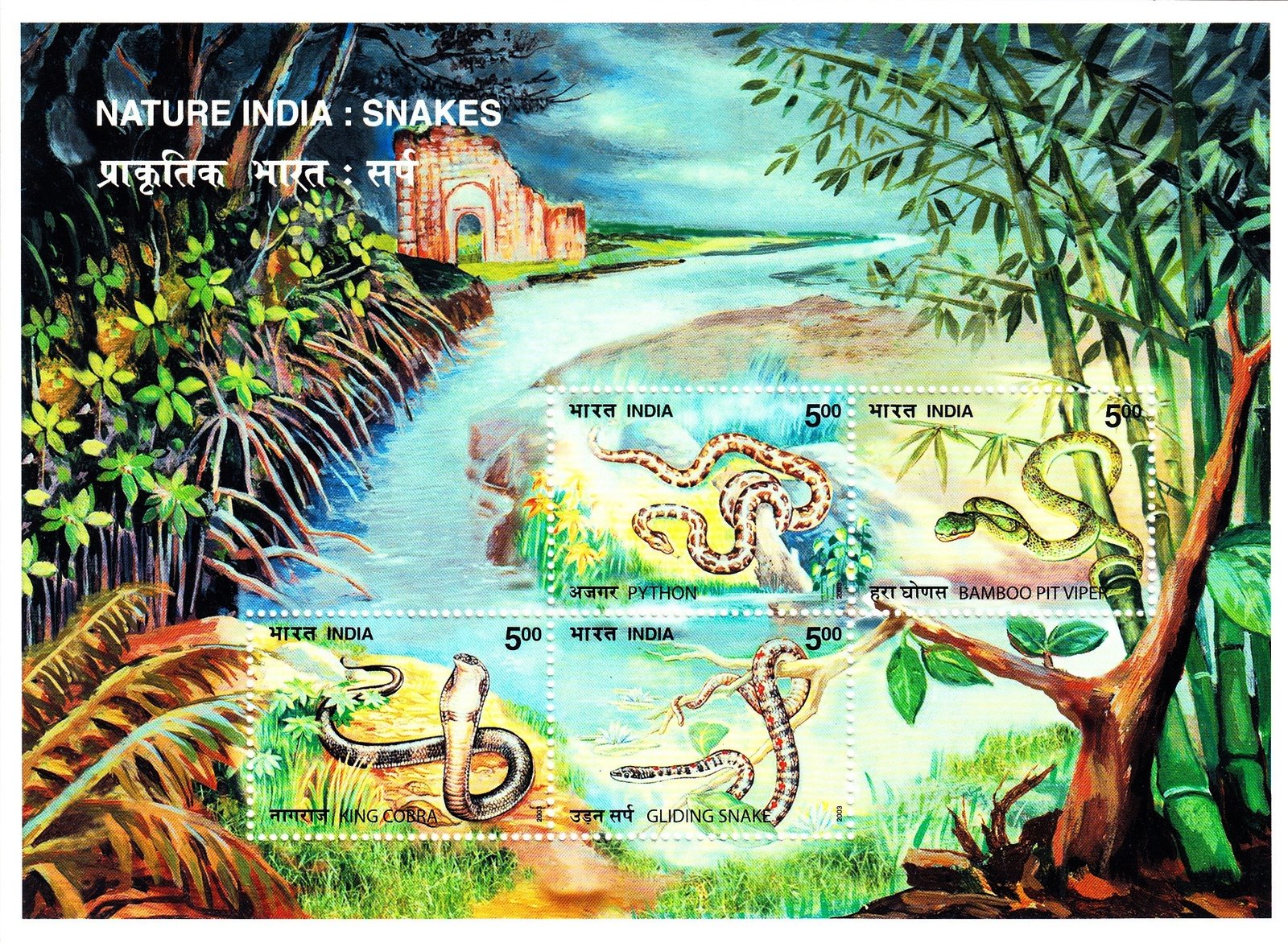
Stamps in this Miniature Sheet


Nature’s Fascinating Creatures
Snakes have long captured human imagination across the world, finding a place in epics, myths, folklore, religion, art, music and even modern films. In India, this fascination ranges from the traditional image of snake charmers to a modern society driven by science and technology.
Diversity of Snakes in India
Snakes belong to the Order Squamata of reptiles, and India is home to about 262 species, of which 56 are venomous. Snake venom serves multiple purposes—it helps in capturing prey, acts as a defence mechanism and aids digestion. Importantly, not all snake bites are fatal; in many cases, fear and shock contribute significantly to casualties.
Indian Python
The Indian Python is one of the largest non-venomous snakes found in India. It inhabits forests, rocky terrains and even open woodlands. A skilled climber and swimmer, the python feeds mainly on mammals, birds and reptiles. Due to extensive hunting for its skin, it is now an endangered species protected under the Indian Wildlife (Protection) Act, 1972.
Bamboo Pit Viper
The Bamboo Pit Viper is a striking green, tree-dwelling snake found in the Western Ghats at elevations above 450 meters. Its bright green coloration provides excellent camouflage among foliage. Though its venom is not highly toxic, a bite can cause pain, swelling, nausea and fever. It primarily feeds on small mammals and birds and gives birth to 7–15 young ones.
King Cobra
The King Cobra, also known as the Hamadryad, is the world’s largest venomous snake. Found in dense forests of peninsular India, it is known for its alertness, aggression and distinctive hood display. Uniquely, it feeds mainly on other snakes. The female builds a nest using leaves and guards her eggs—an uncommon behavior among snakes.
Gliding Snake
The Gliding Snake is a remarkable tree-dwelling species known for its ability to glide through the air. By flattening its body and using controlled movements, it can travel distances of up to 50 meters between trees. Agile and graceful, it moves effortlessly across branches and vertical surfaces.
Conservation and Awareness
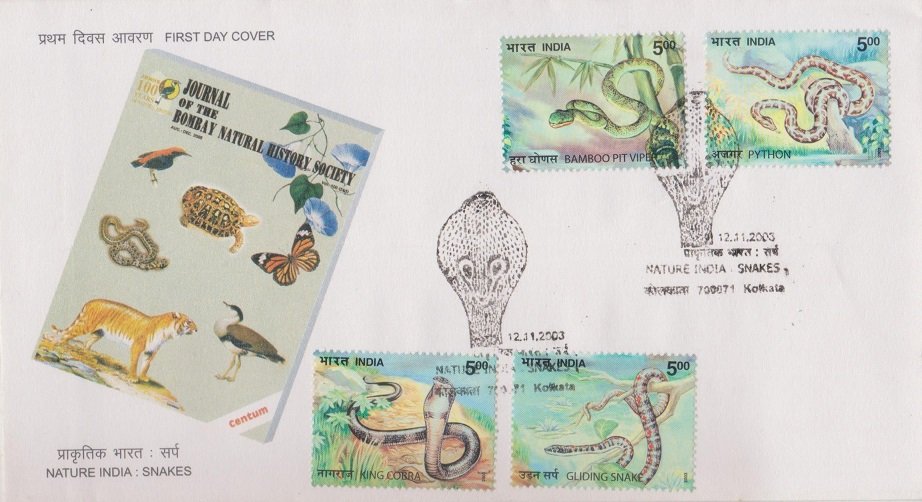
To highlight the beauty and ecological importance of these reptiles, India Post issued a Miniature Sheet consisting of set of four commemorative stamps under the “Nature India” series. This release also marked the publication of the 100th volume of the journal by the Bombay Natural History Society, which has played a crucial role in documenting and conserving India’s biodiversity since 1886.
Commemorative Stamp Set
The stamp series features:
- Indian Python
- Bamboo Pit Viper
- King Cobra
- Gliding Snake
These stamps celebrate the diversity, mystery and ecological significance of snakes while promoting awareness about their conservation.
Conclusion
Snakes, though often misunderstood, are vital components of the ecosystem. By controlling pest populations and maintaining ecological balance, they play an indispensable role in nature. This commemorative stamp series serves as a reminder of the need to respect and protect these fascinating creatures.
First Day Cover