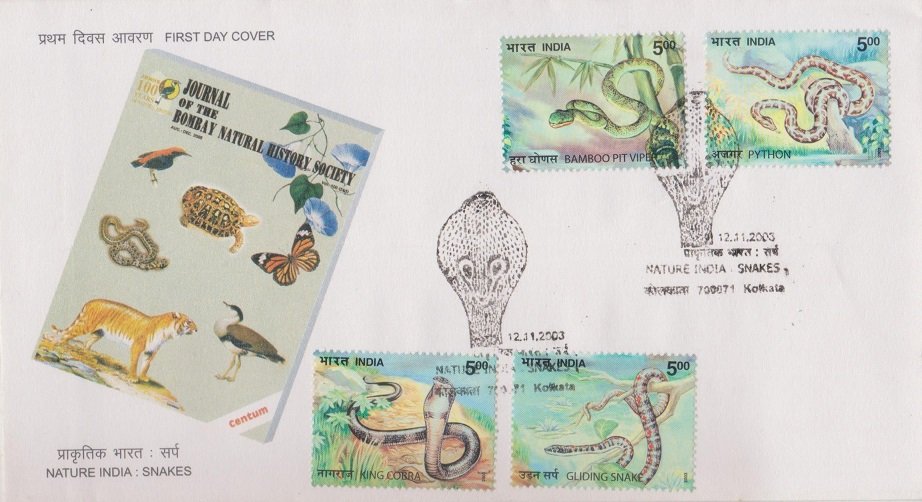
Bamboo Pit Viper

Technical Data
| Date of Issue | November 12, 2003 |
|---|---|
| Denomination | Rs. 5 |
| Quantity | 800,000 |
| Perforation | comb 13½ x 13 |
| Printer | Madras Security Printers |
| Printing Process | Offset Lithography |
| Watermark | No Watermark |
| Colors | Multicolor |
| Credit (Designed By) | Sh. Sankha Samanta |
| Catalog Codes |
Michel IN 1994 Stamp Number IN 2034 Yvert et Tellier IN 1759 Stanley Gibbons IN 2168 WADP Numbering System - WNS IN051.03 |
| Themes | Animals (Fauna) | Reptiles | Snakes |
The Camouflaged Tree Dweller
The Bamboo Pit Viper is a striking and beautifully adapted snake found in the forests of India. Known for its vivid green colour and arboreal lifestyle, it is one of the most distinctive reptiles inhabiting the Western Ghats.
Habitat and Distribution
This species is primarily found in the Western Ghats, usually at elevations above 450 metres. It prefers tree-dominated environments and is often seen in low vegetation, especially in bamboo clusters—hence its name.
Appearance and Camouflage
The Bamboo Pit Viper is bright grass green on the upper side and pale white, yellow or greenish below. This coloration provides excellent camouflage among leaves and branches, helping it remain hidden from both predators and prey in its natural habitat.
Behaviour and Diet
A tree-dwelling (arboreal) species, it spends most of its time coiled on branches, waiting patiently for prey. Its diet mainly consists of small mammals and birds. The snake relies on stealth and precision rather than speed to capture its prey.
Venom and Effects
Although venomous, the Bamboo Pit Viper is not considered highly dangerous to humans. Its bite can cause pain, swelling, nausea, vomiting and fever, but is rarely fatal. Like most snakes, it uses venom primarily for hunting and self-defence.
Reproduction
Unlike many snakes that lay eggs, the Bamboo Pit Viper gives birth to live young. A female can produce between 7 to 15 offspring at a time, ensuring the continuation of the species.
Ecological Importance
This snake plays an important role in maintaining ecological balance by controlling populations of small animals. Its presence is an indicator of a healthy forest ecosystem.
Commemorative Stamp
Highlighting its beauty and ecological significance, India Post included the Bamboo Pit Viper in a commemorative stamp series under “Nature India.” This initiative also aligns with the conservation efforts of the Bombay Natural History Society, which has long documented India’s biodiversity.
Conclusion
The Bamboo Pit Viper, with its vibrant colour and unique adaptations, is a fascinating example of nature’s ingenuity. Though often overlooked, it is an essential part of the ecosystem and a reminder of the importance of conserving India’s rich wildlife heritage.
First Day Cover