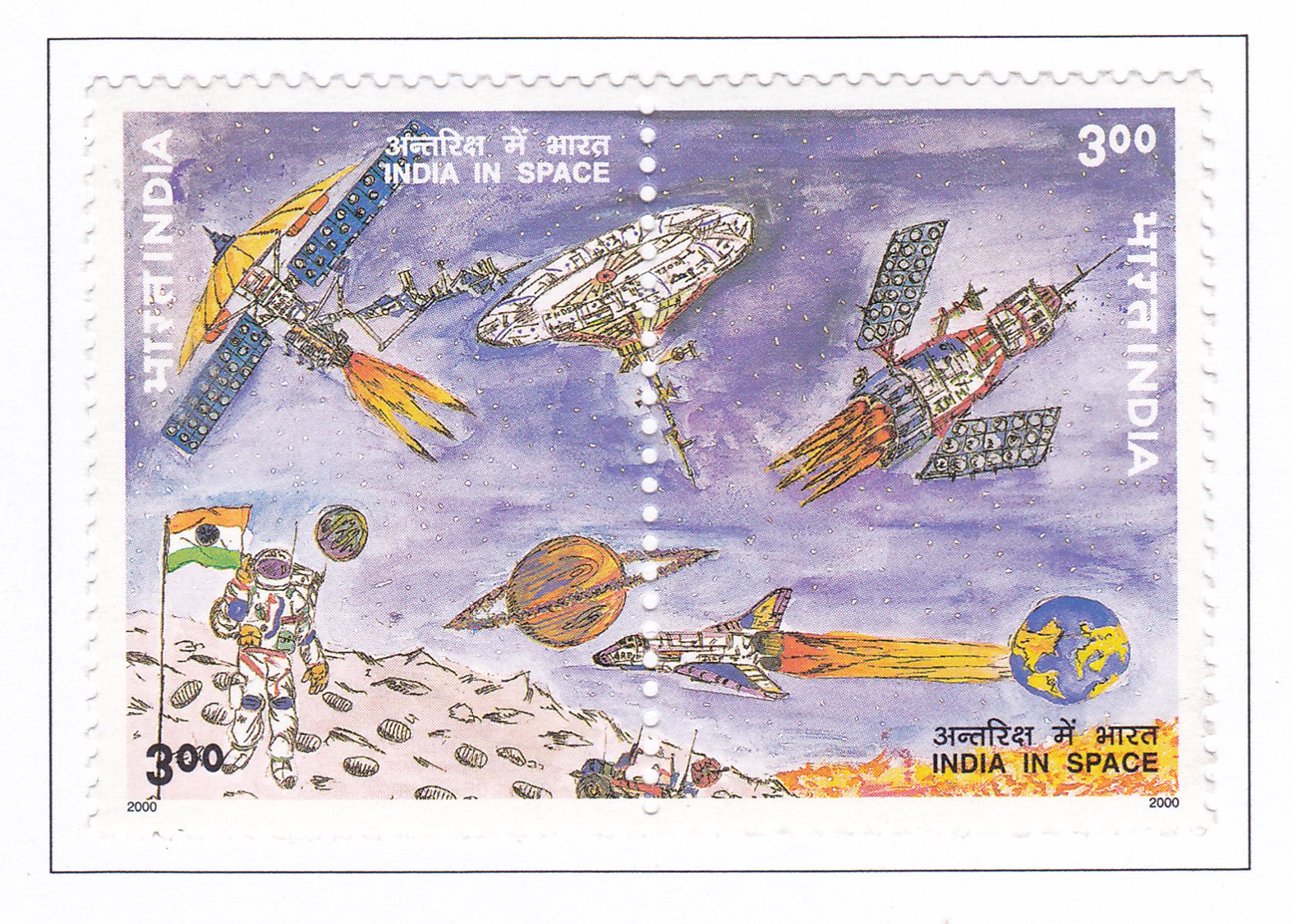
India’s Space Programme Se-tenant Pair
Technical Data
| Stamp Set | India's Space Programme |
|---|---|
| Date of Issue | September 29, 2000 |
| Denomination | Rs. 6 |
| Quantity | 3,000,000 |
| Perforation | comb 13 x 13½ |
| Printer | Calcutta Security Printers Ltd |
| Printing Process | Offset Lithography |
| Watermark | No Watermark |
| Colors | Multicolor |
| Credit (Designed By) | |
| Catalog Codes |
Michel IN 1784-1785 Stamp Number IN 1849 Yvert et Tellier IN 1550-1551 Stanley Gibbons IN 1953a |
| Themes | Astronauts | Flags | Globes | Outer Space | Space Traveling | Spacecraft |
Growth, Achievements and Future Vision
India’s space programme has emerged as a symbol of technological advancement and self-reliance. Formally organized in 1972 with the establishment of the Department of Space, it has been driven by the vision of applying space technology for national development.
Evolution of India’s Space Programme
The creation of the Department of Space in 1972 marked the beginning of a structured and focused approach to space research in India. The programme has consistently emphasized practical applications in areas such as:
- Telecommunication
- Television broadcasting
- Meteorology
- Resource survey and management
Key institutions like Indian Space Research Organisation (ISRO), National Remote Sensing Agency, and Physical Research Laboratory play a crucial role in executing these initiatives.
Major Space Systems: INSAT and IRS
India has developed two major satellite systems that form the backbone of its space infrastructure:
INSAT System
The Indian National Satellite System is one of the world’s largest domestic satellite networks. It provides services such as:
- Telecommunications and mobile communication
- Television broadcasting and educational TV
- Meteorology and disaster warning systems
- Search and rescue operations
INSAT has significantly expanded television access, reaching over 80% of India’s population, and improved weather forecasting through advanced data collection systems.
IRS System
The Indian Remote Sensing Satellite System supports:
- Agriculture and water resource management
- Urban planning and environmental monitoring
- Disaster forecasting (droughts and floods)
- Mineral and ocean resource exploration
This system plays a vital role in planning and sustainable development.
Launch Vehicle Technology: Towards Self-Reliance
India’s journey in launch vehicle development began with modest efforts and has evolved into a robust capability.
- SLV-3: Early launch vehicle capable of placing small satellites in orbit
- ASLV: Boosted capabilities with successful launches in the 1990s
- PSLV: Reliable vehicle for launching remote sensing satellites
- GSLV: Designed for heavier communication satellites
These advancements have enabled India to achieve greater independence in space missions.
Space Science Research in India
Research in space science is actively conducted at premier institutions, including:
- Space Applications Centre, Ahmedabad
- ISRO Satellite Centre, Bangalore
- Space Physics Laboratory, Thiruvananthapuram
These centers contribute to expanding knowledge about space while supporting practical applications.
International Cooperation and Commercial Services
India collaborates with several countries and space agencies, offering training and sharing expertise through international programmes. Commercially, space services and hardware are provided globally via Antrix Corporation.
Future Vision of India’s Space Programme
As India enters the new era of space exploration, the focus remains on innovation and expanded applications. Future goals include:
- Advanced INSAT services with KU and Ka-band technologies
- Direct-to-home television and digital broadcasting
- Tele-education and tele-health services
- Satellite-based navigation and communication systems
- Enhanced disaster management and meteorology
- Development of advanced remote sensing satellites
India aims to maintain leadership in space-based applications while contributing to global scientific knowledge.
Stamp Highlights:
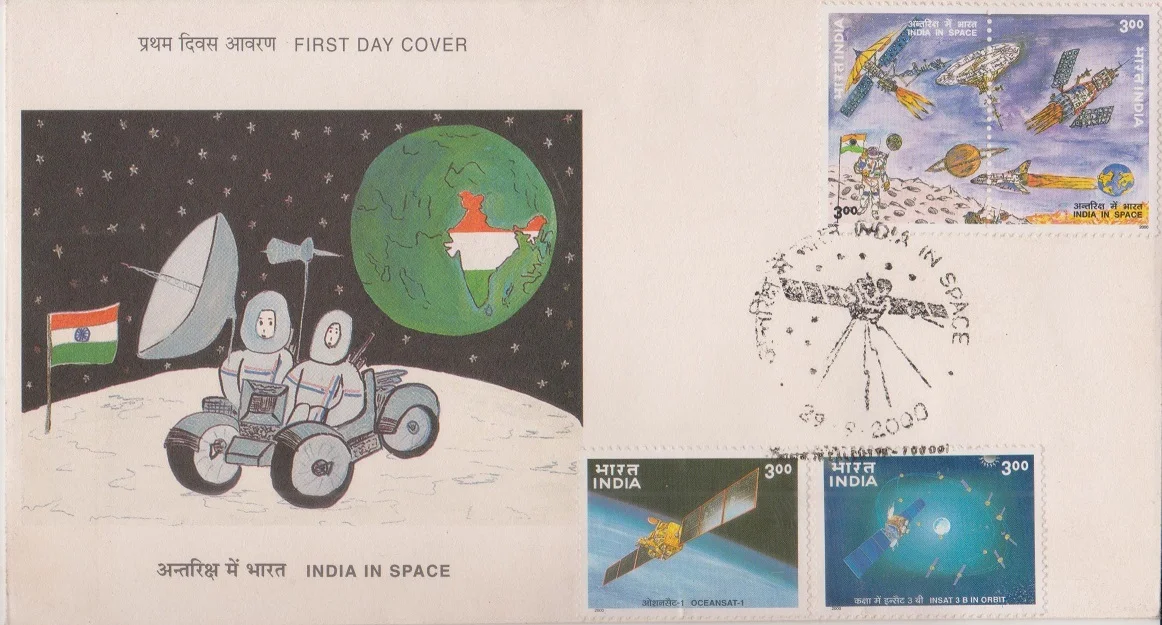
- Depiction of OCEANSAT-1 and INSAT-3B
- A se-tenant stamp featuring a painting by S. Praveen on “India in Space – 2025”
- Reflection of youth imagination and aspiration for space exploration
The First Day Cover features artwork by Parishi Miaish Yagnik, symbolizing the vision of future space achievements.
Conclusion
India’s space programme stands as a testament to innovation, determination, and scientific excellence. From developing satellite systems like INSAT and IRS to achieving launch vehicle self-reliance, the country has made remarkable progress.
Through continued research, global cooperation, and visionary planning, India is poised to play a leading role in the future of space exploration while using space technology for the betterment of society.
First Day Cover