India-Mangolia Joint Issue

Technical Data
| Date of Issue | September 11, 2006 |
|---|---|
| Denomination | Rs. 30 |
| Quantity | 100,000 |
| Perforation | line13¼ x 14 |
| Printer | India Security Press, Nasik |
| Printing Process | Photogravure |
| Watermark | No Watermark |
| Colors | Multicolor |
| Credit (Designed By) | Shri Kamleshwar Singh |
| Catalog Codes |
Michel IN BL36 Stamp Number IN 2167c Stanley Gibbons IN MS2345 WADP Numbering System - WNS IN037MS.2006 |
| Themes | Animals (Fauna) | Horses | Joint Issues | Mammals | Statues |
Stamps in this Miniature Sheet
Relations between India and Mongolia are rooted in deep civilizational bonds that extend back nearly three millennia. Over centuries, literary, cultural, and spiritual exchanges have enriched the ties between the two nations. A remarkable testimony to these exchanges is preserved in the State Public Library of Mongolia, which houses the 109-volume Kanjur and the 224-volume Tanjur, classical Buddhist texts that reflect the strong intellectual and spiritual links between the two countries. Above all, the shared heritage of Buddhism remains a powerful bond uniting the peoples of both nations.
Establishment of Diplomatic Relations
These ancient connections were renewed and strengthened in the modern era following Mongolia’s emergence as a sovereign nation in the twentieth century. Formal diplomatic relations between India and Mongolia were established on 24 December 1955. India subsequently played a supportive role in facilitating Mongolia’s international recognition and its admission to the United Nations in 1961, as well as its participation in various international organizations and financial institutions.
High-Level Visits and Cooperation
The strong relationship between the two countries has been reinforced by numerous high-level visits. From the Indian side, Sarvepalli Radhakrishnan, then Vice-President of India, paid a historic visit to Mongolia in 1957. This was followed by visits from Vice-Presidents Shankar Dayal Sharma (1992), K. R. Narayanan (1996), and Krishan Kant (1999). Earlier, President Ramaswamy Venkataraman undertook a State Visit to Mongolia in July 1988.
From the Mongolian side, Yumjaagiin Tsedenbal visited India in 1959 as Chairman of the Presidium and again in 1973 as Chairman and Prime Minister. After Mongolia’s transition to democracy and a market economy, President Punsalmaagiin Ochirbat paid a State Visit to India in 1994, during which the Treaty of Friendly Relations and Cooperation was signed. President Natsagiin Bagabandi visited India at the beginning of the new millennium, describing it as a “pilgrimage to a sacred land.” The relationship was further strengthened during the State Visit of Prime Minister Nambaryn Enkhbayar in January 2004, when several agreements were signed. Mongolian Foreign Minister Tsend Munkh-Orgil visited India in December 2005 to mark the 50th anniversary of diplomatic relations.
Development Cooperation
India has extended development assistance to Mongolia through the establishment of several institutions, including:
- Rajiv Gandhi School of Art and Production (1996)
- Atal Bihari Vajpayee Centre for Excellence in Information and Communication Technology (2002)
- Indo-Mongolian Joint Higher Secondary School (2003)
- A Chair on Sanskrit and Buddhist Studies at National University of Mongolia (2005)
In recent years, cooperation between the two countries has expanded significantly in fields such as education, information technology, solar energy, agriculture, tourism, trade, and economic development. Both nations also coordinate closely in various international forums.
Commemorating 50 Years of Diplomatic Relations
To commemorate the 50th anniversary of diplomatic relations, numerous activities were organized, including reciprocal naming of streets in New Delhi and Ulaanbaatar, visa-free travel for diplomatic and official passport holders, and special publications dedicated to the occasion. One of the key highlights was the joint issue of commemorative postage stamps by the postal administrations of both countries.
Commemorative Postage Stamp
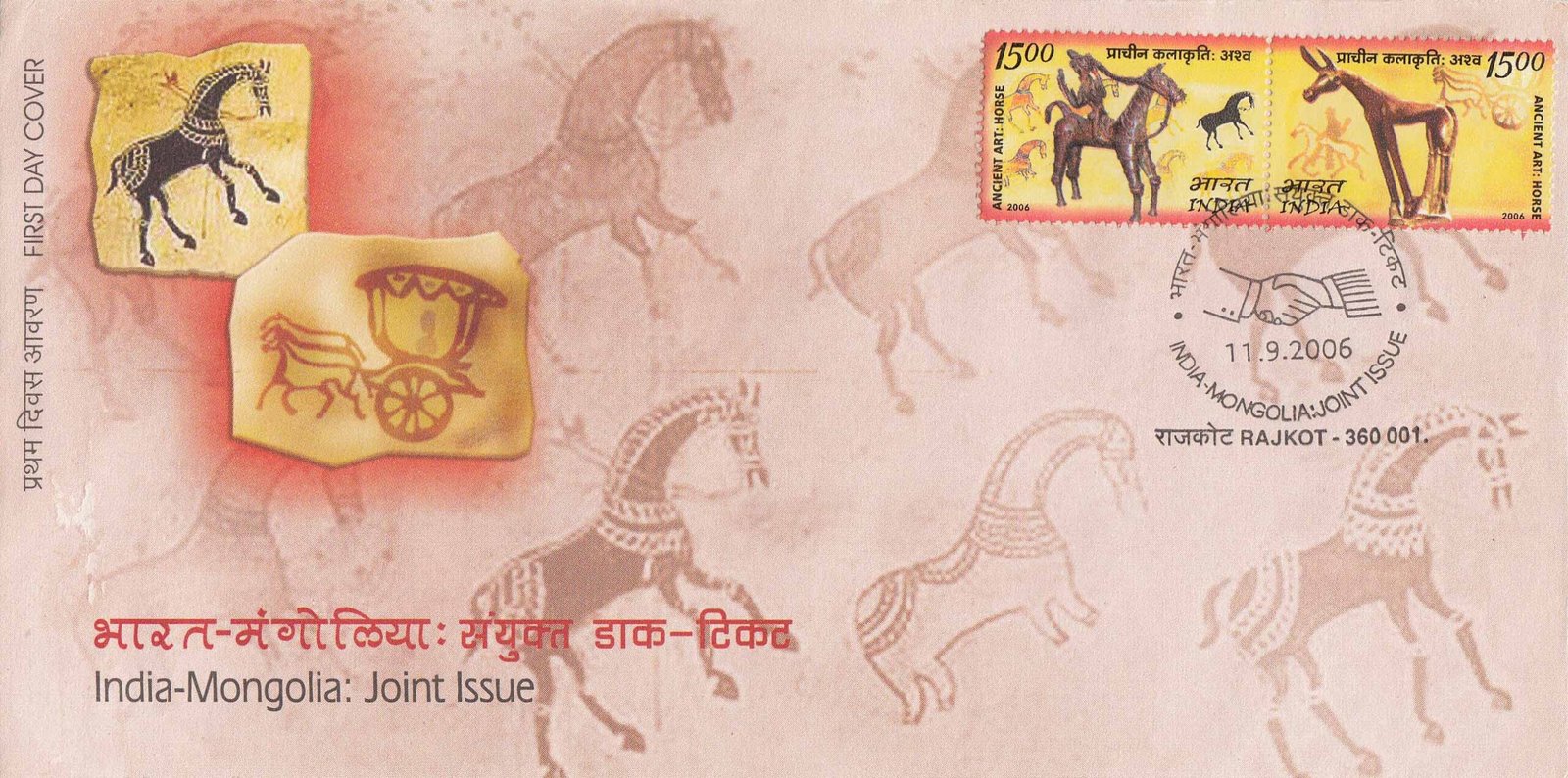
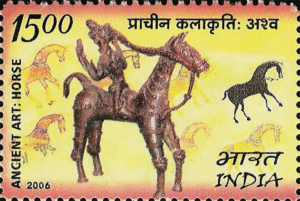
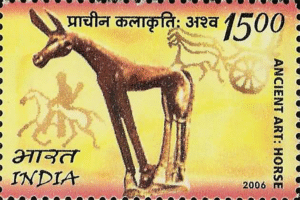
The theme of this philatelic commemoration celebrates the rich artistic traditions of India and Mongolia. One stamp depicts an early twentieth-century bronze replica of the equestrian deity Rao Dev from the Bastar region of Madhya Pradesh, crafted using the traditional lost-wax technique by a Ghadva metalsmith. The other stamp features an ancient bronze sculpture of a horse from Mongolia, an archaeological discovery from the Bronze Age found in Murun.
Through this joint release of a set of two commemorative postage stamps, India Post celebrates the enduring friendship and cooperation between the governments and peoples of India and Mongolia
First Day Cover