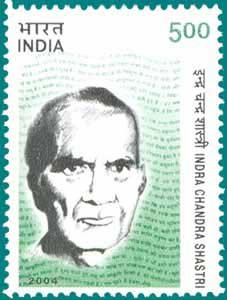
Indra Chandra Shastri (1912-1986)
Technical Data
| Date of Issue | May 27, 2004 |
|---|---|
| Denomination | Rs. 5 |
| Quantity | 400,000 |
| Perforation | comb 13 x 13½ |
| Printer | Security Printing Press, Nashik |
| Printing Process | Photogravure |
| Watermark | No Watermark |
| Colors | Multicolor |
| Credit (Designed By) | Sh. Bharati Mirchandani Smt. Alka Sharma |
| Catalog Codes |
Michel IN 2025 Stamp Number IN 2061 Yvert et Tellier IN 1790 Stanley Gibbons IN 2203 WADP Numbering System - WNS IN011.04 |
| Themes | Famous people | Men | Philosophers |
Renowned Scholar of Philosophy, Linguistics and Jain Studies
Indra Chandra Shastri was an eminent Indian philosopher, linguist, author and Indologist whose intellectual contributions enriched the fields of philosophy, religion, literature and cultural studies. A man of deep scholarship and rare imagination, he devoted his life to exploring ancient knowledge and interpreting it for the modern world.
The famous Hindi writer Jainendra Kumar once described him as a living symbol of Indian intellect. Dr. Shastri’s work spanned diverse academic disciplines including Pali, Prakrit, philosophy, Indology, grammar, linguistics, and epistemology. Inspired by the Jain philosophical concept of Anekantavada, he strongly advocated rational thinking and spiritual inquiry.
Early Life and Education
Dr. Indra Chandra Shastri was born on 27 May 1912 in Dabwali Mandi, now located in Sirsa District, Haryana.
He pursued his early education in Bikaner, where he studied Sanskrit and Prakrit. Later, he earned a Master’s degree in Sanskrit from Agra University. He was awarded the prestigious “Shastracharya” degree in Vedanta from Banaras Hindu University.
Continuing his academic pursuits, he obtained the “Shastri” qualification from Panjab University and the “Nyayatirtha” degree from University of Calcutta.
He completed his Ph.D. under the guidance of Pandit Bal Krishna Mishra. His doctoral dissertation titled “Epistemology of Jain Agamas” received high praise from scholars for its depth and analytical approach.
Role in the Freedom Movement and Social Reform
Influenced by the ideals of Mahatma Gandhi, Dr. Shastri actively participated in the Indian freedom movement.
In 1942, he campaigned against the controversial practice of Bal Diksha, where poor children were forcibly inducted into monastic life by certain Jain ascetics in Rajasthan. His efforts led to the introduction of a bill in the Bikaner Assembly to address this issue.
During the Partition of India, he organized relief camps to assist displaced families.
Academic Career and Contributions
Dr. Shastri played a major role in promoting Sanskrit studies in modern India. In 1959, he was appointed the first Head of the Department of Sanskrit at the University of Delhi.
However, in 1961, he had to resign due to the loss of eyesight caused by glaucoma. Despite this challenge, he continued his scholarly pursuits. Later, he was appointed Professor Emeritus under a scheme of the University Grants Commission. Between 1967 and 1969, he conducted research on the subject “Religion and Modern Man.”
He was also deeply involved in academic organizations. From 1954 to 1958, he served as Secretary of the Akhil Bharatiya Sanskrit Sahitya Sammelan. He organized the 1957 Delhi session of the All India Oriental Conference and was invited as the Chief Speaker at the World Religious Conferences held in Ujjain, Rajgir, and Delhi.
Literary and Scholarly Works
Dr. Shastri was a prolific author, writing nearly 70 books and over 600 research papers. His writings combined classical scholarship with contemporary interpretation, making ancient philosophical ideas relevant to modern society.
One of his notable works is Pali Bhasa Aur Sahitya, which includes a Hindi translation of Wilhelm Geiger’s introduction to the German classic Pali Literatur und Sprache.
His other important works include:
- Sanskrit Kavya Shastra Ka Itihas
- Mahabharat Ke Sukti Ratna
- Alok Aur Unmad
- Hamari Prampara
- Jainism and Democracy
- Dharma Aur Rashtra Nirman
- Bharatiya Arya Bhasaen
He also wrote thought-provoking works such as Religious Shops and Ghosts of Culture, where he critically examined inherited beliefs and cultural traditions through logic and rational analysis.
Honors and Recognition
In recognition of his immense contributions to literature and scholarship, Dr. Shastri received several prestigious honors:
- Sahitya Seva Samman from the Hindi Academy Delhi
- Sahitya Ratna Alankaran conferred by the Vice-Chancellor of the University of Delhi
- President’s Certificate of Honour awarded by the President of India on 15 August 1986
Legacy
Even after losing his eyesight, Dr. Shastri continued to dictate his ideas and produce remarkable scholarly works. His research on Jain philosophy and comparative studies of religious thought established him as a pioneer of Jainology in English, as noted by scholar Satkari Mookerjee.
Dr. Indra Chandra Shastri passed away on 3 November 1986. His life represented a continuous quest for truth, rational inquiry and spiritual evolution—a journey from the personal to the universal.
Commemorative Postage Stamp
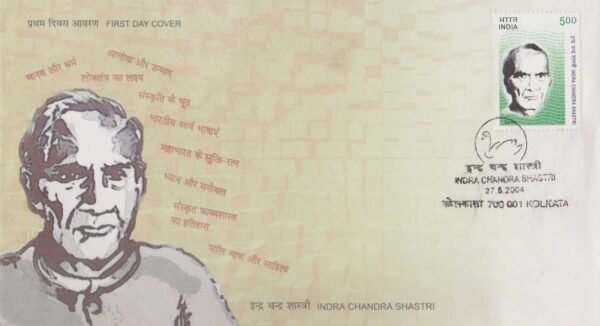
To honour his immense contributions to scholarship, philosophy and Indian intellectual tradition, India Post issued a commemorative postage stamp in memory of Dr. Indra Chandra Shastri, celebrating the legacy of a scholar whose work continues to inspire students and thinkers across generations.
First Day Cover