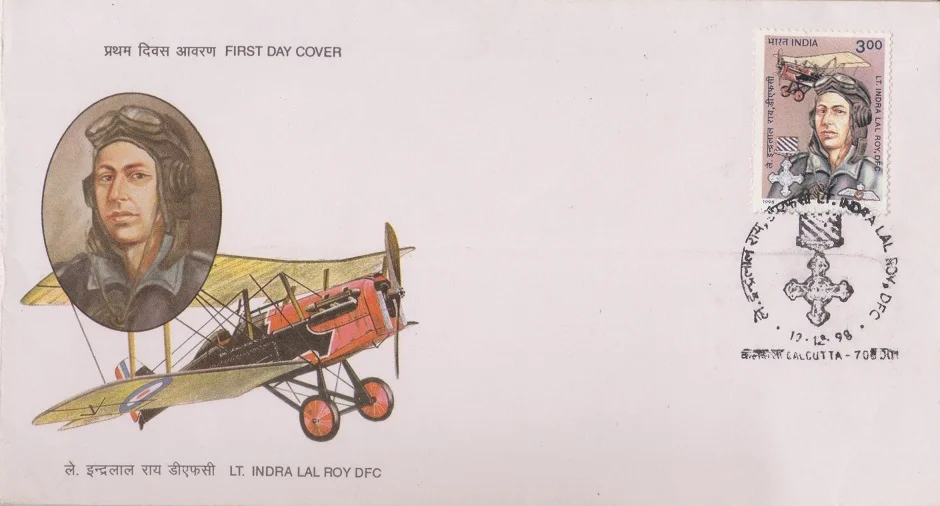
Indra Lal Roy (1898-1918)
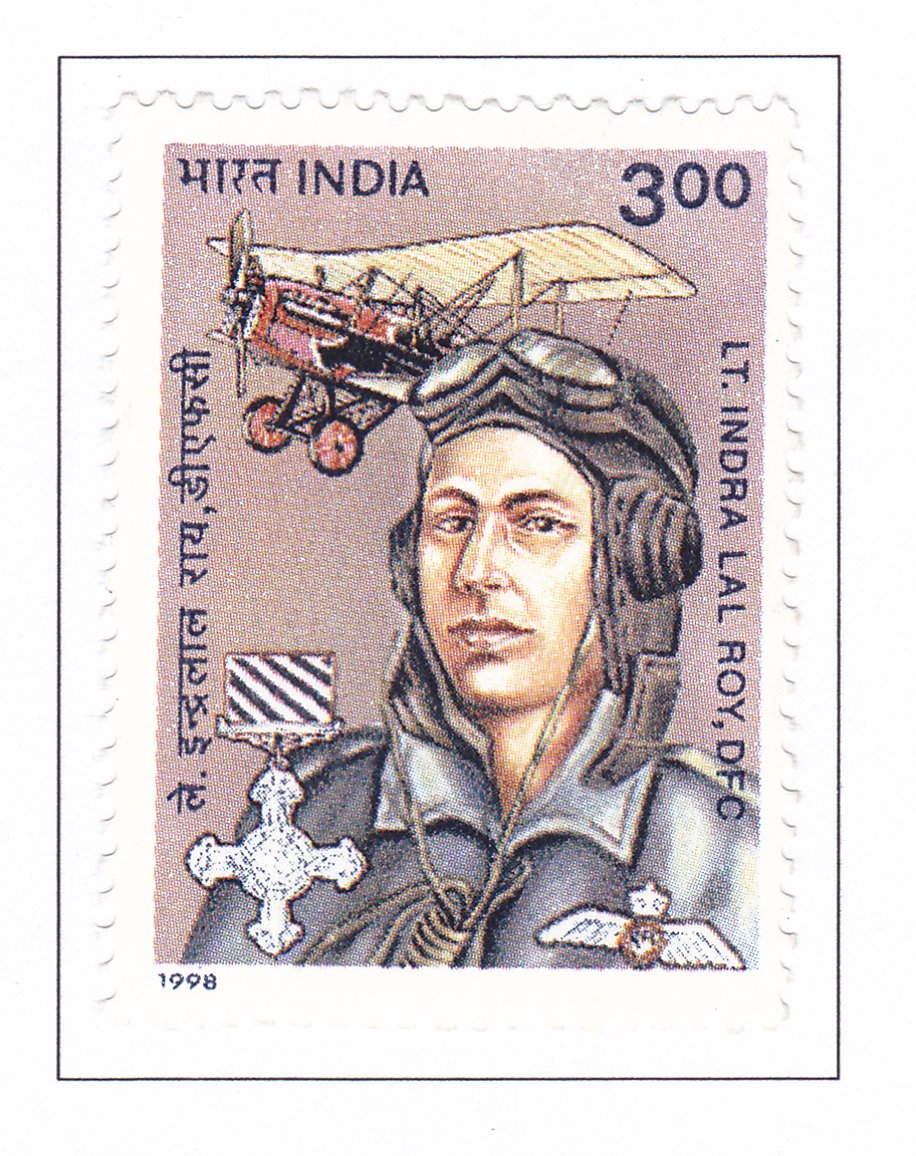
Technical Data
| Stamp Set | Birth Centenary |
|---|---|
| Date of Issue | December 19, 1998 |
| Denomination | Rs. 3 |
| Quantity | 400,000 |
| Perforation | comb 13 x 13½ |
| Printer | Security Printing Press, Nashik |
| Printing Process | Photogravure |
| Watermark | No Watermark |
| Colors | Multicolor |
| Credit (Designed By) | |
| Catalog Codes |
Michel IN 1661 Stamp Number IN 1719 Yvert et Tellier IN 1426 Stanley Gibbons IN 1824 |
| Themes | Aircraft | Anniversaries and Jubilees | Aviation | Famous people | Men | Pilots |
India’s First World War Flying Ace
Indra Lal Roy, fondly known as “Laddie,” was the first Indian fighter pilot to achieve distinction during the World War I. His courage, determination, and exceptional flying skills made him a legendary figure in military aviation history.
Early Life and Education
Lt. Indra Lal Roy was born on 2nd December 1898 in Kolkata (then Calcutta). He came from a well-established family—his father, P. L. Roy, was a respected barrister and zamindar from Barisal (now in Bangladesh).
A brilliant student, Indra earned several scholarships and went on to study at University of Oxford. During his student years, he developed a deep fascination with aviation and spent much of his time building model aircraft.
Entry into the Royal Flying Corps
At just 18 years of age, Indra Lal Roy joined the Royal Flying Corps and received the King’s Commission on 5th July 1917. He was soon appointed a Scout Airman and deployed to France with the 56 Squadron of the Royal Air Force for combat operations.
War Service and Remarkable Courage
Lt. Roy demonstrated exceptional bravery in aerial combat. During the Battle of Cambrai, his aircraft was shot down by German forces. He remained unconscious for three days and was mistakenly declared dead at a British military hospital in Étaples, France. Remarkably, he regained consciousness and recovered.
Refusing to give up, he returned to active duty in July 1918 with the 40 Squadron in France.
Historic Achievement as a Flying Ace
In an extraordinary display of skill and courage, Lt. Indra Lal Roy shot down ten German aircraft within just fourteen days in July 1918. This remarkable feat earned him the distinction of being the only Indian flying ace of World War I.
Final Mission and Martyrdom
Tragically, his brilliant career was cut short on 22nd July 1918 during an aerial dogfight over Estevelles in Pas-de-Calais, France. His aircraft, an SE5A, crashed in flames, and he was martyred in action. He was laid to rest in the cemetery at Estevelles.
Awards and Recognition
For his extraordinary bravery and service, Lt. Indra Lal Roy was posthumously awarded the prestigious Distinguished Flying Cross—making him the first Indian to receive this honour.
The official citation praised him as:
“A very gallant and determined officer… displaying remarkable skill and daring.”
Commemorative Recognition
To honor his legacy, India Post issued a commemorative postage stamp dedicated to Lt. Indra Lal Roy. This tribute celebrates his contribution to aviation and his role as a pioneer among Indian fighter pilots.
Conclusion
Lt. Indra Lal Roy remains a symbol of courage, resilience, and excellence. From surviving near death to becoming a flying ace, his story continues to inspire generations. His legacy stands as a proud chapter in India’s military and aviation history.
First Day Cover