
INS Tarangini
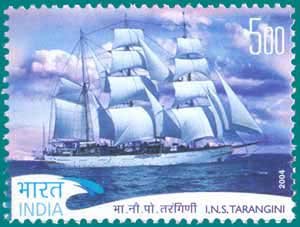
Technical Data
| Date of Issue | April 25, 2004 |
|---|---|
| Denomination | Rs. 5 |
| Perforation | comb 13½ x 13 |
| Printer | Madras Security Printers |
| Watermark | No Watermark |
| Colors | Multicolor |
| Catalog Codes |
Michel IN 2022 Stamp Number IN 2059 Yvert et Tellier IN 1787 Stanley Gibbons IN 2198 WADP Numbering System - WNS IN008.04 |
| Themes | Sailing Ships | Ships |
Introduction
INS Tarangini is a sail training ship of the Indian Navy that symbolizes the spirit of adventure, seamanship, and international goodwill. Reliving the saga of ancient mariners who braved storms and rough seas, INS Tarangini successfully completed a historic circumnavigation voyage dedicated to peace, friendship, and the training of naval cadets.
Design and Construction
INS Tarangini is a three-masted barque designed by Colin Mudie, a renowned naval architect from the United Kingdom. The ship was built by Goa Shipyard Limited. The name “Tarangini” is derived from the Hindi word “Tarang”, meaning wave.
The ship’s crest portrays a mother swan teaching her young one to swim and fly, symbolizing the ship’s main role of training young naval cadets.
Commissioning and Role
INS Tarangini was commissioned into the Indian Navy on 11 November 1997. It is part of the First Training Squadron based at Kochi on the west coast of southern India.
While several naval ships such as INS Tir and INS Krishna are used for training purposes, INS Tarangini holds the distinction of being the only sail training ship in the Indian Navy. Among Asian navies, it is one of the few sailing training ships, while about thirty navies across the world operate such vessels.
Importance of Sail Training
Sail training ships are widely used by navies across the world as platforms for developing seamanship and character among young cadets. Sailing demands practical understanding of the sea, including wind patterns, weather conditions, and navigation techniques.
Training aboard INS Tarangini provides cadets with experience in:
- Seamanship and navigation
- Astro-navigation
- Semaphore and Morse light signalling
- Teamwork, endurance, and courage
Besides training cadets of the First Training Squadron, the ship also conducts sail training programmes for cadets of the National Defence Academy, the Indian Naval Academy, and INS Shivaji.
Circumnavigation Voyage
INS Tarangini embarked on a remarkable circumnavigation voyage on 23 January 2003. During this mission, the ship visited 36 ports across 18 countries and six continents, covering nearly 33,000 nautical miles.
The voyage traversed several major waterways including:
- Arabian Sea
- Red Sea
- Suez Canal
- Mediterranean Sea
- Atlantic Ocean
- Great Lakes
- Panama Canal
- Pacific Ocean
The voyage was undertaken under the theme “Bridges of Friendship across the Oceans”, aiming to promote cultural interaction and broaden the perspectives of young naval officers by exposing them to different maritime traditions and societies.
Success at the Tall Ship Races
INS Tarangini also participated in the Tall Ship Races held in the Great Lakes, where sailing ships from 24 countries competed. Despite the presence of ships from nations with centuries-old sailing traditions, Tarangini performed exceptionally well.
The ship secured first position in two races and third place in the remaining two in the Youth Sailing Division. The Indian team was declared the overall champion, and Tarangini was unanimously judged as the best ship. Because it had travelled from the farthest country, the vessel also received the Long Distance Ship Award.
Symbol of India’s Maritime Strength
The circumnavigation voyage of INS Tarangini demonstrated the determination, seamanship, and endurance of its crew. It highlighted the growing maritime capability and global reach of the Indian Navy, while serving as a cultural ambassador for India across the world.
Commemorative Postage Stamp
To commemorate the spirit and success of this historic voyage, India Post issued a commemorative postage stamp on INS Tarangini. The stamp celebrates the ship’s achievements and its role in promoting naval training, international goodwill, and India’s proud maritime heritage.