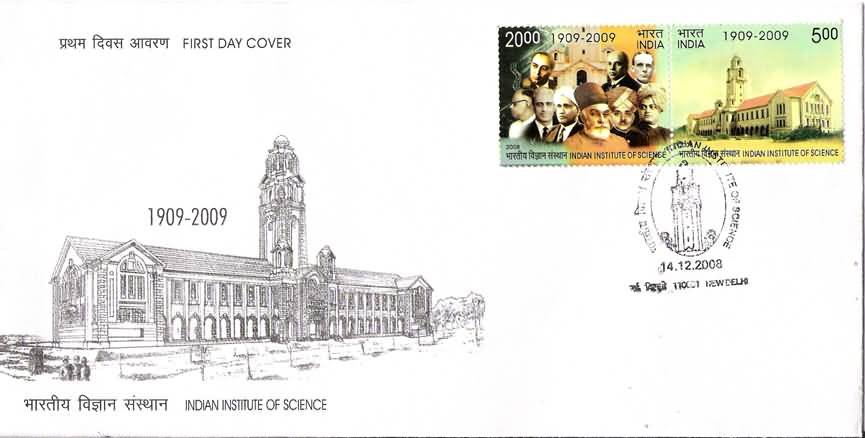
Centenary of the Indian Institute of Science

Technical Data
| Date of Issue | December 14, 2008 |
|---|---|
| Denomination | Rs. 20 |
| Quantity | 1,500,000 |
| Perforation | 13 |
| Printer | India Security Press, Nasik |
| Printing Process | Photo Gravure |
| Watermark | No Watermark |
| Colors | Multicolor |
| Credit (Designed By) | Sh. Sankha Samanta |
| Catalog Codes |
Michel IN 2326 Stamp Number IN 2293b Stanley Gibbons IN 2549 WADP Numbering System - WNS IN069.2008 |
| Themes | Anniversaries and Jubilees | Famous people | Headgear | Men | Science | Scientists |
Vision and Conception
The Institute was conceived at the close of the nineteenth century by the visionary industrialist Jamsetji Nusserwanji Tata as a “Research Institute” or “University of Research.” His dream was to establish an institution that would advance scientific knowledge and contribute to India’s development. From the initial conception in 1896, it took thirteen years of sustained effort before the Institute formally came into existence on May 27, 1909.
Founding Support and Establishment
The creation of IISc was made possible through the collective efforts of distinguished personalities such as Swami Vivekananda, Krishnaraja Wodeyar IV, and Lord Curzon. The princely state of Mysore played a decisive role by generously donating nearly 400 acres of land in Bangalore in March 1907, which became the permanent campus of the Institute.
In 1909, the British Government issued the Vesting Order, formally establishing IISc. It stands as one of India’s earliest and most successful examples of a public–private partnership in higher education.
Early Departments and Growth
The Institute began modestly with two departments—General and Applied Chemistry, and Electro-Technology. Soon thereafter, Departments of Organic Chemistry and Biochemistry were established. In 1933, the Physics Department was founded under the leadership of Nobel Laureate C. V. Raman, who became the first Indian Director of the Institute.
Over the decades, IISc evolved into India’s premier centre for advanced research and postgraduate education in science and engineering, reflecting the growth of scientific and technological capability in the country.
Contribution to National Institutions
IISc has played a foundational role in shaping India’s scientific landscape. Homi J. Bhabha conceptualized the Tata Institute of Fundamental Research and India’s Atomic Energy Programme during his association with IISc. Vikram Sarabhai, founder of India’s space programme, was an alumnus of the Institute.
The Indian Space Research Organisation was later strengthened under the distinguished leadership of Satish Dhawan, who served simultaneously as Director of IISc. The first Indian Institute of Technology Kharagpur was established under the guidance of J. C. Ghosh, then Director of IISc.
Many eminent scientists, including G. N. Ramachandran, Harish-Chandra, C. N. R. Rao, and R. Narasimha, have been closely associated with the Institute.
Academic Excellence and Research Expansion
Today, IISc offers a wide range of Master’s programmes in Engineering, integrated post-B.Sc. programmes in Science, and doctoral programmes across numerous disciplines. Its research laboratories, national facilities, library, and computational infrastructure are among the finest in India.
In response to emerging scientific challenges, the Institute has initiated interdisciplinary Ph.D. programmes in Mathematical Sciences, Chemical Biology, Earth System Science, Nanoscience and Nanotechnology, and Nanoengineering for Integrated Systems. An M.Tech programme in Climate Science and the establishment of a Centre for Earth Sciences further demonstrate its commitment to innovation and sustainability.
A Legacy of Excellence
An anecdote from 1914 reflects the early promise of the Institute. When Lord Willingdon visited the campus, he remarked, “I had no idea that there was anything like this in India.” Morris Travers, the first Director, proudly responded, “There is nothing like it in India; and nothing better in Great Britain.”
More than a century later, the Indian Institute of Science continues to stand as a beacon of excellence in research, education, and national development.
India Post’s commemorative postage stamp celebrates this extraordinary institution and its enduring legacy in advancing science and engineering for the nation.
First Day Cover