
100 Years of International Labour Organization
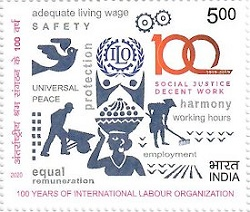
Technical Data
| Date of Issue | January 22, 2020 |
|---|---|
| Denomination | Rs. 5 |
| Quantity | 600,000 |
| Perforation | 14½ x 14¼ |
| Printer | Security Printing Press, Hyderabad |
| Printing Process | Wet Offset |
| Watermark | No Watermark |
| Colors | Multicolor |
| Credit (Designed By) | Sh. Sankha Samanta Smt. Alka Sharma |
| Catalog Codes |
Michel IN 3652, Stamp Number IN 3209 Yvert et Tellier IN 3329 Stanley Gibbons IN 3726 Phila-India IN 3693 |
| Themes | Agriculture |
The International Labour Organization (ILO) came into existence in 1919 and has, over the past century, played a pivotal role in promoting the welfare of workers across the world. As the only Tripartite United Nations Agency, the ILO uniquely brings together Governments, Employers and Workers of its 187 Member States to frame labour standards, develop policies and design programmes that promote decent work, social justice and social protection for all women and men.
India is a founder member of the ILO and has a rich legacy of upholding its objectives and spirit. India’s well-established tripartite consultative mechanisms, with adequate representation of workers, employers and government, have contributed to a robust and dynamic system of labour dialogue and reform.
Aims and Mandate of the ILO
The principal aims of the ILO are to:
- Promote rights at work
- Encourage decent employment opportunities
- Enhance social protection
- Strengthen dialogue on work-related issues
To achieve these objectives, the ILO formulates International Labour Standards in the form of Conventions and Recommendations.
- Conventions are legally binding international treaties for countries that ratify them and are embedded in national constitutional, legal or policy frameworks.
- Recommendations are non-binding instruments that provide guidance for national policies and actions.
Organs of the International Labour Organization
The ILO functions through three main organs:
International Labour Conference
The International Labour Conference is the General Assembly of the ILO and meets annually in June. It adopts international labour standards, approves the biennial programme and budget, and serves as a global forum for discussing social, economic and labour issues.
Governing Body
The Governing Body is the executive council of the ILO and meets three times a year—in March, June and November. It is tripartite in nature and oversees the policies and programmes of the Organization.
International Labour Office
The International Labour Office, headquartered in Geneva, is the permanent secretariat of the ILO. It manages the day-to-day administration and implementation of decisions taken by the Conference and the Governing Body.
India’s Role in the International Labour Conference
Except for the interruption during the Second World War, the International Labour Conference has met regularly since 1919. India has consistently participated in the Conference with tripartite delegations.
The Conference has witnessed the presence of eminent Indian leaders such as Sir Atul Chatterjee (1927), Dr. Nagendra Singh (1950) and Shri Khandubhai Desai (1971). India has also produced eight Vice Presidents of the Conference—representing the Government, Employers and Workers—and has been an active member of key committees including the Committee on Application of Standards, Selection Committee and Resolutions Committee.
India and the ILO Governing Body
Since 1922, India has held a non-elective seat on the Governing Body as one of the ten countries of chief industrial importance. Indian representatives from employers’ and workers’ groups have been elected to the Governing Body at various times.
Four distinguished Indians have served as Chairpersons of the Governing Body:
- Mr. Atul Chatterjee
- Shri Shambhunath Jauhari (1937)
- Shri T. R. Mairani (1963)
- Shri B. G. Deshmukh (1972)
Indian representatives have actively contributed to all sections and committees of the Governing Body.
Indian Contribution to the International Labour Office
The International Labour Office, Geneva, provides secretarial and administrative support to all ILO activities. Over the years, Indians have held positions of prominence within the Office, contributing significantly to the global labour agenda.
ILO Conventions and India
Out of 190 ILO Conventions, including 8 core conventions, India has ratified 47 Conventions and one Protocol, which include six core human rights conventions:
- Forced Labour Convention, 1930 (No. 29)
- Abolition of Forced Labour Convention, 1957 (No. 105)
- Equal Remuneration Convention, 1951 (No. 100)
- Discrimination (Employment and Occupation) Convention, 1958 (No. 111)
- Minimum Age Convention, 1973 (No. 138)
- Worst Forms of Child Labour Convention, 1999 (No. 182)
A Century of Social Justice
For 100 years, the ILO has rendered sustained service to humanity by striving for universal peace through social justice. Its efforts have brought about remarkable improvements in working conditions and the quality of life of millions of workers worldwide.
The completion of 100 years of the ILO also marks a century of India’s association with the Organization, reflecting India’s enduring commitment to the ideals of decent work, equity and social justice.
Commemorative Postage Stamp
To commemorate this historic milestone, the Department of Posts is pleased to issue a Commemorative Postage Stamp on the International Labour Organization, marking 100 years of its foundation and celebrating its invaluable contribution to the world of work.
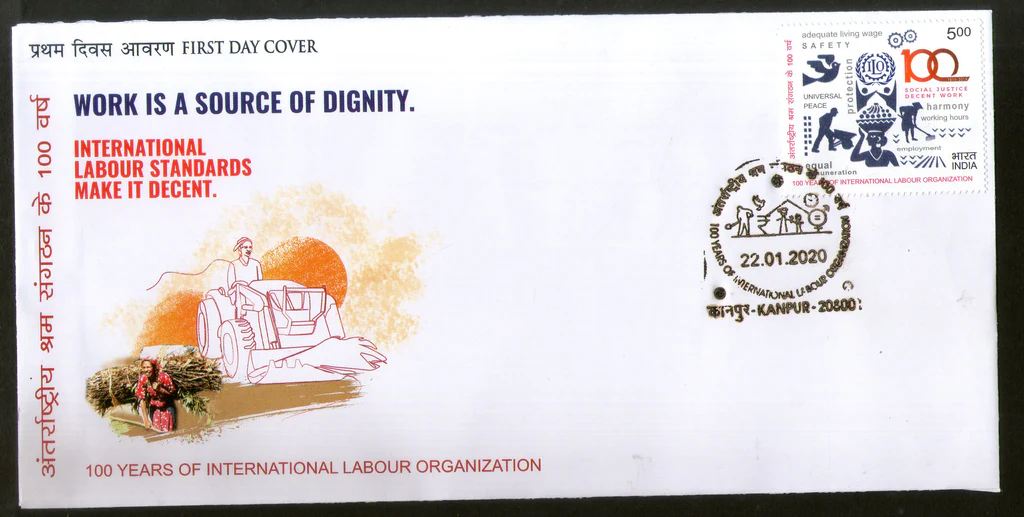
First Day Cover
Leave a Comment
You must be logged in to post a comment.