
International Year of Physics
Technical Data
| Date of Issue | March 30, 2005 |
|---|---|
| Denomination | Rs. 5 |
| Quantity | 400,000 |
| Perforation | comb 13 x 13½ |
| Printer | Security Printing Press, Nashik |
| Watermark | No Watermark |
| Colors | Multicolor |
| Catalog Codes |
Michel IN 2082 Stamp Number IN 2102 Yvert et Tellier IN 1847 Stanley Gibbons IN 2265 WADP Numbering System - WNS IN013.05 |
| Themes | Famous people | International Years | Nobel Laureates | Physicists | Physics | Scientists |
Celebrating Einstein’s Miracle Year
The year 1905 marked a historic turning point in modern science with the publication of groundbreaking papers by Albert Einstein. In that single year, Einstein published five remarkable papers that revolutionized physics and transformed humanity’s understanding of nature. Because of these extraordinary contributions, 1905 is often referred to as the “Miracle Year” of physics.
To celebrate the centenary of these revolutionary discoveries, the global scientific community declared 2005 as the International Year of Physics.
Einstein’s work in 1905 focused on three major scientific breakthroughs: the Special Theory of Relativity, the Photoelectric Effect, and Brownian Motion. Each of these discoveries profoundly reshaped scientific thought.
Special Theory of Relativity
Einstein’s Special Theory of Relativity addressed a fundamental conflict between the laws of motion described by Isaac Newton and the electromagnetic theory of light.
Newton’s laws implied that the speed of light should vary depending on the motion of the observer. However, electromagnetic theory suggested that the speed of light remains constant. Einstein resolved this contradiction by proposing that the speed of light is constant and fundamental, regardless of the observer’s motion.
From this principle, he derived revolutionary conclusions:
- Objects moving close to the speed of light behave differently from those moving at everyday speeds.
- Time appears to slow down for objects moving at extremely high speeds.
- Distances appear to shrink in the direction of motion.
- Energy and mass are closely related.
This relationship is famously expressed in Einstein’s equation:
E = mc²
where E represents energy, m represents mass, and c is the speed of light in vacuum.
Later, Einstein expanded these ideas into the General Theory of Relativity, which explains gravitational phenomena and plays a crucial role in technologies such as satellite navigation systems.
Photoelectric Effect
Einstein’s work on the Photoelectric Effect demonstrated that light behaves not only as a wave but also as particles called photons. He showed that electrons can be ejected from a material only when light with sufficient energy strikes it.
According to his explanation:
- The energy of light depends on its frequency.
- Many low-energy photons cannot eject electrons.
- A single high-energy photon can eject an electron.
This discovery laid the foundation for quantum theory, which revolutionized modern physics. It also led to numerous technological applications, including lasers, photo detectors, and solar cells. Einstein later received the Nobel Prize in Physics in 1921 for this discovery.
Brownian Motion
Einstein’s third major contribution in 1905 explained the mysterious random motion of tiny particles suspended in a fluid. This phenomenon had first been observed by the botanist Robert Brown.
Einstein showed that this movement occurs because microscopic particles constantly collide with molecules of the surrounding liquid. His explanation provided strong evidence that matter is composed of atoms and molecules.
Today, the theory of Brownian Motion is used in many scientific fields, including:
- Biology and cell processes
- Chemistry and material science
- Ecology and environmental studies
- Financial modeling and stock market analysis
Lasting Impact on Modern Science
Einstein’s discoveries in 1905 completely transformed the scientific view of the universe. They proved that:
- Matter is made of atoms and molecules.
- Light consists of energy packets called photons.
- Newton’s classical mechanics is only an approximation under normal conditions.
These ideas paved the way for quantum mechanics and influenced later scientists such as Subrahmanyan Chandrasekhar, who studied stellar evolution and predicted the existence of neutron stars and black holes. They also inspired the development of Bose–Einstein Statistics by Satyendra Nath Bose and Einstein, which transformed our understanding of how atoms behave collectively.
Commemorative Stamp
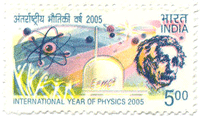
Even a century later, scientists continue exploring the profound implications of Einstein’s work. To commemorate this extraordinary scientific milestone, India Post issued a Commemorative postage stamp on the International Year of Physics 2005 under the 9th Definitive Series, honoring the revolutionary contributions of Albert Einstein and the enduring impact of modern physics.