
International Yoga Day
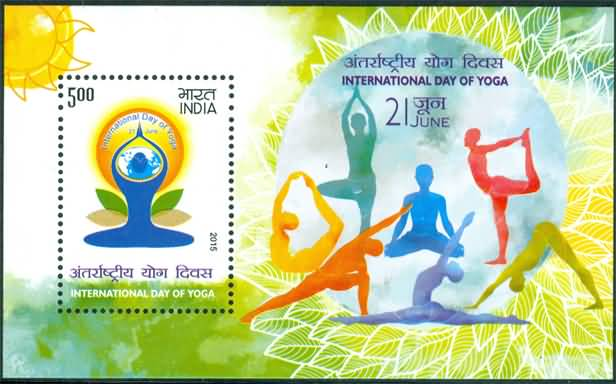
Technical Data
| Date of Issue | June 21, 2015 |
|---|---|
| Denomination | Rs. 5 |
| Quantity | 200,000 |
| Perforation | 13½ |
| Printer | Security Printing Press, Hyderabad |
| Printing Process | Wet Offset |
| Watermark | No Watermark |
| Colors | Multicolor |
| Credit (Designed By) | Shri Kamleshwar Singh Smt. Alka Sharma |
| Catalog Codes |
Michel IN BL129 Stamp Number IN 2729a Yvert et Tellier IN BF117 Stanley Gibbons IN MS3049 |
| Themes | Seals(Emblems) |
Global Recognition of India’s Ancient Wisdom
The declaration of International Day of Yoga marked a historic global acknowledgment of India’s ancient spiritual and scientific heritage.
While addressing the 69th session of the United Nations General Assembly on September 27, 2014, the Prime Minister of India, Narendra Modi, urged the international community to adopt a dedicated day to celebrate Yoga worldwide.
He described Yoga as:
“An invaluable gift of ancient Indian tradition. It embodies unity of mind and body; thought and action; restraint and fulfilment; harmony between man and nature and a holistic approach to health and well-being.”
He emphasized that Yoga is not merely physical exercise but a path toward inner harmony and global consciousness.
UN Resolution Establishing International Day of Yoga
On December 11, 2014, the 193-member United Nations General Assembly adopted the resolution by consensus, with a record 177 co-sponsoring countries, declaring 21st June as the International Day of Yoga.
The resolution recognized Yoga as a holistic approach to health and well-being and encouraged wider dissemination of information about its benefits for global health. Yoga is widely acknowledged for disease prevention, health promotion, and the management of lifestyle-related disorders.
Meaning and Philosophy of Yoga
The word “Yoga” is derived from the Sanskrit root yuj, meaning “to join,” “to yoke,” or “to unite.” It signifies the union of individual consciousness with universal consciousness. A person who attains this state is known as a yogi and is said to achieve liberation—referred to as mukti, nirvana, kaivalya, or moksha.
Yoga is both an art and science of healthy living. It works at multiple levels—body, mind, emotion, and energy—aiming to create balance and harmony in every aspect of life.
Historical Origins of Yoga
The science of Yoga dates back thousands of years. According to Yogic tradition, Shiva is regarded as the first yogi (Adiyogi) and the first guru (Adi Guru).
Although Yoga is believed to have existed in the pre-Vedic period, it was systematized and codified by the sage Patanjali in his Yoga Sutras. His work laid the foundation for structured Yogic practice and philosophy.
Over centuries, numerous sages and Yoga masters enriched and preserved the tradition, leading to its global spread in modern times.
Major Paths of Yoga
Yoga is broadly categorized into four principal paths:
- Karma Yoga – the path of action (utilizing the body)
- Jnana Yoga – the path of knowledge (utilizing the mind)
- Bhakti Yoga – the path of devotion (utilizing emotion)
- Kriya Yoga – the path of energy and internal transformation
Various traditional schools and guru–shishya paramparas have evolved distinct practices, all aiming toward self-realization and liberation.
Common Yoga practices include:
Yama, Niyama, Asana, Pranayama, Pratyahara, Dharana, Dhyana, Samadhi, Bandhas, Mudras, Shatkarmas, Mantra-japa, and disciplined lifestyle practices.
Philatelic Significance
To celebrate the global recognition of Yoga and its role in promoting health, harmony, and peace, India Post issued a Commemorative Postage Stamp in the form of a Miniature Sheet dedicated to International Day of Yoga – 21 June.
This commemorative stamp highlights India’s contribution to global wellness and symbolizes Yoga’s universal appeal as a means to achieve physical health, mental clarity, and spiritual growth.
Leave a Comment
You must be logged in to post a comment.