
J. P. Naik

Technical Data
| Date of Issue | September 5, 2007 |
|---|---|
| Denomination | Rs. 5 |
| Quantity | 400,000 |
| Perforation | 13½ |
| Printer | Security Printing Press, Hyderabad |
| Printing Process | Wet Offset |
| Watermark | No Watermark |
| Colors | Multicolor |
| Credit (Designed By) | Sh. Brahm Prakash |
| Catalog Codes |
Michel IN 2223 Stamp Number IN 2520 Yvert et Tellier IN 1988 Stanley Gibbons IN 2420 WADP Numbering System - WNS IN039.2007 |
| Themes | Anniversaries and Jubilees | Education | Famous people | Men | Ruins | Universities |
Founder of ICSSR and Champion of Social Science Research
Prof. J.P. Naik was the Founder Member-Secretary of the Indian Council of Social Science Research (ICSSR), New Delhi. Under his stewardship, the Council evolved into a premier institution, nurturing generations of Indian social scientists and earning international recognition for Indian social science research.
A grassroots thinker at heart, Naik firmly believed that the development of social science research must be rooted in addressing concrete and specific problems across different regions of the country. His approach ensured that research remained socially relevant and nationally meaningful.
Architect of India’s First Education Policy
Naik’s contribution to Indian education was singular and transformative. He served as Member-Secretary of the Indian Education Commission (1964–66) and was the chief architect of its landmark 1968 report. Based on this comprehensive document, India’s first National Education Policy was drafted by him and later adopted by Parliament in a modified form in 1968.
In 1963, Naik conceptualized and planned the establishment of the National Council of Educational Research and Training (NCERT), which went on to play a pivotal role in shaping school education in India. He also assisted Shri G. Parthasarathy in the establishment of Jawaharlal Nehru University, strengthening India’s higher education landscape.
As Member-Secretary of ICSSR, he facilitated the establishment of several state-level social science research centres, thereby decentralizing and expanding academic research across the nation.
Early Life and Freedom Struggle
Born on 5th September 1907 into a poor family, Naik displayed academic brilliance from an early age. He graduated from Rajaram College, Kolhapur, and joined its faculty as a teacher.
During Civil Disobedience Movement led by Mahatma Gandhi in 1930, Naik resigned from his position, went underground, and worked in the backward villages of Dharwad district. Arrested and sentenced to two years of rigorous imprisonment, he chose to serve as a ward boy in the jail hospital, informally pursuing medical studies under the supervision of the British jail doctor.
His dedication to rural upliftment and education reform remained a defining feature of his life.
Institution Builder and Policy Reformer
Between 1948 and 1959, Naik established his dream institution, the Indian Institute of Education. Later, as Adviser in the Education Ministry (1959–1964), he also served as Member-Secretary of the Central Advisory Board of Education (1960–1978). He compiled the Silver Jubilee Volume on the history of the CABE in 1960 and played a vital role in preparing state-level Five-Year Plans for education.
His expertise in primary education drew international attention. In 1952, UNESCO invited him to a conference on primary education in Mumbai. He was subsequently placed on the Executive Committee of the International Institute of Educational Planning in Paris. UNESCO also supported him in writing his reflective work, Education Commission and After. The Dag Hammarskjöld Foundation invited him as an adviser on educational alternatives and innovations for developing countries.
Prolific Writer and Global Recognition
A prolific author, Naik wrote 41 books and booklets. His History of Education in India received international acclaim, while Elementary Education in India: Promise to Keep earned the Dadabhai Naoroji Award. The Education Commission Report gained global recognition for its depth and vision.
His later works, Education Commission and After and Health for All, significantly influenced India’s education and health policies, including contributing to the formulation of the national health policy in 1983.
In 1974, he was honoured with the Padma Bhushan for his exceptional service to the nation.
A Life of Simplicity and Commitment
Despite holding high positions, Naik chose to work for a nominal salary of Re. 1 per month, valuing independence and integrity above personal gain. A freedom fighter in his youth, he remained committed to intellectual and moral freedom throughout his life.
Prof. J.P. Naik passed away on 30th August 1981, leaving behind a profound legacy. In 1989–90, UNESCO included him in its prestigious series “100 Thinkers on Education”, placing him alongside global luminaries from Confucius onward.
Commemorative Postage Stamp on Prof. J.P. Naik
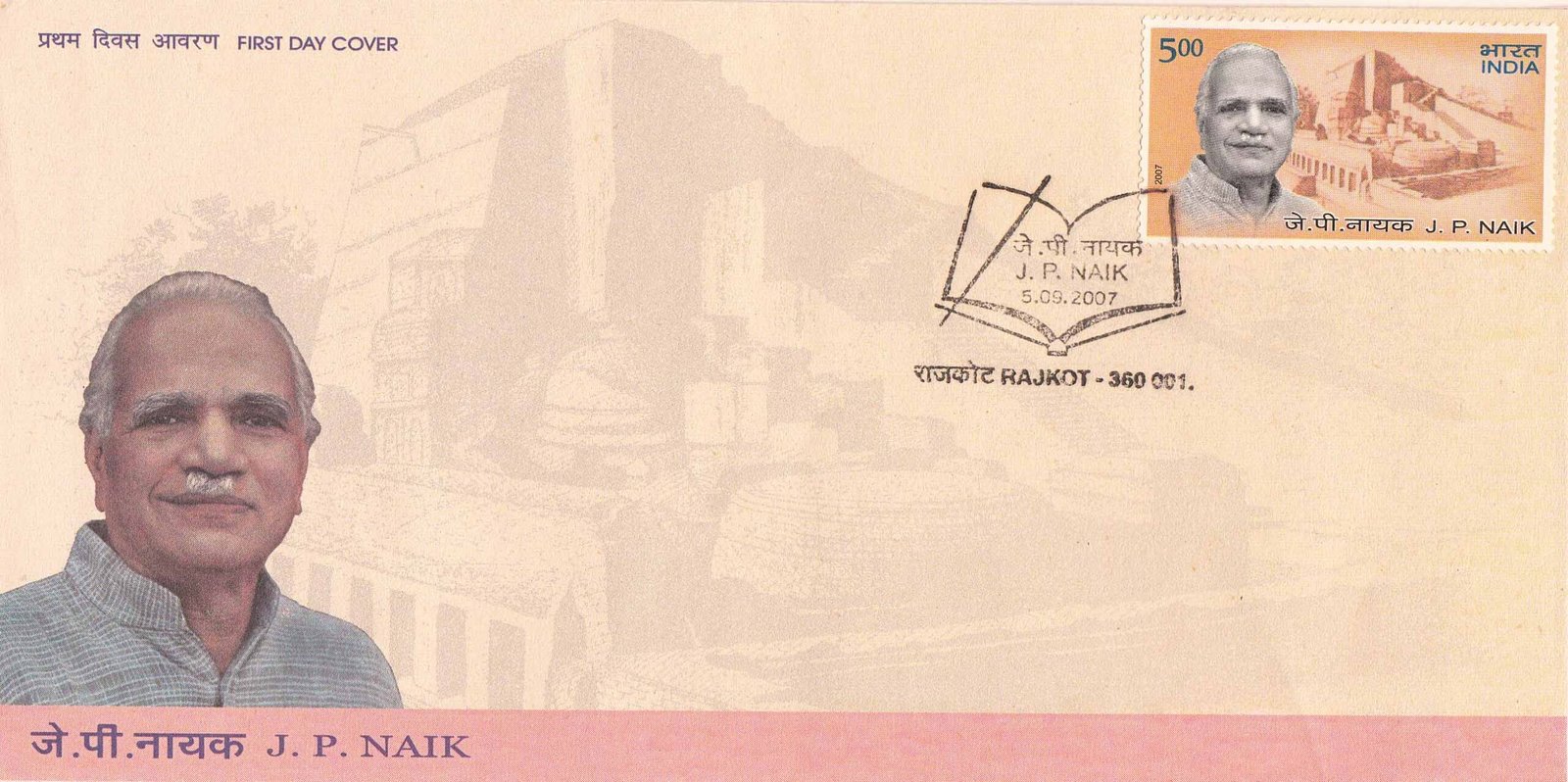
The Department of Posts proudly releases a commemorative postage stamp in honour of Prof. J.P. Naik, an eminent educationist, freedom fighter, and visionary architect of modern India’s educational and social science framework.
An Enduring Legacy
Prof. J.P. Naik’s departure created a void in India’s educational landscape that is difficult to fill. His vision, scholarship, and commitment to equity and excellence in education continue to inspire generations.
This commemorative postage stamp stands as a tribute to his monumental contributions to Indian education, social science research, and nation-building.
First Day Cover
Leave a Comment
You must be logged in to post a comment.