
National Flag – Jai Hind
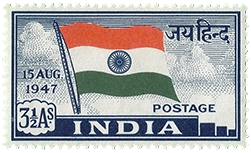
Technical Data
| Stamp Set | Independence |
|---|---|
| Date of Issue | November 21, 1947 |
| Denomination | 3.50 ANNAS |
| Quantity | 2,300,000 |
| Perforation | comb 13½ x 14 |
| Printer | Nasik Security Press |
| Watermark | Star of India Multiple [Up] |
| Colors | Multicolor |
| Catalog Codes |
Michel IN 184 Stamp Number IN 201 Yvert et Tellier IN 2 Stanley Gibbons IN 302 |
| Themes | Flags | Special Occasions |
A Historic Journey from Ancient Couriers to Air Mail
The India Post holds a distinguished place in India’s history, much like its ancient temples. The Indian Postal System originated from the essential need for communication, enabling rulers to stay connected with officials across distant regions and remain informed about developments throughout their empire.
Early Origins of the Indian Postal System
The foundations of the Indian Postal System can be traced back to the medieval period. The renowned traveler Ibn Battuta, who visited India during the reign of Muhammad bin Tughluq in the 14th century, documented a well-organized communication network.
He described two types of couriers:
- Foot couriers, stationed every mile
- Horse couriers, positioned every four miles
Each courier carried messages along with a whip fitted with bells to signal their arrival, ensuring swift relay of information across vast distances.
Growth During the British Era
The modern Indian postal system was formally opened to the public in 1837, with postage charges collected in cash. To simplify payments, copper tokens were introduced, with a standard rate of two annas per hundred miles.
A major milestone came in 1852, when postage stamps were first introduced in Sindh, marking a significant advancement in postal operations and efficiency.
Introduction of Air Mail in India
A revolutionary development occurred in 1911 with India’s first official air mail service. The historic flight was conducted by Henri Pequet, who transported approximately 6,500 letters and postcards.
The journey took place from the exhibition grounds in Allahabad to Naini, marking the beginning of air-based mail delivery in India.
To commemorate this landmark event, a special souvenir postmark was issued, symbolizing the integration of aviation into the postal network.
Legacy of the Indian Postal System
From its origins as a courier-based communication system to the adoption of air mail services, the Indian Postal System has evolved into one of the largest and most reliable networks in the world. It continues to play a vital role in connecting people across the country.
Conclusion
The journey of the Indian Postal System reflects centuries of innovation and adaptation. From ancient relay couriers to modern advancements, it remains a cornerstone of communication in India, ensuring connectivity and efficiency across the nation.