
Narasimha the Man-Lion
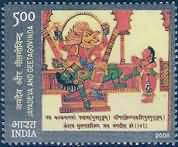
Technical Data
| Date of Issue | July 27, 2009 |
|---|---|
| Denomination | Rs. 5 |
| Quantity | 1,000,000 |
| Perforation | 13 |
| Printer | India Security Press, Nasik |
| Printing Process | Photo Gravure |
| Watermark | No Watermark |
| Colors | Multicolor |
| Credit (Designed By) | Sh. Sankha Samanta |
| Catalog Codes |
Michel IN 2384 Stamp Number IN 2334g Stanley Gibbons IN 2608 WADP Numbering System - WNS IN041.2009 |
| Themes | Poems |
The Fierce Protector in Dashavatara
Narasimha, the fourth incarnation of Lord Vishnu in the sacred Dashavatara tradition, is worshipped as the divine Man-Lion who appeared to protect devotion and destroy tyranny. His incarnation symbolizes the ultimate triumph of faith and righteousness over arrogance and evil.
Narasimha is one of the most dramatic and powerful avatars of Vishnu, manifesting in a unique half-man, half-lion form to uphold cosmic order.
The Legend of Narasimha
According to Hindu mythology, the demon king Hiranyakashipu obtained a boon that made him nearly invincible — he could not be killed by man or beast, indoors or outdoors, during day or night, on earth or in the sky, or by any weapon.
When Hiranyakashipu began persecuting his own son Prahlada for his unwavering devotion to Vishnu, the Lord manifested as Narasimha — neither man nor animal — at twilight (neither day nor night), on a palace threshold (neither indoors nor outdoors). Placing the tyrant on his lap (neither earth nor sky), Narasimha ended his reign using his claws (not a weapon).
This extraordinary incarnation restored dharma and protected the innocent devotee Prahlada.
Narasimha in Geetagovinda and Dashavatara
The revered Sanskrit devotional classic Gita Govinda, composed by Jayadeva, glorifies Narasimha in its celebrated Dashavatara stotra. Jayadeva poetically describes the fierce yet compassionate form of the Lord who tears apart the arrogance of evil to safeguard devotion.
Through lyrical verses, Narasimha is portrayed not merely as a destroyer, but as a divine protector whose fury is guided by justice and love for his devotees.
The Dashavatara hymns have been sung for centuries in temples and incorporated into classical dance traditions, devotional music, and spiritual discourses across India.
Symbolism of Narasimha Avatar
The Narasimha incarnation represents:
- Protection of true devotion
- Destruction of ego and tyranny
- Divine justice beyond logical constraints
- The assurance that righteousness will prevail
His form teaches that divine power transcends human definitions and limitations.
Influence on Art and Culture
The powerful imagery of Narasimha has inspired:
- Temple sculptures depicting the Ugra (fierce) form
- Paintings illustrating the Prahlada episode
- Classical dance dramas based on Dashavatara
- Devotional hymns and spiritual performances
From ancient temple architecture to manuscript illustrations, Narasimha remains one of the most visually striking incarnations of Vishnu.
Commemorative Stamp on Dashavatara
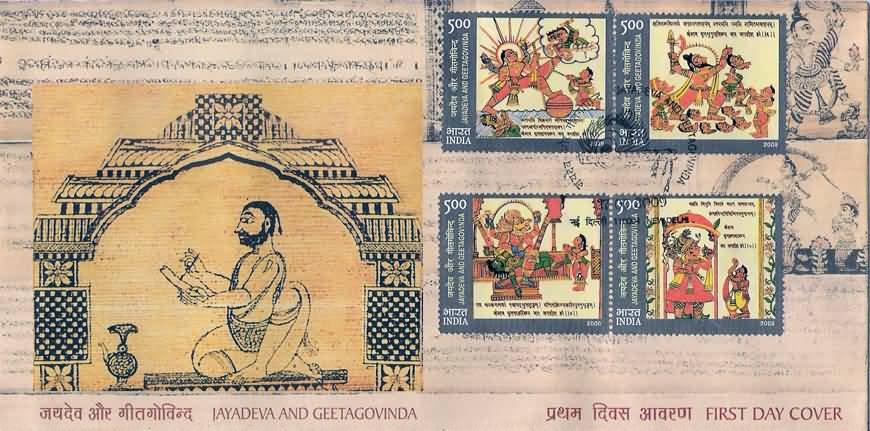
To celebrate India’s spiritual and literary heritage, India Post issued commemorative postage stamp dedicated to Jayadeva and the Dashavatara theme of Geetagovinda. Narasimha, as one of the principal avatars, features in this philatelic tribute honoring India’s mythological legacy.
Narasimha: The Eternal Defender of Faith
Narasimha the Man-Lion stands as a powerful reminder that divine protection arises whenever righteousness is threatened. As celebrated in Geetagovinda and in the Dashavatara tradition, his story continues to inspire devotion, courage, and faith across centuries.
Through sacred texts, temple traditions, artistic representations, and commemorative stamps, the legacy of Narasimha remains a symbol of divine justice and unwavering protection.
First Day Cover
Leave a Comment
You must be logged in to post a comment.