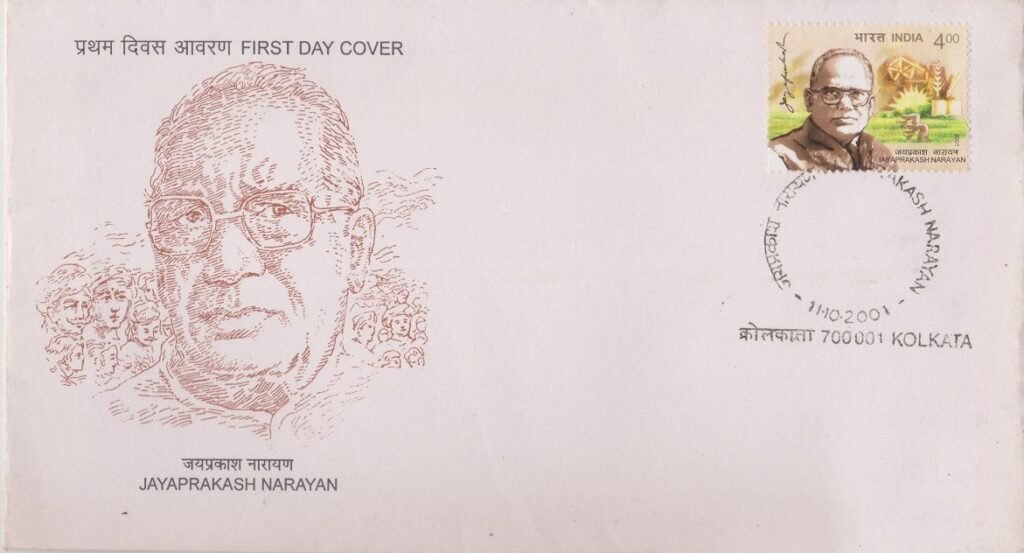
Jayaprakash Narayan (1902-1979)
Technical Data
| Stamp Set | Birth Centenary |
|---|---|
| Date of Issue | October 11, 2001 |
| Denomination | Rs. 4 |
| Quantity | 400,000 |
| Perforation | comb 13 |
| Printer | Madras Security Printers |
| Printing Process | Offset Lithography |
| Watermark | No Watermark |
| Colors | Multicolor |
| Credit (Designed By) | Sh. Sankha Samanta |
| Catalog Codes |
Michel IN 1861 Stamp Number IN 1919 Yvert et Tellier IN 1625 Stanley Gibbons IN 2026 |
| Themes | Anniversaries and Jubilees | Famous people | Men | Optical Instruments | Politicians |
Architect of Total Revolution and Indian Democracy
Jayaprakash Narayan (1902–1979) was one of the most influential political figures of 20th-century India. Popularly known as J.P., he combined the simplicity of a saint with the sharp insight of a political strategist, leaving a lasting impact on India’s democratic and social landscape.
Early Life and Education
Jayaprakash Narayan was born in Sitabdiara. As a student at Patna College, he was deeply affected by the Rowlatt Act and the Jallianwala Bagh massacre. In protest, he abandoned his studies under the British system.
In 1922, he moved to the United States for higher education, studying at institutions such as the University of California Berkeley, University of Wisconsin, and Ohio University. During his time abroad, he was influenced by Marxist thought and developed a deep understanding of socialism.
Entry into Freedom Struggle
After returning to India, Jayaprakash Narayan joined the freedom movement under the guidance of Mahatma Gandhi. His wife, Prabhavati Devi, was closely associated with Gandhi and lived in his ashram during J.P.’s absence.
He later co-founded the Congress Socialist Party along with Acharya Narendra Dev, promoting socialist ideals within the Indian National Congress.
Role in Quit India Movement
Jayaprakash Narayan played a crucial role in the Quit India Movement. His daring underground activities and escape from British custody became legendary, marking him as a fearless revolutionary leader. He spent nearly eight years in prison during the freedom struggle.
Shift to Social Movements
After independence and the death of Gandhi in 1948, J.P. formed a Socialist Party. However, in 1954, he withdrew from active politics to join Vinoba Bhave in the Bhoodan Movement.
He dedicated himself to social causes such as:
- Rural development
- Land reforms
- Rehabilitation of Chambal dacoits
Total Revolution and Political Comeback
In the 1970s, Jayaprakash Narayan returned to active politics, deeply concerned about issues like civil liberties, unemployment, inflation, and electoral integrity.
In 1974, he launched the movement for “Total Revolution”, calling for a complete transformation of society and governance. This movement ultimately led to the formation of the first non-Congress government in India in 1977.
Literary Contributions
Jayaprakash Narayan was also a profound thinker and writer. His works on socialism, democracy, and governance remain influential. Some of his notable writings include:
- Why Socialism (1936)
- Towards Struggle (1946)
- In the Lahore Fort (1970)
- A Plea for the Reconstruction of Indian Polity (1959)
- From Socialism to Sarvodaya (1959)
- Swaraj for the People (1961)
Legacy
Jayaprakash Narayan is remembered as a champion of democracy, social justice, and ethical politics. His vision of a just and equitable society continues to inspire generations.
To honour his immense contribution, the Department of Posts issued a commemorative postage stamp celebrating the life and legacy of Jayaprakash Narayan.
First Day Cover