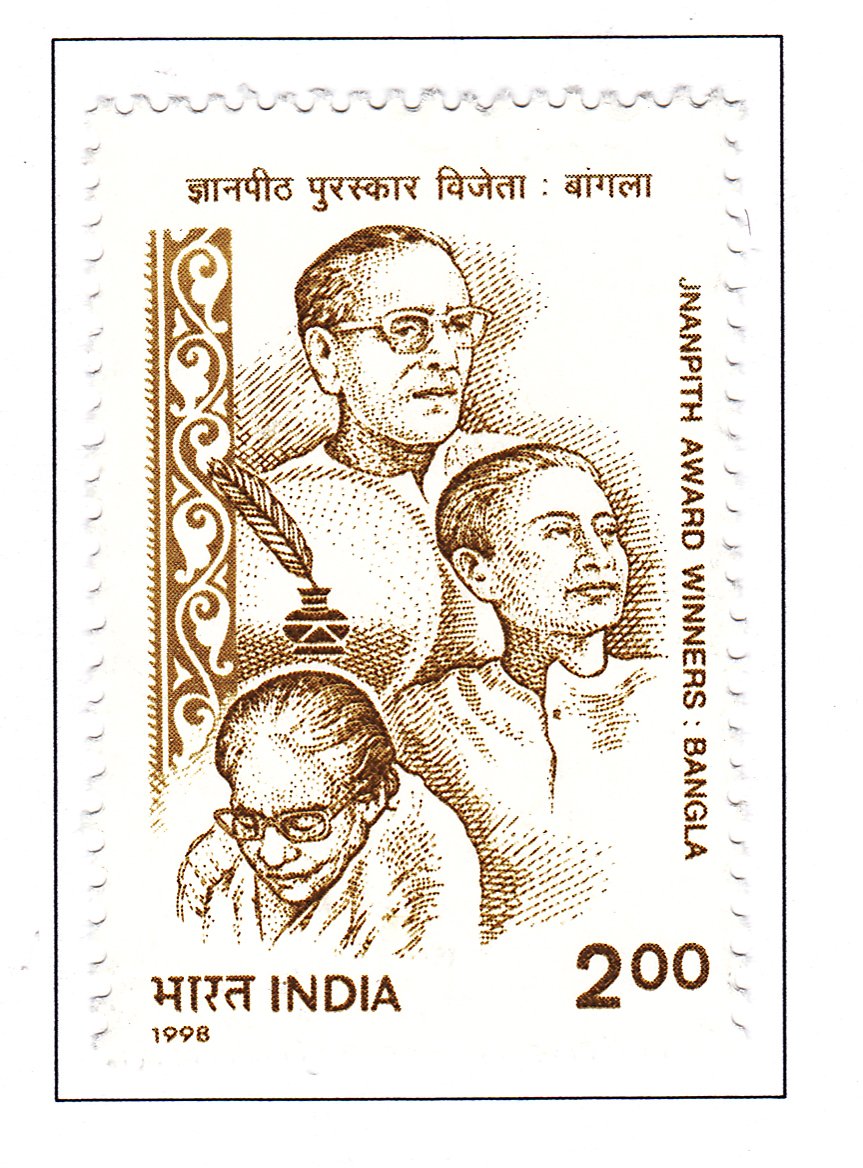
Jnanpith Award Winners : Bangla
Technical Data
| Date of Issue | June 5, 1998 |
|---|---|
| Denomination | Rs. 2 |
| Quantity | 400,000 |
| Perforation | comb 13 |
| Printer | Security Printing Press, Nashik |
| Printing Process | Photogravure |
| Watermark | No Watermark |
| Colors | Bistre brown |
| Credit (Designed By) | Sh. Sankha Samanta |
| Catalog Codes |
Michel IN 1628 Stamp Number IN 1683 Yvert et Tellier IN 1394 Stanley Gibbons IN 1792 |
| Themes | Commemoration | Famous people | Literary People (Poets and Writers) | Men | Women |
Celebrating Three Literary Giants
The Jnanpith Literary Award is one of India’s highest honors in literature. It recognizes outstanding creative works in the languages listed in the Eighth Schedule of the Constitution of India. Over the years, the award has become a trusted symbol of literary excellence and cultural richness.
To honor the contribution of Bangla literature, the Department of Posts issued a special commemorative postage stamp featuring three celebrated Jnanpith Laureates in Bangla:
- Bishnu Dey
- Tarashankar Bandopadhyay
- Ashapurna Devi
These writers enriched Indian literature through creativity, social insight, and cultural depth.
Jnanpith Award: Symbol of Literary Excellence
Jnanpith Award recognizes authors whose work reflects the diversity and spirit of India.
The award celebrates:
- Outstanding literary achievement
- Cultural values
- Creativity in Indian languages
- National literary heritage
The three Bangla laureates honored on the stamp represent the richness of Bengali literature.
Bishnu Dey (1909–1982)
Bishnu Dey received the Jnanpith Award in 1971 for his poetry collection:
Smriti Satta Bhavishyat
Literary Importance
This work explored:
- Memory of the past
- Reality of the present
- Hope for the future
His poetry reflected the struggles and aspirations of society, blending lyric beauty with philosophical depth.
Other Contributions
Bishnu Dey was also a respected art critic who wrote about:
- Rabindranath Tagore
- Jamini Roy
Tarashankar Bandopadhyay (1898–1971)
Tarashankar Bandopadhyay received the Jnanpith Award in 1966 for his celebrated novel:
Ganadevata
Literary Importance
The novel portrays:
- Rural Indian society
- Social change
- Impact of industrialization
- Economic and caste tensions
His writing captured the transformation of village life with compassion and realism.
Legacy
Tarashankar is regarded as one of the greatest chroniclers of rural Bengal and social change in Indian literature.
Ashapurna Devi (1909–1995)
Ashapurna Devi was awarded the Jnanpith Award in 1976 for her novel:
Pratham Pratishruti
Literary Importance
This novel depicts:
- Bengali women’s lives from the 19th century
- Social restrictions
- Struggles for dignity and freedom
The central character Satyawati symbolizes courage and determination.
Honors
Ashapurna Devi also received:
- Tagore Award
- Leela Award
- Bhuvan Mohini Gold Medal
- Padma Shri in 1976
She remains one of the most influential women writers in Indian literature.
Contribution of Bangla Literature
These three writers collectively enriched Bangla and Indian literature through:
- Poetry
- Social realism
- Women’s voices
- Cultural reflection
- Human values
Their works continue to inspire readers across generations.
Commemorative Postage Stamp
The Department of Posts issued a special commemorative postage stamp in memory of:
- Bishnu Dey
- Tarashankar Bandopadhyay
- Ashapurna Devi
The stamp honors their timeless contribution to Indian literature.
Conclusion
The Jnanpith Laureates in Bangla represent the highest traditions of Indian literary excellence. Through poetry, novels, and social insight, Bishnu Dey, Tarashankar Bandopadhyay, and Ashapurna Devi gave voice to history, humanity, and cultural identity. Their legacy remains a proud part of India’s literary heritage.
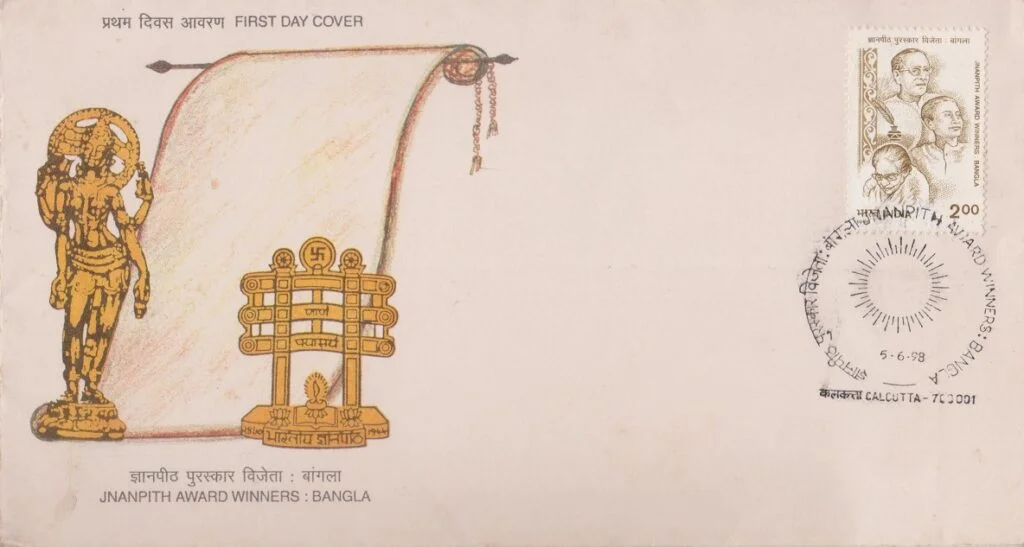
First Day Cover