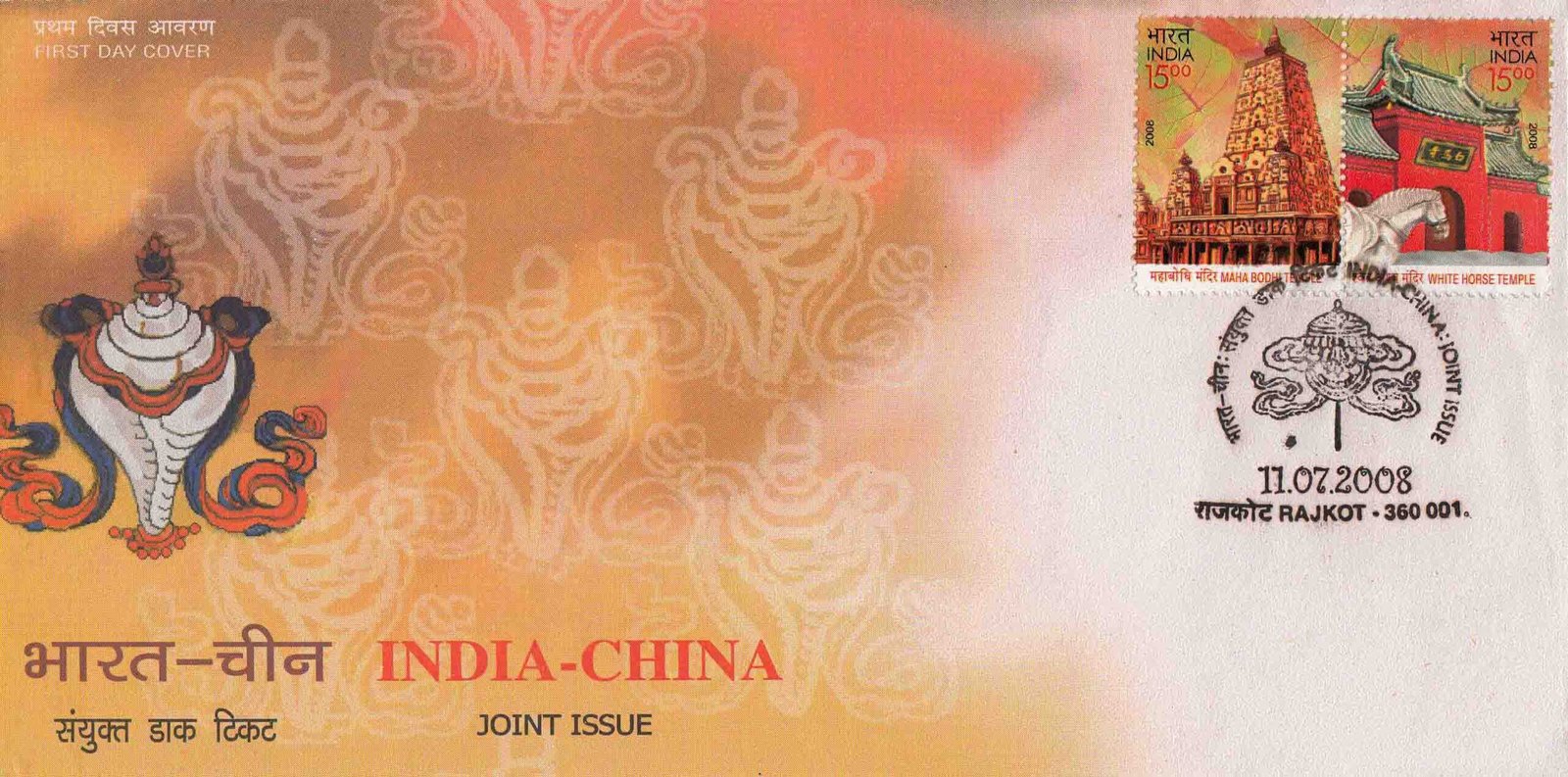
White Horse Temple, Luoyang, China

Technical Data
| Date of Issue | July 11, 2008 |
|---|---|
| Denomination | Rs. 15 |
| Quantity | 800,000 |
| Perforation | 13 |
| Printer | India Security Press, Nasik |
| Printing Process | Photo Gravure |
| Watermark | No Watermark |
| Colors | Multicolor |
| Credit (Designed By) | Sh. Bharati Mirchandani |
| Catalog Codes |
Michel IN 2278 Stamp Number IN 2246b Stanley Gibbons IN 2484 WADP Numbering System - WNS IN022.2008 |
| Themes | Architecture | Buildings | Joint Issues | Temples | UNESCO World Heritage Sites |
Historical Background
India and China, two ancient civilizations with rich cultural traditions, have shared centuries of intellectual and spiritual exchanges. Buddhism played a pivotal role in fostering this interaction, encouraging the movement of monks, scholars, and sacred texts between the two lands. The commemorative postage stamp depicting the White Horse Temple celebrates this profound historical connection and honours the earliest foundation of Buddhism in China.
Origin of the White Horse Temple
The White Horse Temple, situated about 12 kilometres east of Luoyang in Henan Province, was established in A.D. 68 during the reign of Emperor Ming of the Han dynasty. According to legend, Emperor Ming dreamed of a golden deity flying over his palace. His ministers interpreted the dream as a vision of the Buddha from India. Inspired by this revelation, the Emperor sent a delegation to India to learn about Buddhism.
The delegation travelled across mountains and deserts, reaching regions near present-day Afghanistan. There, they studied Buddhist teachings and obtained sacred scriptures and images. They also invited two eminent Indian monks, Kasyapa Matanga and Dharmaraksha (known in China as She Moteng and Zhu Falan), to accompany them to China. The monks returned carrying Buddhist sutras and statues on the back of a white horse. In commemoration of this journey, the Emperor ordered the construction of a temple, which was named the White Horse Temple.
Centre of Buddhist Learning
Within the White Horse Temple, the earliest Chinese translation of the Forty-two Sutras was completed. This marked the formal introduction of Buddhist scripture into China. The monastery soon became an important centre for Buddhist studies and spiritual practice. From this sacred site, Buddhism gradually spread across China and later to neighbouring countries such as Japan, Korea, and Vietnam.
Because of its foundational importance, the White Horse Temple is often regarded as the “Founder’s Home” and the “Cradle of Buddhism” in China.
Architectural Significance
The temple complex is renowned for its magnificent ancient architecture and spiritual ambience. Important structures within the complex include the Hall of Heavenly Kings, the Hall of the Great Buddha, the Hall of Mahavira, the Hall of Guidance, and the Cool and Clear Terrace. Each hall houses revered images of the Buddha and reflects traditional Chinese architectural elegance combined with Buddhist symbolism.
Philatelic Significance
The commemorative postage stamp featuring the White Horse Temple symbolizes the enduring cultural and spiritual bonds between India and China. Issued as part of a joint philatelic initiative, it highlights the shared Buddhist heritage that has connected the two nations for centuries. The stamp serves not only as a tribute to an important historical monument but also as a reminder of the long-standing friendship and mutual respect between these ancient civilizations.
First Day Cover