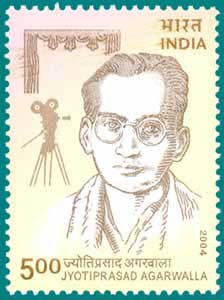
Jyotiprasad Agarwalla (1903-1951)
Technical Data
| Date of Issue | June 17, 2004 |
|---|---|
| Denomination | Rs. 5 |
| Quantity | 400,000 |
| Perforation | comb 13 x 13½ |
| Printer | Security Printing Press, Nashik |
| Printing Process | Photogravure |
| Watermark | No Watermark |
| Colors | Multicolor |
| Credit (Designed By) | Sh. Sankha Samanta Smt. Alka Sharma |
| Catalog Codes |
Michel IN 2027 Stamp Number IN 2063 Yvert et Tellier IN 1792 Stanley Gibbons IN 2205 WADP Numbering System - WNS IN013.04 |
| Themes | Anniversaries and Jubilees | Famous people | Literary People (Poets and Writers) | Men | Movies | Optical Instruments |
Cultural Icon and Pioneer of Assamese Cinema
Jyotiprasad Agarwalla was a celebrated cultural icon of Assam and one of the most influential figures in modern Assamese culture. A poet, playwright, filmmaker, musician, and nationalist, he dedicated his life to the promotion of art, literature, and social unity. Fondly known as “Rupkonwar” (Prince of Beauty), Agarwalla believed that true happiness in life comes from the propagation and preservation of culture, a philosophy clearly reflected in his work and achievements.
Early Life and Education
Jyotiprasad Agarwalla was born on 17 June 1903 to Parmananda Agarwalla and Kiranmoyee Devi. He received his early education at Tezpur High School and later studied in Dibrugarh.
His life took a significant turn in 1921 when Mahatma Gandhi visited Tezpur. Inspired by Gandhi’s message, the young Agarwalla left school to join the nationalist movement. Later, he continued his studies at National College Calcutta and Chittaranjan Das University.
Role in the Freedom Movement
Agarwalla’s early inspiration turned into a lifelong commitment to nationalism. During the 1930s, he became an active Satyagrahi and travelled extensively in rural areas around Tezpur, spreading awareness and inspiring people through patriotic songs and speeches.
In 1932, he was arrested by the British authorities for his political activities and fined Rs. 500. During this period of political struggle, he married Debajani Bhuyan of Dibrugarh in 1936.
During the Quit India Movement, Agarwalla served as a commander of the volunteer force and remained underground while spreading revolutionary messages. Following the advice of Mahatma Gandhi, he surrendered to the British authorities at the Darrang District Court on 15 August 1943, but was later released due to lack of evidence.
Literary and Musical Contributions
Jyotiprasad Agarwalla’s artistic talent emerged early. At just 14 years old, he wrote the musical dance drama Shonit Kunwari. The play introduced an innovative dance style called Padumkali, which blended Bihu and Bhawna. It was first staged in 1924 at the Ban Theatre, marking a milestone in Assamese drama.
His other notable literary works include:
- Karengar Ligiri
- Rupalim
- Labhita
- Nimati Kanya
Agarwalla was also a prolific poet. His literary work Jyoti Ramayana remains an important contribution to children’s literature.
In music, he introduced Jyoti Sangeet, a unique blend of Assamese folk, Hindustani classical, and Western musical traditions.
Pioneer of Assamese Cinema
Jyotiprasad Agarwalla was also a pioneer of cinema in Assam. In 1927, he travelled abroad and joined University of Edinburgh, where he explored contemporary trends in music, drama, and cinema. In 1929, he studied cinematography in Berlin, gaining valuable technical knowledge.
After returning to India, he created Joymati, the first Assamese film, released on 10 March 1935. The film was a landmark in the cinematic history of Assam and was remarkable for its advanced cinematic techniques and realistic acting.
His second film, Indramalati, further established his reputation as a pioneering filmmaker.
He also established several important cultural institutions, including:
- Chitraban Studio
- Jonaki Theatre
- Tezpur Sangeet Mahavidyalaya
Along with Bishnu Prasad Rabha, he also produced some of the earliest gramophone recordings of Assamese plays.
Legacy and Cultural Impact
Jyotiprasad Agarwalla devoted his entire life to the cultural revival of Assamese society. His works consistently promoted unity among the diverse ethnic communities of Assam. He strongly believed that real cultural transformation could only occur through education and empowerment of the masses.
He also actively supported the movement for establishing Assamese as the official language of Assam and contributed to the development of Gauhati University.
Death and Commemoration
Jyotiprasad Agarwalla passed away on 17 February 1951. In honour of his immense contribution to Assamese culture, this day is celebrated annually in Assam as Silpi Divas.
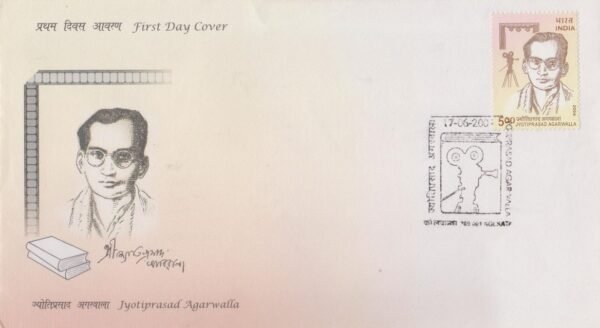
To pay tribute to his extraordinary legacy, India Post issued a commemorative postage stamp in honour of Jyotiprasad Agarwalla, celebrating the life of a visionary artist who shaped the cultural and artistic identity of Assam.
First Day Cover