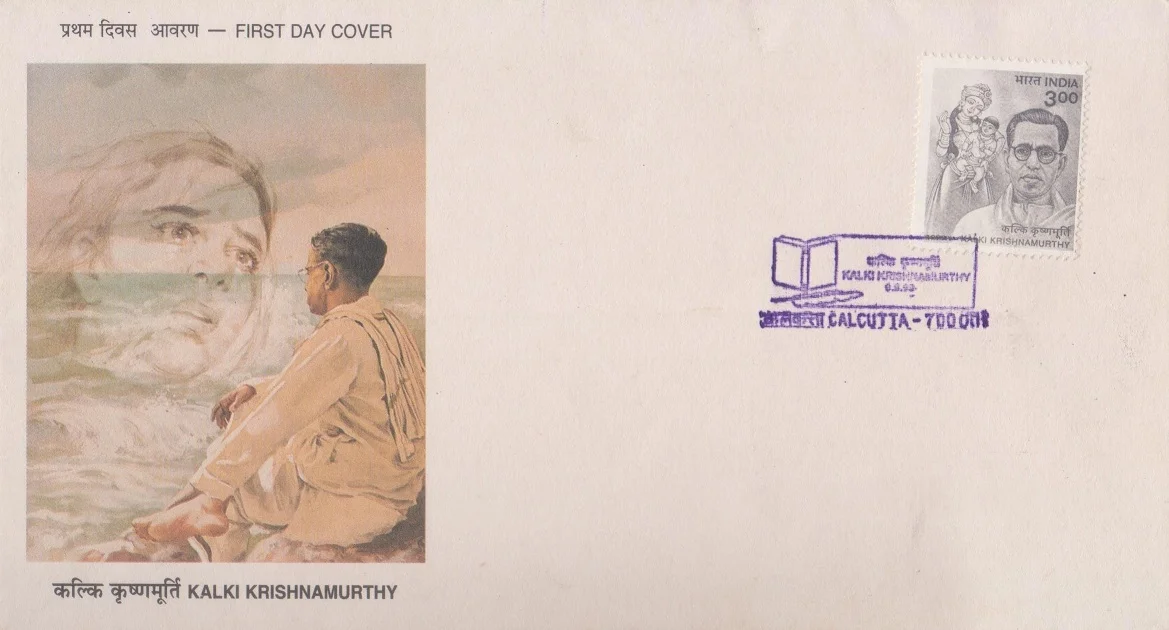
Kalki Krishnamurthy
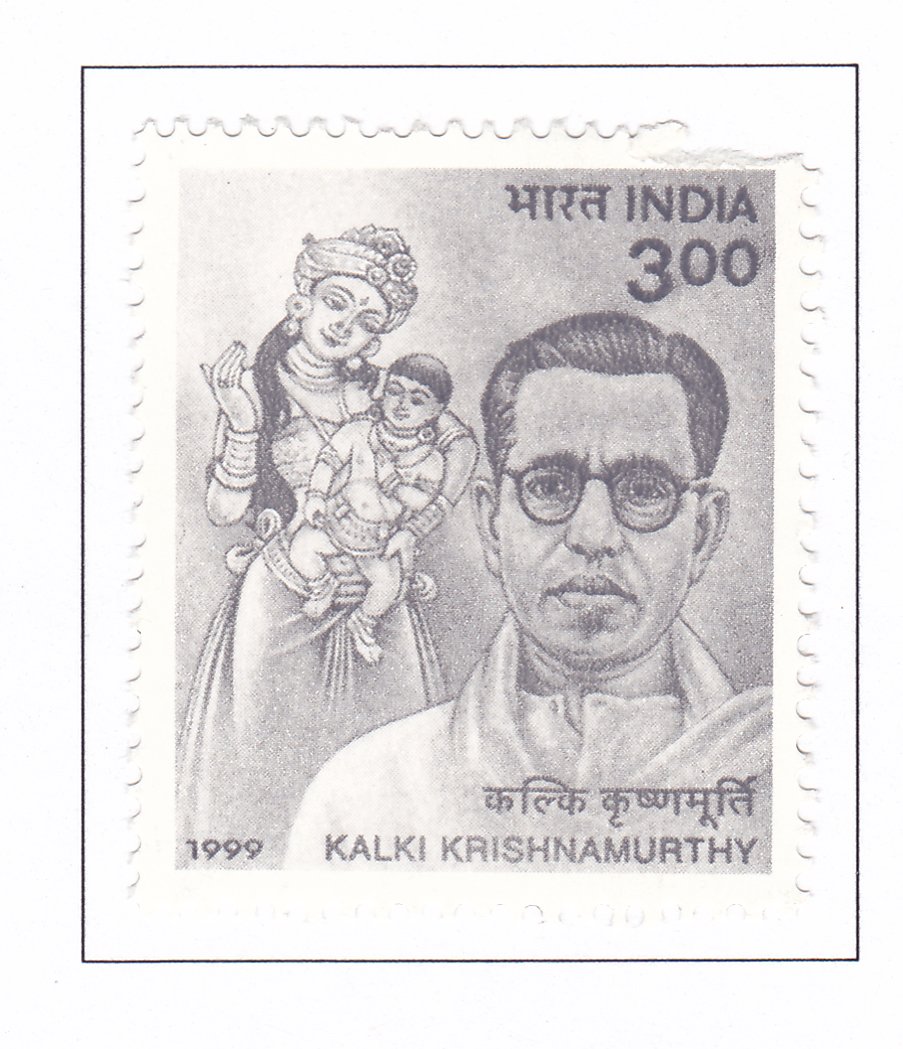
Technical Data
| Stamp Set | Birth Centenary |
|---|---|
| Date of Issue | September 9, 1999 |
| Denomination | Rs. 3 |
| Quantity | 400,000 |
| Perforation | comb 14 |
| Printer | Security Printing Press, Nashik |
| Printing Process | Photogravure |
| Watermark | No Watermark |
| Colors | Violet grey |
| Credit (Designed By) | |
| Catalog Codes |
Michel IN 1698 Stamp Number IN 1759 Yvert et Tellier IN 1465 Stanley Gibbons IN 1861 |
| Themes | Anniversaries and Jubilees | Authors | Famous people | Literary People (Poets and Writers) | Literature | Men | Optical Instruments |
Pioneer of Modern Tamil Literature and Journalism
Kalki Krishnamurthy (1899–1954), one of the most celebrated figures in 20th-century Tamil literature and journalism, holds a distinguished place for his immense contribution to Indian literary culture. In his short yet impactful life, he produced an extraordinary body of work, including novels, short stories, travelogues, critiques, and patriotic writings—all marked by simplicity, humor, and a noble vision.
Early Life and Freedom Struggle
Born into a poor family in Tamil Nadu, Kalki Krishnamurthy received his early education in Tiruchirappalli. A brilliant student at the National College School, his academic journey was interrupted when he joined the Non-Cooperation Movement.
He was imprisoned in 1922 for delivering what were termed “seditious speeches” and later jailed again in 1930 and 1941 for his participation in the freedom movement as a satyagrahi. His political engagement was deeply influenced by leaders like Mahatma Gandhi and C. Rajagopalachari.
Journalism and the Magazine ‘Kalki’
In 1941, Kalki Krishnamurthy founded the influential Tamil magazine Kalki, which he edited until his death in 1954. Through this platform, he addressed a wide range of social, cultural, and political issues.
His writings actively supported:
- The Indian freedom struggle
- Social reforms like abolition of child marriage and untouchability
- Promotion of Tamil language, literature, and classical arts
- Revival of Indian cultural heritage
He also translated The Story of My Experiments with Truth into Tamil, making it accessible to a wider audience.
Literary Contributions and Famous Works
Kalki Krishnamurthy revolutionized Tamil prose by introducing a simple and engaging writing style at a time when complex, academic language was the norm. His works reached the masses and gained immense popularity.
Some of his most famous works include:
- Parthiban Kanavu
- Sivakamiyin Sapatham
- Ponniyin Selvan
- Alai Osai (which earned him the Sahitya Akademi Award posthumously)
His historical novels, especially Ponniyin Selvan, captivated readers and remain timeless classics in Tamil literature.
Legacy and Recognition
Kalki Krishnamurthy’s works have been translated into multiple Indian and international languages, including English, German, and Russian, reflecting their universal appeal.
To honor his legacy, India Post issued a commemorative postage stamp on his birth centenary. The stamp and First Day Cover featured artistic depictions inspired by his iconic works, including Ponniyin Selvan and Alai Osai.
Conclusion
Kalki Krishnamurthy was not just a writer but a visionary who used literature as a tool for social reform and cultural revival. His accessible style, powerful storytelling, and dedication to national and social causes continue to inspire generations. He remains a cornerstone of modern Tamil literature and journalism.
First Day Cover