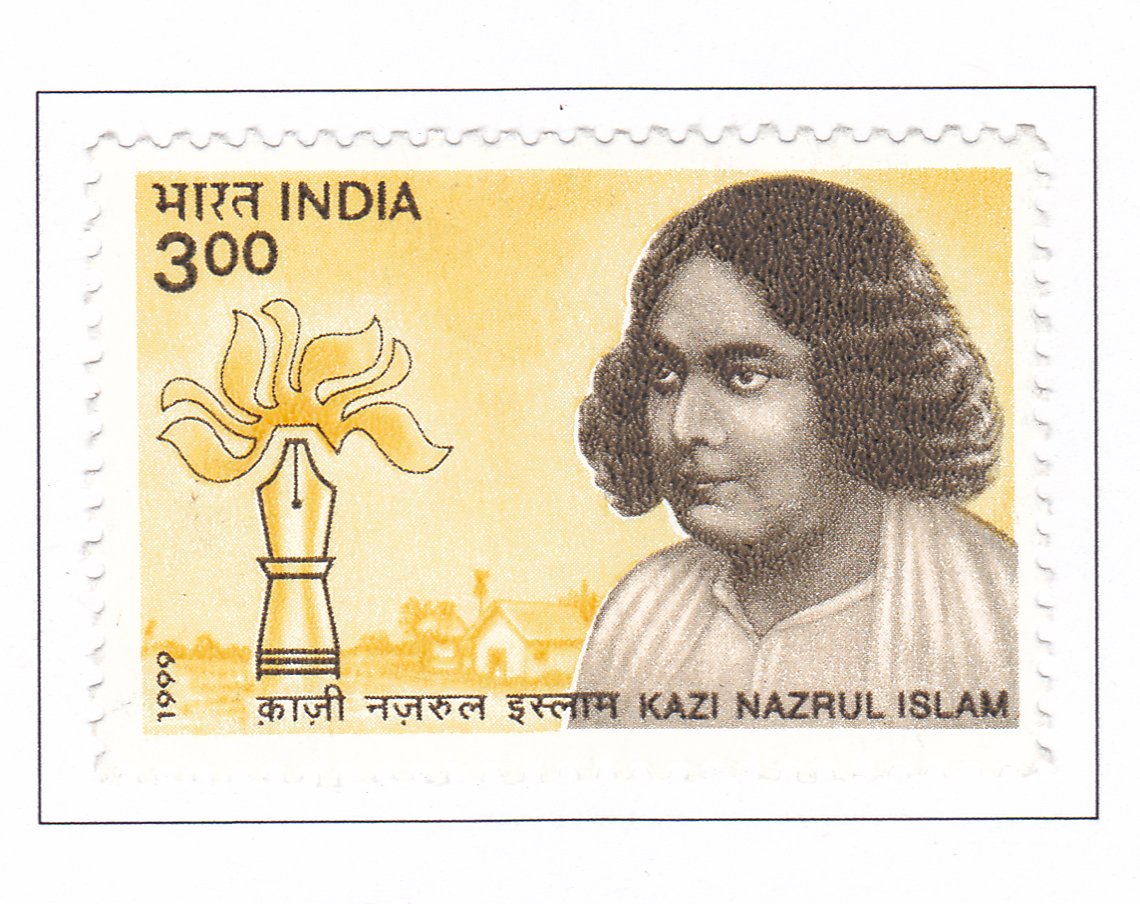
Kazi Nazrul Islam (1899-1976)
Technical Data
| Stamp Set | Linguistic Harmony Of India |
|---|---|
| Date of Issue | September 14, 1999 |
| Denomination | Rs. 3 |
| Perforation | comb 13 |
| Printer | Security Printing Press, Nashik |
| Printing Process | Photogravure |
| Watermark | No Watermark |
| Colors | Multicolor |
| Credit (Designed By) | |
| Catalog Codes |
Michel IN 1699 Stamp Number IN 1760 Yvert et Tellier IN 1466 Stanley Gibbons IN 1865 |
| Themes | Anniversaries and Jubilees | Authors | Famous people | Literary People (Poets and Writers) | Literature | Men |
The Revolutionary Poet and Symbol of Linguistic Harmony in India
Kazi Nazrul Islam (1899–1976), famously known as the Revolutionary Poet of Bengal, emerged from humble beginnings to become one of the most influential literary figures in Indian and Bangladeshi history. His powerful writings and patriotic spirit played a significant role in inspiring the masses during India’s freedom movement.
Early Literary Journey and Rise to Fame
The literary career of Kazi Nazrul Islam began with contributions to various periodicals. His poetry quickly gained recognition for its emotional intensity and bold expression.
His iconic poem “Vidrohi” (The Rebel), published in 1922, established his unique voice in Bengali literature and marked a turning point in his career. Through this work, he became a symbol of resistance and rebellion against oppression.
Contribution to Music and Literature
Kazi Nazrul Islam was not only a poet but also a prolific composer, creating nearly 3,000 songs. His works combined literary brilliance with musical creativity, making them widely popular.
Some of his notable compositions include:
- Bisher Banshi
- Agamoni
- Pralay Veena
- Dolan Champa
- Samyabadi
These works inspired people to participate in the struggle for independence and promoted ideals of equality and justice. He often set his own poems to music, gaining widespread recognition through broadcasts on All India Radio, especially from its Kolkata station.
Later Life and Recognition
In 1942, while participating in a programme at All India Radio, Kazi Nazrul Islam fell seriously ill and permanently lost his ability to speak. Despite this tragic setback, his legacy continued to grow.
After the formation of Bangladesh in 1972, he was invited by its government and honored as the national poet. He spent his final years there and passed away in 1976.
In recognition of his immense contribution, he received several prestigious awards, including:
- Padma Bhushan
- Ekushey Padak
Kazi Nazrul Islam and Linguistic Harmony in India
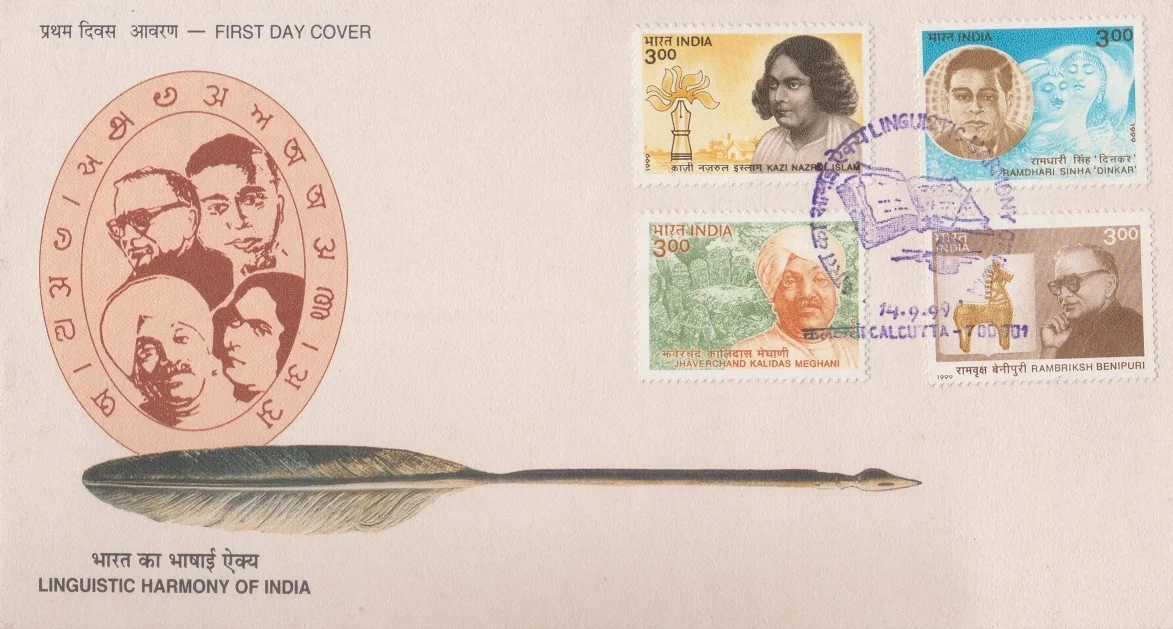
Kazi Nazrul Islam was featured in a special series of commemorative stamps issued by India Post to celebrate Linguistic Harmony in India. This series honored four distinguished literary figures:
- Kazi Nazrul Islam
- Ramdhari Singh Dinkar
- Jhaverchand Meghani
- Rambriksh Benipuri
Released on 14th September 1999, marking the 50th anniversary of Hindi Diwas, the stamp series symbolized the unity of India’s diverse linguistic and literary traditions.
Legacy and Cultural Significance
India’s literary heritage, though diverse in language and region, reflects a shared cultural identity shaped by centuries of interaction. Kazi Nazrul Islam’s works embody this unity, blending themes of rebellion, equality, spirituality, and harmony.
His poetry continues to inspire generations, standing as a testament to the power of literature in uniting people across boundaries.
Conclusion
Kazi Nazrul Islam remains a timeless figure whose contributions transcend borders. As a poet, composer, and visionary, he not only enriched Bengali literature but also strengthened the ideals of unity and linguistic harmony in India.
First Day Cover