Khajuraho Millennium

Technical Data
| Date of Issue | March 6, 1999 |
|---|---|
| Denomination | Rs. 15 |
| Quantity | 1,000,000 |
| Perforation | comb 13 |
| Printer | Security Printing Press, Nashik |
| Printing Process | Photogravure |
| Watermark | No Watermark |
| Colors | Multicolor |
| Credit (Designed By) | |
| Catalog Codes |
Michel IN 1679 Stamp Number IN 1740 Yvert et Tellier IN 1446 Stanley Gibbons IN 1842 |
| Themes | Anniversaries and Jubilees | Statues | Temples |
The Glorious Temple Heritage of Central India
Khajuraho, the ancient city of temples, is located in Chhatarpur district in the heart of Central India. Famous across the world for its magnificent temples and intricate sculptures, Khajuraho represents one of the greatest achievements of Indian art and architecture.
To celebrate one thousand years of the Khajuraho temples, the Department of Posts issued a commemorative postage stamp dedicated to the Millenary of the Khajuraho Group of Monuments.
Historical Background of Khajuraho
The region around Khajuraho was known in ancient times as Vatsa. During the medieval period, it came to be called Jejakbhukti and later, in the fourteenth century, the region became known as Bundelkhand.
Khajuraho flourished under the rule of the Chandella dynasty between the ninth and twelfth centuries AD. The Chandella rulers were great patrons of art, architecture, and culture.
Kings such as Yashovarman, Dhang, Ganda, and Vidyadhara transformed the region into a major cultural center. Under their patronage, splendid temples, tanks, forts, and palaces were constructed.
The Chandella Temples of Khajuraho
According to tradition, Khajuraho originally had eighty-five temples. Today, only twenty-five survive.
These surviving temples are among the finest examples of Central Indian temple architecture. The Khajuraho temples are known for their lofty design, rich sculptural decoration, and harmonious proportions.
Unlike many other temple complexes, the temples at Khajuraho were built without enclosing walls. Instead, they stand on high raised platforms known as jagati.
Most temples include the major architectural components of a traditional Hindu temple:
- Ardhamandapa (porch)
- Mandapa (hall)
- Antarala (vestibule)
- Garbhagriha (sanctum)
Some of the larger temples also include smaller subsidiary shrines at the four corners of the platform. These are known as Panchayatana temples.
Temples Dedicated to Different Faiths
The Khajuraho temples belong to both the Brahmanical and Jain traditions.
The Brahmanical temples are dedicated to deities such as Shiva, Vishnu, Surya, and Devi, while the Jain temples are dedicated to the Tirthankaras.
This wide variety of temples reflects the religious tolerance and cultural richness of the Chandella period.
Three Groups of Khajuraho Temples
The temples of Khajuraho are divided into three main groups:
Western Group of Temples
The Western Group is the most famous and architecturally important. It includes:
- Lakshmana Temple
- Jagdambi Temple
- Kandariya Mahadeva Temple
- Chitragupta Temple
- Vishvanatha Temple
Among these, the Kandariya Mahadeva Temple is often regarded as the grandest temple of Khajuraho.
Eastern Group of Temples
The Eastern Group mainly consists of Jain temples along with a few Hindu temples. These monuments are known for their fine carvings and religious significance.
Southern Group of Temples
The Southern Group contains a smaller number of temples but is equally important for understanding the architectural evolution of Khajuraho.
The Famous Sculptures of Khajuraho
The Khajuraho temples are celebrated for their remarkable sculptures.
The walls of the temples are richly decorated with figures of gods, goddesses, apsaras, sura-sundaris, musicians, dancers, animals, and scenes from daily life.
Among all these sculptures, the apsaras and sura-sundaris are considered the most graceful and impressive.
One of the most famous sculptures is “Apsara Removing a Thorn from Her Foot.” This elegant figure captures the beauty, movement, and artistic brilliance of Khajuraho sculpture.
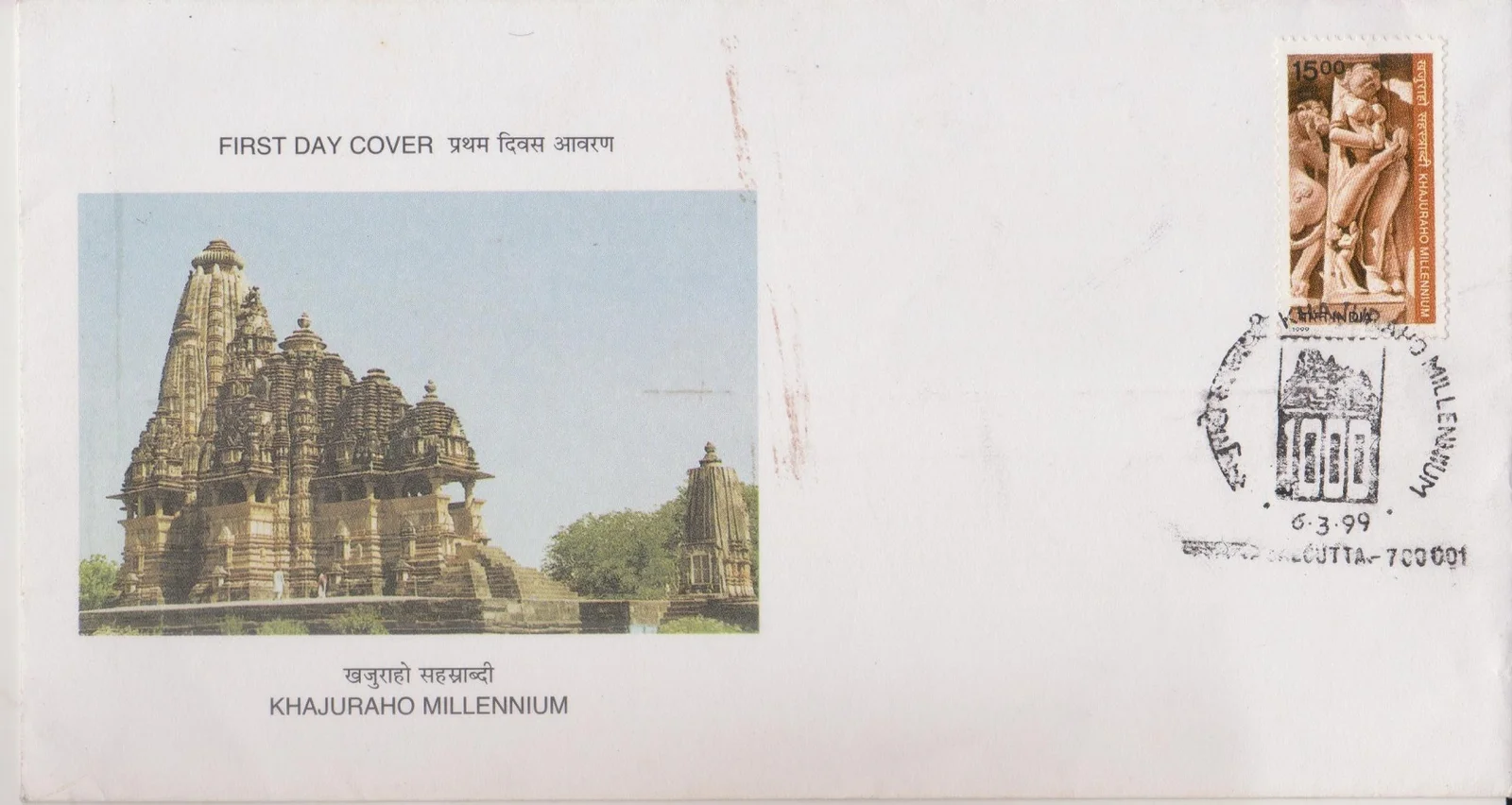
The commemorative stamp issued by the Department of Posts features this famous sculpture.
Vishvanatha Temple on the First Day Cover
The First Day Cover issued with the stamp carries an image of the Vishvanatha Temple, which dates back to 999 AD.
The Vishvanatha Temple is one of the finest monuments in the Western Group of Khajuraho and stands as an important example of Chandella temple architecture.
UNESCO World Heritage Site
The Khajuraho Group of Monuments has been recognized as a UNESCO World Heritage Site because of its exceptional artistic and cultural value.
The temples are admired not only for their architectural beauty but also for the skill and imagination displayed in their sculptures.
Today, Khajuraho remains one of India’s most important historical and tourist destinations.
Khajuraho Millenary Commemorative Stamp
The commemorative postage stamp on the Millenary of Khajuraho honors one thousand years of this extraordinary temple complex.
The stamp serves as a tribute to the genius of the Chandella rulers and the craftsmen who created one of the most remarkable architectural treasures in India.
It also highlights the continuing importance of preserving the Khajuraho temples for future generations.
First Day Cover