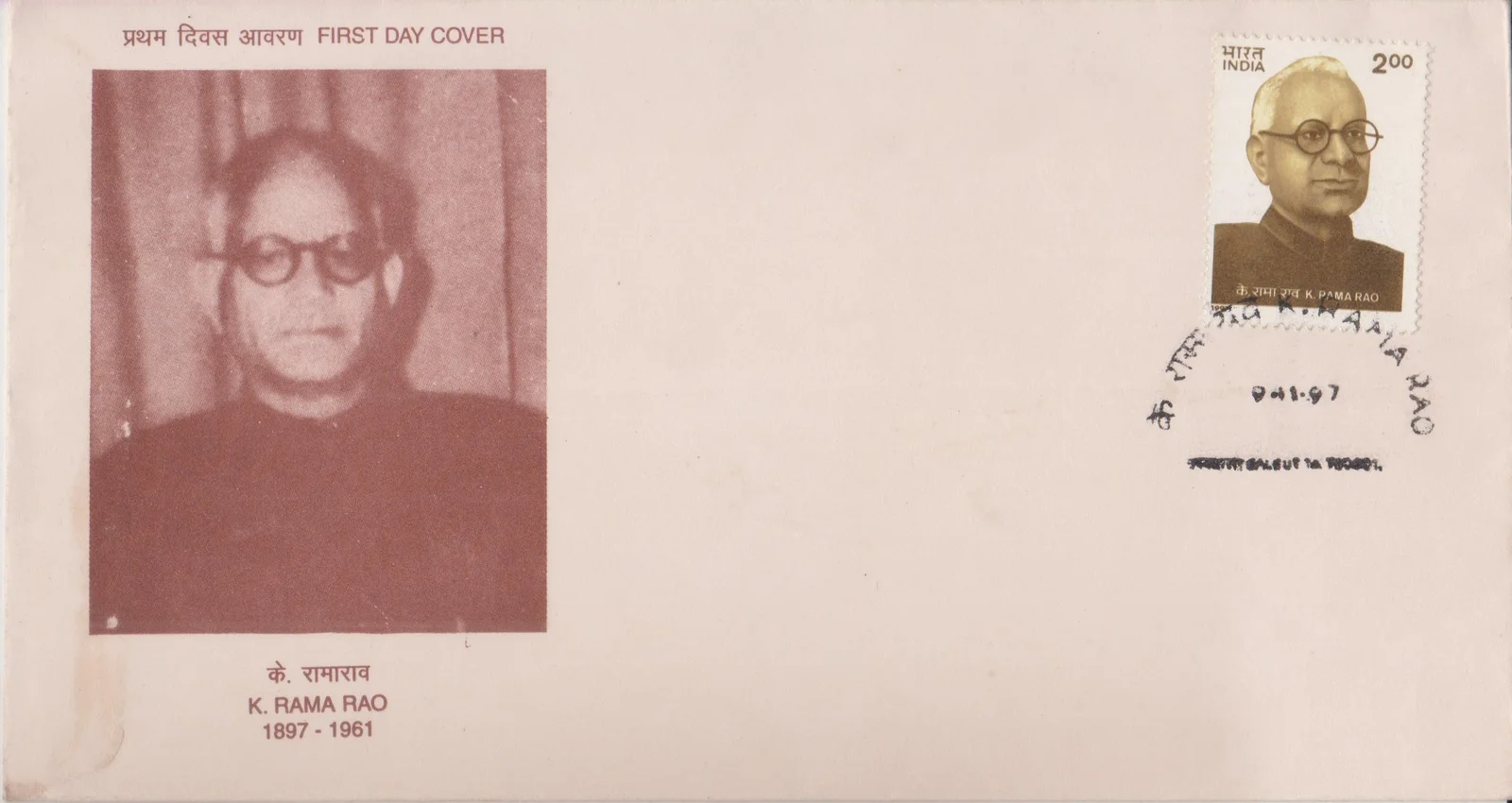
Kotamaraju Rama Rao (1896-1953)

Technical Data
| Stamp Set | Birth Centenary |
|---|---|
| Date of Issue | November 9, 1997 |
| Denomination | Rs. 2 |
| Quantity | 400,000 |
| Perforation | comb 13 x 13½ |
| Printer | Security Printing Press, Nashik |
| Printing Process | Photogravure |
| Watermark | No Watermark |
| Colors | Multicolor |
| Credit (Designed By) | |
| Catalog Codes |
Michel IN 1588 Stamp Number IN 1653 Yvert et Tellier IN 1360 Stanley Gibbons IN 1752 |
| Themes | Anniversaries and Jubilees | Famous people | Journalists | Men | Optical Instruments | Politicians |
Fighting Editor, Freedom Fighter, and Parliamentarian
Kotamaraju Rama Rao was one of India’s most distinguished journalists, courageous editors, and nationalist leaders. Known for his fearless writing and commitment to truth, he played a vital role in India’s freedom struggle and the development of Indian journalism.
Born on 9 November 1897 in Chirala, Kotamaraju Rama Rao is remembered as a patriot of integrity, courage, and public service.
Early Life and Education
Kotamaraju Rama Rao completed his graduation in English from University of Madras.
He began his professional career as a lecturer at Pachaiyappa’s College before entering the world of journalism.
Beginning of a Journalism Career
His journalism journey started in 1919 with the nationalist English daily Sind Observer in Karachi.
He later worked with several leading newspapers across India, including:
- The Times of India in Bombay
- Free Press Journal in Bombay
- The People in Lahore
- Eastern Economist in Calcutta
- Hindustan Times in New Delhi
- Searchlight in Patna
- Indian Republic in Madras
Founder Editor of National Herald
The peak of his journalism career came in June 1938 when Jawaharlal Nehru appointed him as the founder-editor of National Herald in Lucknow.
Under his leadership, the newspaper became a strong voice for Indian nationalism and democratic values.
Imprisonment During Freedom Struggle
In 1942, the British Government jailed Kotamaraju Rama Rao for his editorial titled Jail or Jungle, in which he exposed police repression against Satyagrahis in Lucknow Central Jail.
When the British later shut down the National Herald in the same year, Mahatma Gandhi invited him to Sevagram Ashram. From there, Rama Rao continued writing and syndicated reports to numerous Indian and international journals.
Champion of Journalists’ Rights
Kotamaraju Rama Rao was a founder of the Indian Federation of Working Journalists (IFWJ).
He also gave evidence before the first Press Commission regarding the condition and future of India’s newspaper industry, making lasting contributions to media reform.
Political and Public Service
After independence, he continued serving the nation in public life.
His achievements included:
- Elected to India’s first Rajya Sabha in 1952 from undivided Madras State
- Appointed the first Advisor on Plan Publicity to the Nehru Government in 1956
- Authored several books on politics, journalism, and public affairs
Praise from National Leaders
Many national leaders deeply admired Rama Rao:
- Mahatma Gandhi called him a “Fighting Editor”
- Jawaharlal Nehru praised his editorial leadership
- C. Rajagopalachari recognized him as an outstanding editor
Death and Legacy
Kotamaraju Rama Rao passed away on 9 March 1961.
He remains remembered as one of India’s finest journalist-patriots whose pen became a weapon in the fight for freedom.
Commemorative Postage Stamp
The Department of Posts issued a commemorative postage stamp to mark the birth centenary of Kotamaraju Rama Rao and honor his outstanding contribution to journalism, democracy, and India’s freedom movement.
First Day Cover