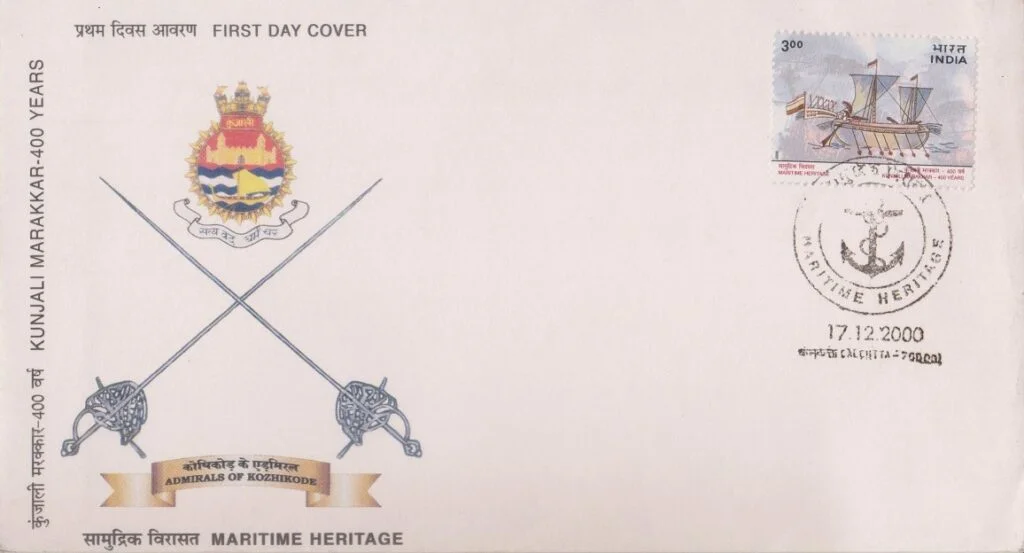
Kunjali Marakkar- 400 years

Technical Data
| Date of Issue | December 17, 2000 |
|---|---|
| Denomination | Rs. 3 |
| Quantity | 700,000 |
| Perforation | comb 13 |
| Printer | Calcutta Security Printers Ltd |
| Printing Process | Offset Lithography |
| Watermark | No Watermark |
| Colors | Multicolor |
| Credit (Designed By) | Sh. Sankha Samanta |
| Catalog Codes |
Michel IN 1805 Stamp Number IN 1864 Yvert et Tellier IN 1571 Stanley Gibbons IN 1973 |
| Themes | Admirals | Anniversaries and Jubilees | Sailing Ships |
Legendary Admirals of India’s Maritime Heritage
The story of Kunjali Marakkar is a remarkable chapter in India’s maritime history, reflecting courage, naval strategy, and resistance against foreign domination. Their legacy is deeply rooted in India’s long-standing tradition of seafaring and naval excellence.
India’s Ancient Maritime Heritage
India’s maritime legacy dates back to the Indus Valley Civilization (circa 3000 BCE). The discovery of the port city Lothal provides strong evidence of advanced dockyards and trade networks.
By the 4th century BCE, as recorded by Megasthenes at the court of Chandragupta Maurya, shipbuilding had become a thriving industry. Over time, Indian ship technology evolved significantly, as seen in the depictions at Ajanta Caves.
Texts like Yuktikalpataru (11th century) further describe various ship types, showcasing India’s advanced maritime knowledge.
Rise of Naval Power in Medieval India
India’s naval strength reached its peak under the Chola rulers. Rajaraja Chola I expanded control over Lakshadweep and the Maldives, while Rajendra Chola I extended influence to Sri Lanka and established naval bases in the Andaman and Nicobar Islands.
These achievements highlight India’s dominance over the Indian Ocean for centuries.
Arrival of European Powers
The balance of power shifted with the arrival of European traders in the 15th century. The landing of Vasco da Gama at Calicut in 1498 marked the beginning of Portuguese interference in Indian maritime trade.
The Zamorin of Calicut, who controlled the spice trade on the Malabar Coast, faced increasing challenges as the Portuguese sought to dominate sea routes.
Rise of Kunjali Marakkars
In response to Portuguese aggression, Kunjali Marakkar emerged as naval commanders under the Zamorin. The first Kunjali Marakkar dedicated his fleet and services to defending Indian waters.
Over time, four generations of Marakkars played a heroic role in resisting Portuguese expansion through strategic naval warfare.
Kunjali Marakkar IV: The Greatest Admiral
Among them, Kunjali Marakkar IV was the most famous. He fought the Portuguese with remarkable skill and achieved several victories. He also formed alliances with regional powers like the Rani of Ullal and the Sultan of Bijapur.
However, his growing power led to tensions with the Zamorin. The Portuguese exploited this rift and formed an alliance with the Zamorin. In 1600, they jointly attacked and defeated Kunjali Marakkar IV.
Captured and handed over to the Portuguese, he was taken to Goa and executed, displaying courage and dignity till the end.
Naval Warfare and Strategy
The Marakkars were known for their innovative naval tactics. They used small, fast boats called “war-paroes,” which could navigate narrow waterways and lagoons.
These boats allowed them to launch surprise attacks on Portuguese ships, set sails on fire, and retreat quickly into shallow waters—demonstrating early forms of guerrilla naval warfare.
Legacy and Commemoration
Kunjali Marakkar symbolize bravery, resistance, and India’s rich maritime heritage. Their efforts played a crucial role in defending Indian trade routes against colonial forces.
In recognition of their contribution, the Department of Posts issued a commemorative postage stamp marking 400 years of Kunjali Marakkar’s legacy, honoring these great naval heroes.
First Day Cover