
Devika Rani
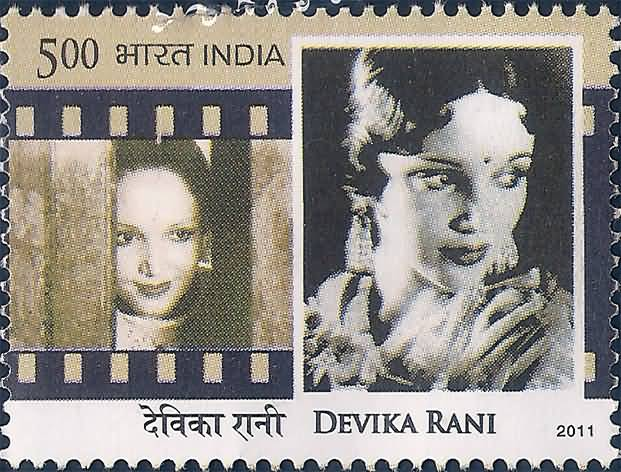
Technical Data
| Date of Issue | February 13, 2011 |
|---|---|
| Denomination | Rs. 5 |
| Quantity | 400,000 |
| Perforation | 13 |
| Printer | India Security Press, Nashik |
| Printing Process | Wet Offset |
| Watermark | No Watermark |
| Colors | Multicolor |
| Credit (Designed By) | Sh. Sankha Samanta |
| Catalog Codes |
Michel IN 2589 Stamp Number IN 2513 Stanley Gibbons IN 2802 WADP Numbering System - WNS IN013.2011 |
| Themes | Actors | Famous people | Women |
The First Lady of Indian Cinema
Early Life and Education
Devika Rani was born on 30 March 1908 at Visakhapatnam, British India (now in Andhra Pradesh). She was the daughter of Colonel Choudhury, the Surgeon-General of Madras, and the grandniece of Rabindranath Tagore, one of India’s greatest literary figures.
Exceptionally accomplished, she pursued higher studies in England at the Royal Academy of Dramatic Art (RADA) and the Royal Academy of Music, London. She also held a degree in architecture and was a successful designer of Paisley textiles, reflecting her wide-ranging artistic talents.
Entry into Cinema and European Exposure
Devika Rani married filmmaker Himansu Rai in 1929, marking the beginning of a historic partnership in Indian cinema. Her first association with filmmaking was as a costume designer (and possibly an extra) for ‘Prapancha Pash’ (1929), produced by Rai and directed by Franz Osten.
While in Germany for the film’s editing, Devika Rani gained invaluable exposure to European cinema. She observed masters such as Fritz Lang, G.W. Pabst, and Josef von Sternberg at work, and even assisted Marlene Dietrich on the sets of ‘Der blaue Engel’ (1930). She also worked briefly with renowned theatre director Max Reinhardt. One of the earliest BBC broadcasts to India, aired on 15 May 1933, featured a recital by Devika Rani.
Bombay Talkies and Rise to Stardom
With European co-productions becoming difficult after 1933, Devika Rani and Himansu Rai returned to India. She starred in ‘Karma’, Rai’s first sound film, made in English and promoted as “the first Indian talkie with English dialogue.”
In 1934, the couple founded Bombay Talkies, one of India’s most influential film studios. Devika Rani emerged as its leading star and dominated the first decade of Indian sound cinema. Her performance in ‘Achhut Kanya’ was particularly iconic—her arched eyebrows, bead jewellery and knee-length, vaguely Rajasthani-style dress came to define the Hindi cinema image of the “village belle.” Through her roles, she set the standard for the post-1950 Hindi film heroine.
Leadership and Later Life
Devika Rani, along with Ashok Kumar, remained the face of Bombay Talkies until the death of Himansu Rai in 1940. Thereafter, she took over the management of the studio, a rare achievement for a woman of her time. She successfully ran Bombay Talkies until her retirement in 1945.
Later in life, she married the Russian émigré painter Svetoslav Roerich and withdrew from public life.
Death and Legacy
Devika Rani passed away on 9 March 1994 in Bangalore, Karnataka, India. Revered as the First Lady of Indian Cinema, she played a pioneering role not only as an actress but also as a studio manager and cultural bridge between Indian and European cinematic traditions. Her influence shaped the evolution of Hindi cinema for generations.
Philatelic Tribute
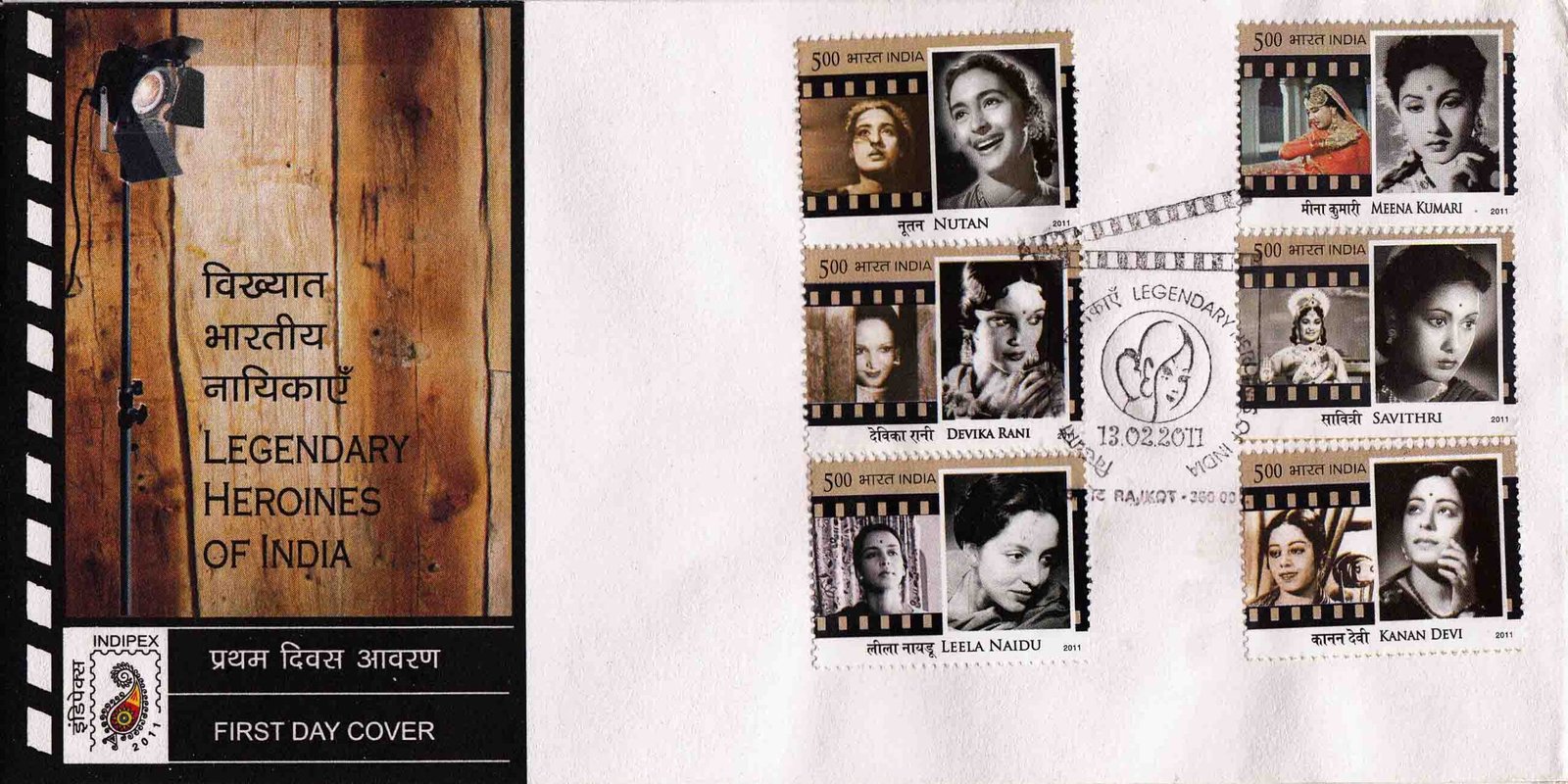
As part of the “Legendary Heroines of India” series, India Post is happy to issue a commemorative postage stamp on Devika Rani, honouring her as a trailblazer of Indian cinema, the grandniece of Rabindranath Tagore, and the spouse of celebrated artist Svetoslav Roerich.
First Day Cover
Leave a Comment
You must be logged in to post a comment.