
Legendary singers of India

Technical Data
| Date of Issue | December 30, 2016 |
|---|---|
| Denomination | Rs. 50 |
| Quantity | 150,000 |
| Perforation | 13¾ x 13¼ |
| Printer | Security Printing Press, Hyderabad |
| Printing Process | Wet Offset |
| Watermark | No Watermark |
| Colors | Multicolor |
| Credit (Designed By) | Sh. Sankha Samanta Smt. Alka Sharma |
| Catalog Codes |
Michel IN BL152 Yvert et Tellier IN BF139 Stanley Gibbons IN MS3230 |
| Themes | Famous people | Men | Optical Instruments | Singers | Women |
Stamps in this Miniature Sheet
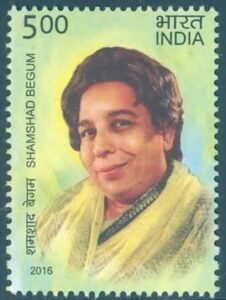
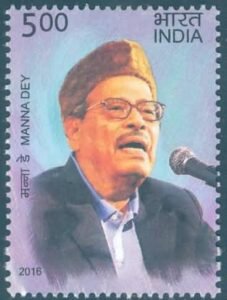
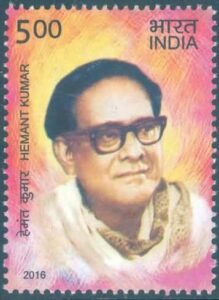
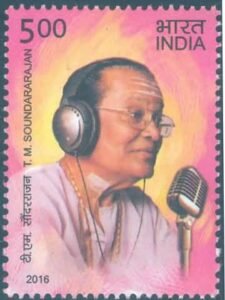
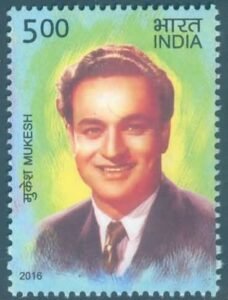
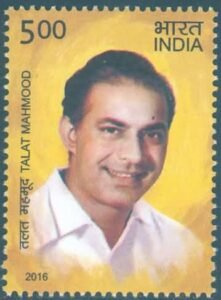
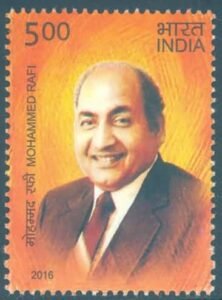
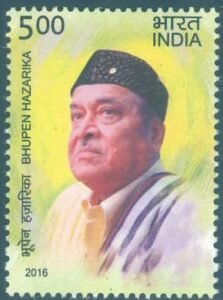
Legendary Voices of Indian Cinema
India’s film and music industries have been shaped by a galaxy of legendary playback singers whose melodious voices have transcended generations. From the early pioneers of the 1930s to the maestros of later decades, these artists brought depth, soul, and emotion to Indian cinema, turning songs into timeless treasures.
Shamshad Begum (14 April 1919 – 23 April 2013)
One of the first female playback singers of the Hindi film industry, Shamshad Begum possessed a unique and powerful voice that stood out in the early years of Indian cinema. Beginning her career with All India Radio in 1937 at Peshawar and Lahore, she quickly became a household name. Between the 1940s and 1960s, she recorded over 6,000 songs in multiple Indian languages, including Hindi, Punjabi, Marathi, Bengali, Gujarati, and Tamil. Her remarkable vocal range and distinct tone laid the foundation for the playback era in India, and her songs continue to enchant listeners even today.
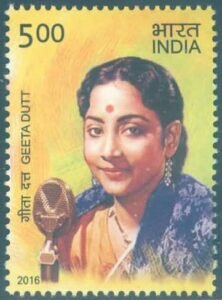
Geeta Dutt (23 November 1930 – 20 July 1972)
Gifted with a rich, emotive voice, Geeta Dutt was one of the most versatile playback singers in Hindi cinema. She debuted in 1946 with Bhakta Prahlad, but her breakthrough came with Do Bhai (1947) where “Mera Sundar Sapna Beet Gaya” touched millions of hearts. Equally at ease with classical and light melodies, Geeta Dutt’s songs were filled with warmth and expressiveness. She also made a lasting contribution to Bengali music, leaving behind a repertoire that continues to captivate music lovers.
Talat Mahmood (24 February 1924 – 9 May 1998)
Renowned for his velvety voice and emotional depth, Talat Mahmood was a master of ghazals and soft romantic songs. He brought a refined, poetic quality to Indian music and became one of the most respected male playback singers of his time. His ghazals, infused with subtle emotion, remain timeless classics. In recognition of his contributions to Indian music, he was awarded the Padma Bhushan in 1992.
Mohammed Rafi (24 December 1924 – 31 July 1980)
A legend of versatility, Mohammed Rafi’s voice embodied every human emotion — from devotion and patriotism to romance and sorrow. Between the 1950s and 1970s, he reigned supreme in Hindi cinema, lending his voice to a vast range of genres including ghazals, bhajans, qawwalis, and romantic songs. His smooth delivery, control, and adaptability made him a favourite of music directors and audiences alike. Rafi was honoured with the Padma Shri in 1967 for his immense contribution to Indian music.
Mukesh (22 July 1923 – 27 August 1976)
Mukesh, often called the “voice of Raj Kapoor,” became synonymous with soulful and heartfelt melodies. His emotionally resonant voice lent sincerity and pathos to Hindi film music. From Aah (1954) to Kabhi Kabhie (1976), his songs defined the golden era of melody. He won several Filmfare Awards for Best Playback Singer and was also honoured with the National Film Award for Best Male Playback Singer. His music continues to stir hearts with its simplicity and emotion.
Manna Dey (1 May 1919 – 24 October 2013)
A towering figure in Indian music, Manna Dey combined classical excellence with popular appeal. Starting with Tamanna (1943), he went on to sing in over 3,500 films across multiple Indian languages. Known for his mastery over ragas and his versatility in qawwalis and romantic duets, Manna Dey’s experimentation with fusion and Western influences earned him wide acclaim. He received the Padma Shri (1971), Padma Bhushan (2005), and the Dadasaheb Phalke Award (2007) for his exceptional contributions.
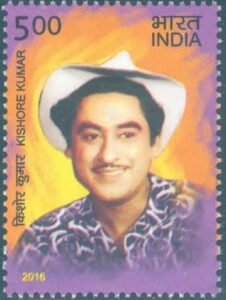
Kishore Kumar (4 August 1929 – 13 October 1987)
Kishore Kumar was a multi-talented genius — singer, actor, composer, lyricist, and filmmaker. His voice, infused with playfulness and emotion, brought energy and charm to every song. Known for his yodeling style, he created a distinct place in Indian music. From romantic hits to light-hearted numbers, Kishore’s songs remain perennial favourites. His work in films such as Pyar Ka Mausam (1969) and New Delhi (1957) showcased his innovative singing style and boundless creativity.
Hemant Kumar (16 June 1920 – 26 September 1989)
Hemant Kumar was an accomplished singer, composer, and music director whose deep and soothing voice brought grace to Indian film music. Active in both Hindi and Bengali cinema, he was one of the foremost exponents of Rabindra Sangeet. His memorable Hindi film compositions include Bees Saal Baad (1962), Sahib Bibi Aur Ghulam (1962), and Anupama (1966). Over his long career, he recorded around 2,000 songs, many of which remain classics in both Hindi and Bengali music.
T.M. Soundararajan (24 March 1922 – 25 May 2013)
Popularly known as TMS, T.M. Soundararajan was the voice of Tamil cinema for more than six decades. He sang over 20,000 film songs and 3,000 devotional compositions across several Indian languages. His powerful, expressive singing style perfectly complemented the performances of legendary actors M.G. Ramachandran and Sivaji Ganesan. A versatile artist, TMS also composed music and acted in films, leaving behind an unmatched musical legacy in South Indian cinema.
Dr. Bhupen Hazarika (8 September 1926 – 5 November 2011)
A multifaceted cultural icon from Assam, Dr. Bhupen Hazarika was a poet, singer, composer, and filmmaker whose works carried deep social and emotional resonance. Known for his baritone voice and profound lyrics, his compositions addressed themes of humanity, love, and social justice. He made major contributions to Assamese, Bengali, and Hindi cinema, with memorable scores in Ek Pal (1986) and Rudaali (1993). Honoured with the Padma Shri (1977), his music continues to inspire unity and compassion across generations.
A Tribute to Timeless Melody
These musical legends defined the golden era of Indian playback singing and set artistic standards that continue to inspire today’s musicians. Their timeless songs not only enriched Indian cinema but also became integral to the nation’s emotional and cultural identity. Their voices, immortalized in melody, continue to echo in the hearts of millions.
Leave a Comment
You must be logged in to post a comment.