
Liver Transplantation in India
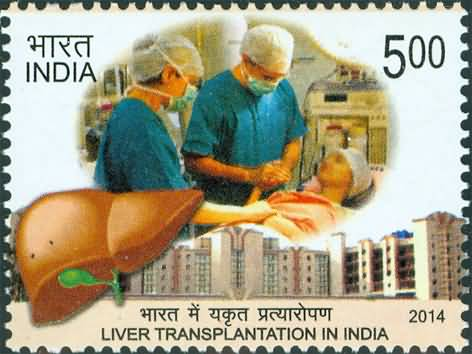
Technical Data
| Date of Issue | November 4, 2014 |
|---|---|
| Denomination | Rs. 5 |
| Quantity | 600,000 |
| Perforation | 13½ |
| Printer | Security Printing Press, Hyderabad |
| Printing Process | Wet Offset |
| Watermark | No Watermark |
| Colors | Multicolor |
| Credit (Designed By) | Ms. Nenu Gupta |
| Catalog Codes |
Michel IN 2849 Yvert et Tellier IN 2593 Stanley Gibbons IN 3022 |
| Themes | Healthcare | Hospitals |
The Only Definitive Treatment for Liver Failure
Liver failure is a life-threatening condition, and the only proven and definitive treatment is liver transplantation. During this procedure, the diseased or damaged liver is surgically removed and replaced with a healthy one, restoring essential functions vital for survival.
Global Beginnings of Liver Transplantation
The first successful liver transplantation was performed on a child in 1967, marking a historic medical breakthrough. Over the following decades, advancements in surgical techniques, expertise and post-operative care transformed what was once an experimental procedure into a widely accepted and lifesaving treatment.
In 1983, the National Institutes of Health (NIH) officially recognized liver transplantation as a validated and effective therapy for end-stage liver disease (ESLD), further accelerating global progress.
Liver Transplantation in India
India achieved a major medical milestone when the first successful liver transplant in the country was conducted at Indraprastha Apollo Hospital, New Delhi, on 15 November 1998. This landmark procedure opened the door for state-of-the-art transplant programs in India, enabling thousands of patients to access lifesaving care.
Types of Liver Transplants
Two primary forms of liver transplantation are practiced:
1. Living Donor Liver Transplantation (LDLT)
A portion of a healthy individual’s liver is transplanted into the recipient.
Because the liver has an extraordinary ability to regenerate, both donor and recipient liver segments grow back to normal size within weeks.
2. Cadaveric (Deceased Donor) Transplantation
The donor is a brain-dead individual whose family consents to organ donation.
This form of transplantation plays a vital role in addressing the growing demand for donor livers.
Advancements in Procedure and Post-Operative Care
The success of liver transplantation has dramatically improved due to:
- Advanced immuno-suppressive medications that prevent organ rejection
- Refined surgical techniques ensuring enhanced safety
- Specialized post-transplant care protocols
Today, liver transplantation is an accepted and effective treatment for several liver ailments affecting both adults and children.
India’s Leadership in Liver Transplants
In just 15 years, India has performed approximately 4,500 liver transplants, marking a remarkable ascent in the field. The country has emerged as a global leader in liver transplantation by offering high-quality, affordable, and advanced transplant services.
Philatelic Tribute
In recognition of this medical achievement and India’s growing expertise in organ transplantation, a commemorative postage stamp on Liver Transplantation was issued.
It honours the nation’s progress, medical excellence, and the countless lives saved through this transformative procedure.
Leave a Comment
You must be logged in to post a comment.