
Bal Gangadhar Tilak 1856-1920
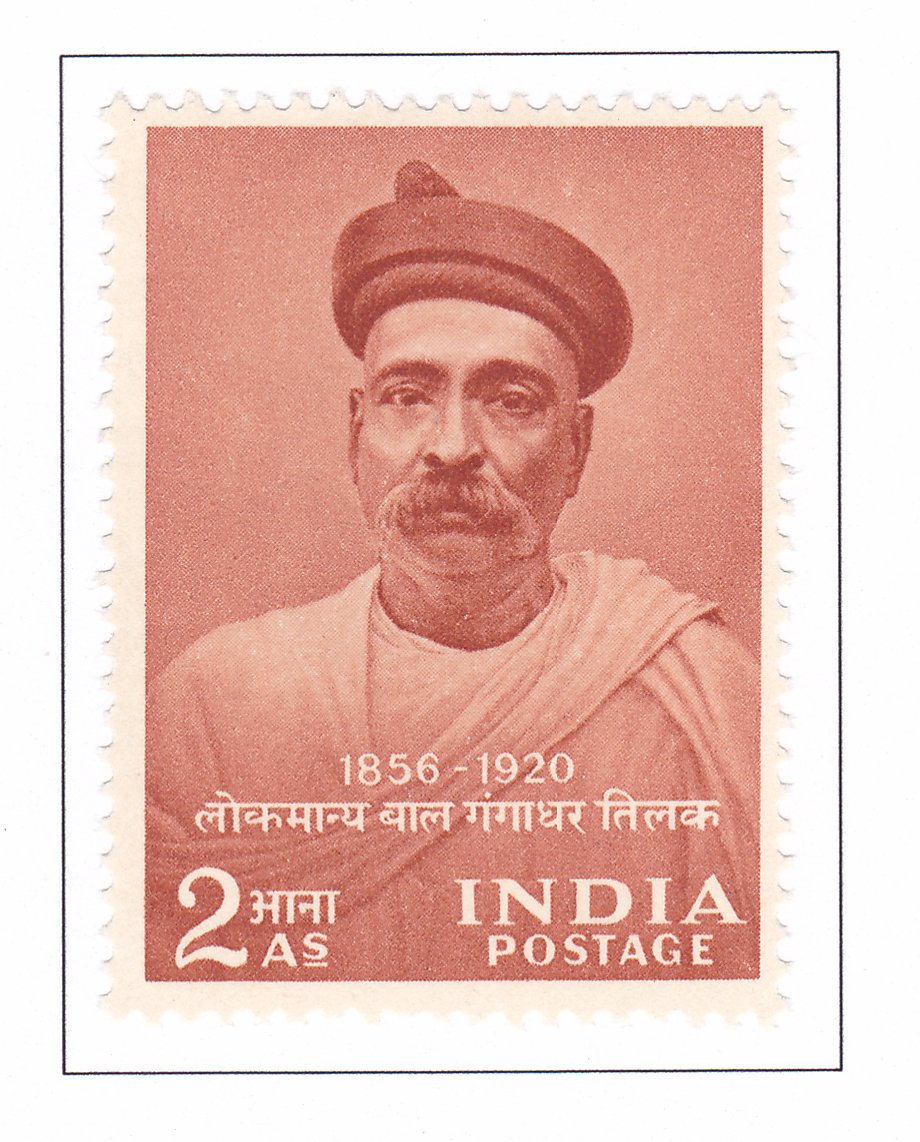
Technical Data
| Stamp Set | Birth Centenary |
|---|---|
| Date of Issue | July 23, 1956 |
| Denomination | 2 ANNAS |
| Quantity | 22,800,000 |
| Perforation | comb 13 x 13½ |
| Printer | Security Printing Press, Nashik |
| Watermark | Star of India Multiple [Up] |
| Colors | Chestnut |
| Catalog Codes |
Michel IN 258 Stamp Number IN 274 Yvert et Tellier IN 70 Stanley Gibbons IN 374 |
| Themes | Famous people | Freedom Fighters | Journalists | Men | Politicians |
Introduction
The commemorative postage stamp on Bal Gangadhar Tilak was issued to honour one of the greatest leaders of India’s freedom struggle. Known as “Lokmanya,” meaning “accepted by the people,” Tilak was among the earliest and strongest voices demanding independence from British rule.
Born in 1856, one year before the Indian Rebellion of 1857, Tilak became one of the most influential pioneers of the national movement. For more than twenty-five years, he inspired millions of Indians and became both the idol of the masses and the greatest fear of the colonial government.
Early Life and Journalism
After completing his studies in 1879, Tilak refused the security of a government job and chose instead to dedicate his life to public service. He founded two important newspapers, Kesari and The Mahratta.
Through these newspapers, Tilak awakened political consciousness among the people. His powerful writing in Marathi and English gave strength and direction to the freedom movement. His articles were fearless, direct, and full of patriotic spirit.
Leader of National Resistance
Tilak soon emerged as the central figure of resistance against British rule. His courage and determination made him immensely popular, but they also brought him into conflict with the colonial authorities.
In 1897, he was tried for sedition and sentenced to eighteen months in prison.
Later, in 1908, Tilak was again arrested and sentenced to six years of transportation in Mandalay. Even in prison, he continued his intellectual work and wrote his famous book, Gita Rahasya.
Scholar and Thinker
Tilak was not only a political leader but also a great scholar. His studies of the Vedas earned him international respect. Among his important works were The Orion and The Arctic Home in the Vedas.
Prominent scholars such as Max Müller and Albrecht Weber campaigned for his release from prison, showing the admiration he commanded around the world.
Home Rule Movement
After his release from prison, Tilak returned to public life with even greater determination. He joined hands with Annie Besant to launch the Home Rule Movement.
It was during this period that Tilak gave India one of its most memorable slogans:
“Swaraj is my birth-right and I shall have it.”
This slogan became the battle cry of the Indian freedom movement and inspired countless patriots.
Gandhi’s Tribute
After Tilak’s death in 1920, Mahatma Gandhi paid him a moving tribute. Gandhi described him as “a giant among men” and said that no one had preached the message of Swaraj with greater courage and consistency.
Importance of the Stamp
The stamp issued on the birth centenary of Lokmanya Tilak pays tribute to a man who helped shape modern India. A member of the famous triumvirate of Lala Lajpat Rai, Bal Gangadhar Tilak and Bipin Chandra Pal, popularly known as Lal-Bal-Pal, Tilak remains one of the greatest symbols of patriotism and sacrifice.
Conclusion
Lokmanya Bal Gangadhar Tilak was more than a leader—he was the voice of India’s struggle for freedom. His fearless journalism, inspiring slogan, and tireless service made him a maker of modern India. The commemorative stamp ensures that his legacy continues to inspire future generations.