
M. Bhakthavatsalam

Technical Data
| Date of Issue | December 31, 2008 |
|---|---|
| Denomination | Rs. 5 |
| Quantity | 400,000 |
| Perforation | 13 |
| Printer | India Security Press, Nasik |
| Printing Process | Photogravure |
| Watermark | No Watermark |
| Colors | Multicolor |
| Credit (Designed By) | |
| Catalog Codes |
Michel IN 2335 Stamp Number IN 2303 Stanley Gibbons IN 2558 WADP Numbering System - WNS IN079.2008 |
| Themes | Famous people | Men | Optical Instruments | Politicians |
Freedom Fighter and Visionary Chief Minister of Tamil Nadu
M. Bhakthavatsalam was born on October 9, 1897, at Nazarathpet in Chingleput District of Tamil Nadu. He received his early education at Christian Mission School and P.S. High School, Chennai, before graduating in Economics from Presidency College, Madras, in 1916. He later studied law at Madras Law College, apprenticed under Alladi Krishnaswamy Iyer, and enrolled as an advocate. However, in 1927, he gave up a promising legal career to dedicate himself fully to the national movement.
Role in the Freedom Struggle
During his college days, Bhakthavatsalam actively participated in the Home Rule Movement led by Annie Besant. It was during this time that he came into close contact with C. Rajagopalachari (Rajaji). Deeply influenced by Mahatma Gandhi, he joined the agitation against the Rowlatt Bill and formally entered the freedom struggle in 1921.
He played a significant role in the Civil Disobedience Movement and was imprisoned in 1932. To strengthen Congress propaganda, he started the Tamil daily newspaper India and served as its Managing Director until 1933. He was again imprisoned for nine months during the Individual Satyagraha Movement (1940–41) and spent two years in jail for his active participation in the Quit India Movement of 1942.
Political Career and Administrative Contributions
Bhakthavatsalam’s public service extended beyond the freedom struggle. He served as Deputy Mayor of the Madras Corporation in 1937 and began his ministerial career as Parliamentary Secretary in Rajaji’s Ministry the same year. He joined the Cabinet in 1946 and remained a key figure in successive ministries.
Except for a brief period in 1952–53, he served continuously in the Cabinet for 21 years—as a Minister until 1963 and as Chief Minister of Tamil Nadu from 1963 to 1967. As Chief Minister, he contributed significantly to the development of industry, education, agriculture, and infrastructure in the State.
Among the enduring monuments to his vision are the establishment of Madurai University (now Madurai Kamaraj University) and the execution of the Kundah and Periyar hydro-electric projects. Under his leadership, Madras became the first state to establish a separate Highways Department.
As Minister for Religious Endowments, he played a pivotal role in improving temple administration and undertaking large-scale renovation works, many supported by UNESCO assistance. His initiatives encouraged temple architecture, music, sculpture, and both general and technical education under temple patronage. As Education Minister, he strengthened institutions like the Coimbatore Agricultural College, shaping it into a premier centre for agricultural studies.
Legacy
M. Bhakthavatsalam passed away on February 13, 1987. Remembered as a dedicated freedom fighter, efficient administrator, and farsighted leader, his contributions greatly influenced the socio-economic development of Tamil Nadu.
Commemorative Postage Stamp in His Honour
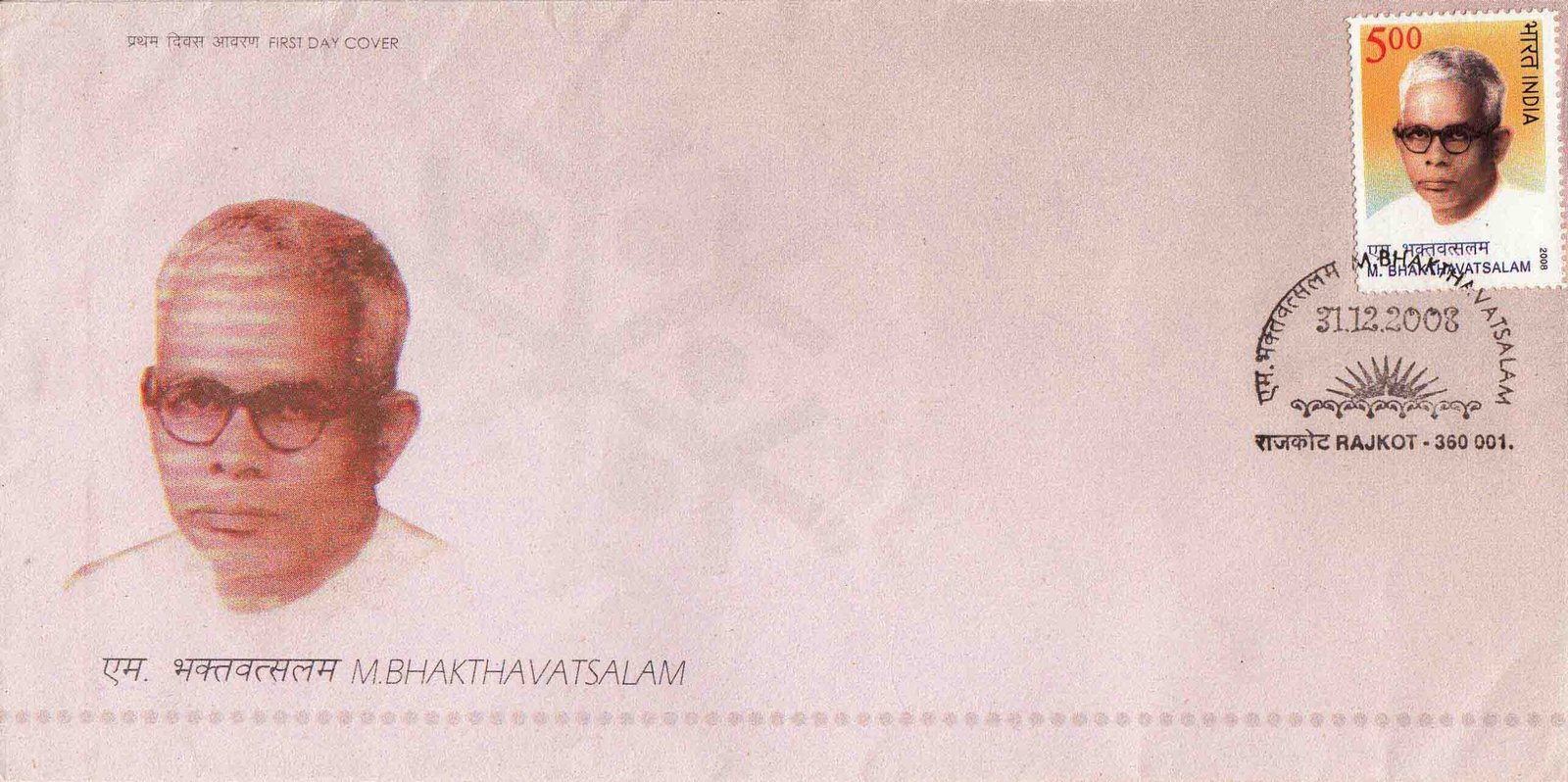
To honour his distinguished service to the nation and the state, India Post released a commemorative postage stamp in his memory. The stamp stands as a tribute to his lifelong commitment to public service, national freedom, and progressive governance.
Through this philatelic recognition, his legacy continues to inspire future generations.
First Day Cover
Leave a Comment
You must be logged in to post a comment.