
M. Singaravelar
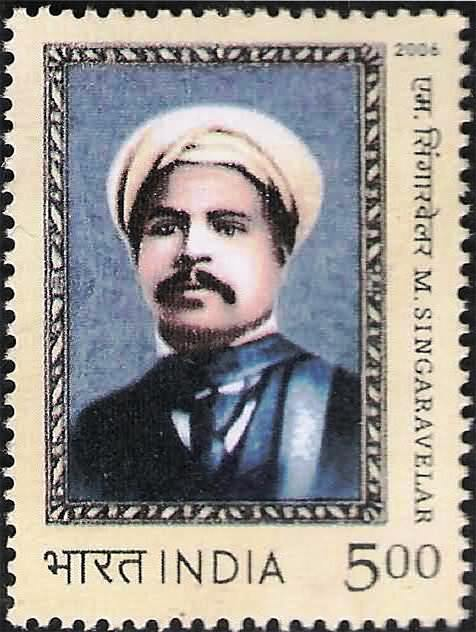
Technical Data
| Date of Issue | March 2, 2006 |
|---|---|
| Denomination | Rs. 5 |
| Quantity | 400,000 |
| Perforation | comb13¼ x 13½ |
| Printer | India Security Press, Nasik |
| Printing Process | Photogravure |
| Watermark | No Watermark |
| Colors | Multicolor |
| Credit (Designed By) | Sh. Sankha Samanta |
| Catalog Codes |
Michel IN 2135 Stamp Number IN 2147 Yvert et Tellier IN 1900 Stanley Gibbons IN 2320 WADP Numbering System - WNS IN015.2006 |
| Themes | Anniversaries and Jubilees | Famous people | Headgear | Labour Organisations | Men | Politicians | Reformers |
M. Singaravelar (Malayapuram Singaravelu) was a freedom fighter, lawyer, labour union leader, and social reformer who played an important role in the development of the labour movement and communist ideology in India. He was also the first member of the Corporation of Madras, marking his contribution to public service and governance.
Early Life and Education
Singaravelar was born on 18 February 1860 into a wealthy family. His parents were Venkatachalam Chetty and Valliammai. He received his schooling at the Hindu High School in Triplicane and later graduated from Presidency College. After obtaining a law degree, he began practicing at the Madras High Court.
During this period he came into contact with several prominent nationalist leaders and thinkers, including the poet Subramania Bharati, V. Sakkarai Chettiar, and V. O. Chidambaram Pillai.
Entry into the Labour and Freedom Movement
Inspired by the Russian Revolution of 1905 and the working-class struggles in Bombay in 1908, Singaravelar became deeply involved in the nationalist and labour movements. He worked tirelessly to improve the conditions and unity of the Indian working class.
He was instrumental in spreading the communist movement in India. Though initially associated with the Indian National Congress, after 1921 he devoted himself to building a strong labour movement.
Together with Vi. Kalyanasundaranar, he played a key role in forming the Madras Labour Union, one of the earliest organized labour unions in India.
Labour Movement and May Day
Singaravelar actively led workers’ strikes and labour agitations to secure better rights for workers. He is remembered for introducing the celebration of International Workers’ Day in India in 1923. On this historic day, he also announced the formation of the Labour Kisan Party of Hindustan.
Role in Social Welfare and Reform
As a public leader, Singaravelar worked for public welfare and social equality. He launched several initiatives to provide medical assistance to the poor and is also regarded as a pioneer who helped pave the way for the mid-day meal scheme in schools.
Responding to Mahatma Gandhi’s call during the Non-Cooperation Movement, he gave up his legal practice and joined the freedom struggle wholeheartedly. He also participated in protests against the Simon Commission and organized demonstrations in Chennai against the Rowlatt Act.
His association with E. V. Ramasamy greatly influenced the Self-Respect Movement, through which he opposed superstition, caste discrimination, and social inequality, and supported women’s liberation.
Literary Contributions
Singaravelar was also a prolific writer. He authored several books and published important labour-oriented journals, including:
- Labour Kisan Gazette (fortnightly)
- Thozhilalan (Tamil weekly)
He was a scholar who knew several languages, including English, Tamil, Russian, French, and German. His personal library contained around 10,000 books, which he later donated to the Communist Party of India.
Death and Commemoration
M. Singaravelar passed away on 11 February 1946. To honour his contributions to the freedom struggle, labour rights, and social reform, India Post issued a commemorative postage stamp in his memory.
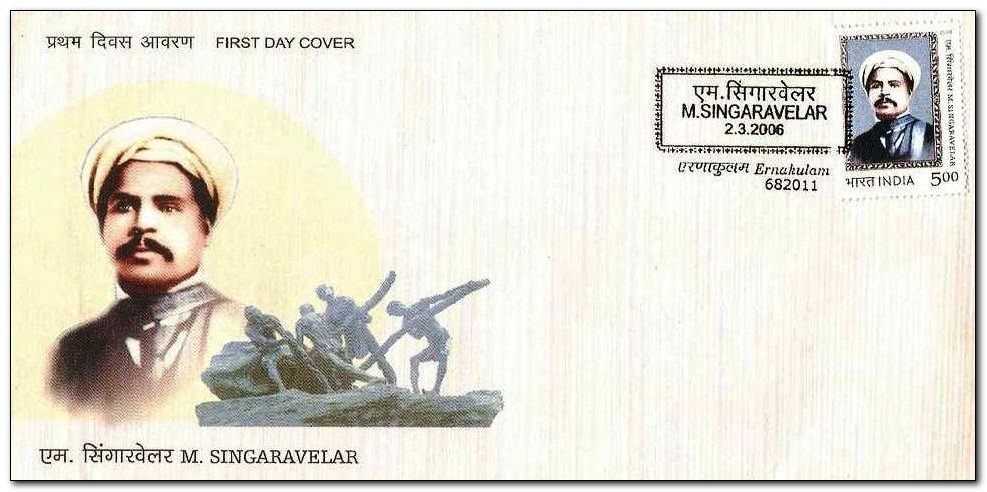
First Day Cover
Leave a Comment
You must be logged in to post a comment.