
Maha Kavi Magh

Technical Data
| Date of Issue | February 9, 2009 |
|---|---|
| Denomination | Rs. 5 |
| Quantity | 400,000 |
| Perforation | 13 |
| Printer | India Security Press, Nasik |
| Printing Process | Photo Gravure |
| Watermark | No Watermark |
| Colors | Multicolor |
| Credit (Designed By) | Ms. Nenu Gupta |
| Catalog Codes |
Michel IN 2350 Stamp Number IN 2313 Yvert et Tellier IN 2115 Stanley Gibbons IN 2575 WADP Numbering System - WNS IN011.2009 |
| Themes | Commemoration | Famous people | Feathers | Literary People (Poets and Writers) | Men | Stationery |
Master of Sanskrit Poetry and Author of Shishupal Vadha
Magha, popularly known as Maha Kavi Magh, was born around 675 A.D. in Bhinmal, Rajasthan. He was the son of Dattaka and the grandson of Suprabhadeva, who served as a minister to King Varmalata of Gujarat. Celebrated as one of the greatest Sanskrit poets, Magh’s literary brilliance earned him a place alongside legendary poets like Kalidasa and Bharavi.
Shishupal Vadha: A Timeless Sanskrit Epic
Magh authored only one epic, Shishupalavadha, yet this single work established his immortality in Sanskrit literature. The epic consists of 20 cantos and approximately 1,650 stanzas. It is based on an episode from the Mahabharata, specifically the incident during King Yudhishthira’s Rajasuya Yagya.
In this episode, Shishupala publicly insults Lord Krishna, leading to a dramatic confrontation. Although the incident occupies only a small part of the Mahabharata, Magh transformed it into a grand poetic masterpiece. His extraordinary command over vocabulary, grammar, literary devices, and ornate style turned a brief narrative into a richly layered epic exploring politics, philosophy, nature, human emotions, and aesthetics.
A Living Dictionary of Sanskrit
Magh’s vocabulary was vast and remarkably diverse. Scholars often remark that there is hardly a Sanskrit word not found in Shishupal Vadha. The famous saying:
“Nav Sarga Gate Maghe Nav Shabda Na Vidyate”
suggests that by the ninth canto, nearly every Sanskrit word had already appeared in the text. This extraordinary lexical richness makes Shishupal Vadha a living dictionary of the Sanskrit language.
Literary Excellence and Unique Style
Magh combined:
- Kalidasa’s mastery of similes
- Bharavi’s powerful word imagery
- Dandin’s elegant prose style
He skillfully used 41 different metres in his epic—far exceeding Bharavi’s 24—demonstrating exceptional metrical mastery.
Magh also experimented with rare grammatical constructions, showcasing his expertise as both poet and grammarian. Some of his verses are structured so ingeniously that they can be read both forwards and backwards. One famous example is a stanza largely composed using only the syllables “Ra” and “Jha,” reflecting his unparalleled command over phonetics and poetic craft.
Encyclopaedic Knowledge
The Shishupal Vadha reflects Magh’s vast scholarship. He was well-versed in:
- Vedas and Vedanta
- Astrology and Astronomy
- Political science and statecraft
- Philosophy and religion
- Dramaturgy
- Sciences related to elephants and horses
- Fine arts such as painting and sculpture
His vivid descriptions of nature, mountains, rivers, seasons, and human beauty are celebrated for their freshness and depth. According to Magh, true beauty lies in constant renewal:
“Kshane Kshane Yat Navatam Upaiti, Tadeva Rupam Ramaniyatayah”
(That which appears ever-new at every moment is true beauty.)
A Generous and Noble Soul
Despite receiving immense wealth from his patron King Bhoja and inheriting substantial family fortune, Magh died in poverty. His generosity knew no bounds—he freely distributed his wealth among the poor and the needy. His life reflected egalitarian values and compassion, making him not only a literary genius but also a noble human being.
Legacy of Maha Kavi Magh
Maha Kavi Magh remains one of the towering figures of classical Sanskrit literature. His Shishupal Vadha continues to be studied for its linguistic richness, poetic brilliance, and intellectual depth.
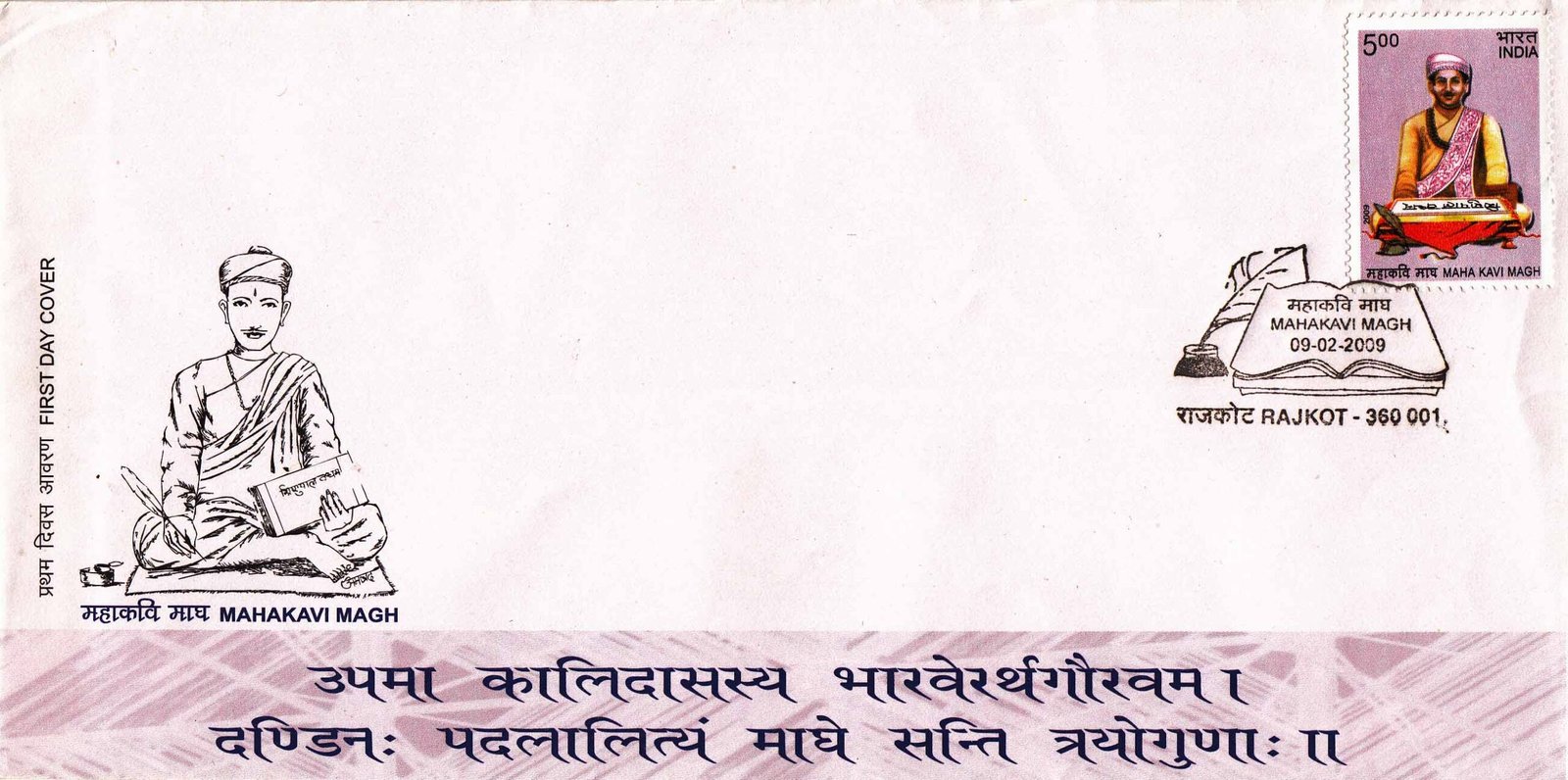
In recognition of his immense contribution to Indian literature, India Post issued a commemorative postage stamp in his honour.
First Day Cover
Leave a Comment
You must be logged in to post a comment.