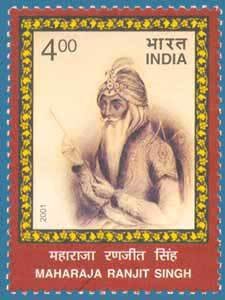
Maharaja Ranjit Singh
Technical Data
| Date of Issue | November 9, 2001 |
|---|---|
| Denomination | Rs. 4 |
| Quantity | 400,000 |
| Perforation | comb 13 |
| Printer | Eagle Press Ltd. |
| Printing Process | Offset Lithography |
| Watermark | No Watermark |
| Colors | Multicolor |
| Credit (Designed By) | |
| Catalog Codes |
Michel IN 1873 Stamp Number IN 1941 Yvert et Tellier IN 1638 Stanley Gibbons IN 2038 |
| Themes | Anniversaries and Jubilees | Famous people | Kings | Men |
The Architect of a Secular and United Punjab
Maharaja Ranjit Singh (1780–1839) is widely regarded as one of the greatest rulers in Indian history and a pioneer of secular governance. Known as the founder of the Sikh Empire, he played a crucial role in uniting Punjab and laying the foundation for a strong, inclusive state.
Early Life and Rise to Power
Born in 1780, Maharaja Ranjit Singh was the son of Mahan Singh, a chieftain. After his father’s death, when he was just eleven years old, Ranjit Singh was thrust into leadership at a very young age.
At that time, Punjab was fragmented by internal conflicts, rivalries, and external threats. Despite these challenges, he displayed remarkable courage and leadership, taking up arms early in life to defend and unify the region.
Unification of Punjab and Formation of the Sikh Empire
Through determination, strategic insight, and military skill, Maharaja Ranjit Singh succeeded in uniting a divided Punjab. He inspired people to rise above differences and work towards a common goal, eventually establishing a powerful kingdom in northern India.
Though he had little formal education, his practical knowledge of warfare and governance enabled him to build one of the strongest empires of his time.
Military Strength and Leadership
Maharaja Ranjit Singh created a formidable army that successfully defended India against foreign invasions. For the first time in centuries, traditional invaders were effectively repelled.
Despite his military achievements, he was known for his humane approach. He avoided unnecessary violence and ruled without cruelty or oppression—an uncommon trait among rulers of that era.
Secular Governance and Just Rule
A defining feature of Maharaja Ranjit Singh’s rule was his commitment to secularism. He treated all his subjects equally, regardless of religion, caste, or creed. Justice in his kingdom was fair and impartial, reflecting his inclusive vision of governance.
He valued merit and loyalty above all, surrounding himself with capable and dedicated administrators. Rejecting the idea of divine kingship, he never claimed supernatural powers or adopted grandiose titles. Instead, he remained grounded and focused on effective leadership.
Legacy and Historical Significance
Maharaja Ranjit Singh passed away in Lahore in June 1839, leaving behind a powerful legacy. He is remembered as a brilliant soldier, visionary statesman, and a unifier who laid the groundwork for a modern nation beyond communal divisions.
His reign marked a turning point in Indian history, symbolizing strength, unity, and secular ideals.
Commemoration and Recognition
In honor of his extraordinary contributions, the Department of Posts issued a commemorative postage stamp, paying tribute to one of India’s greatest heroes whose impact continues to inspire generations.
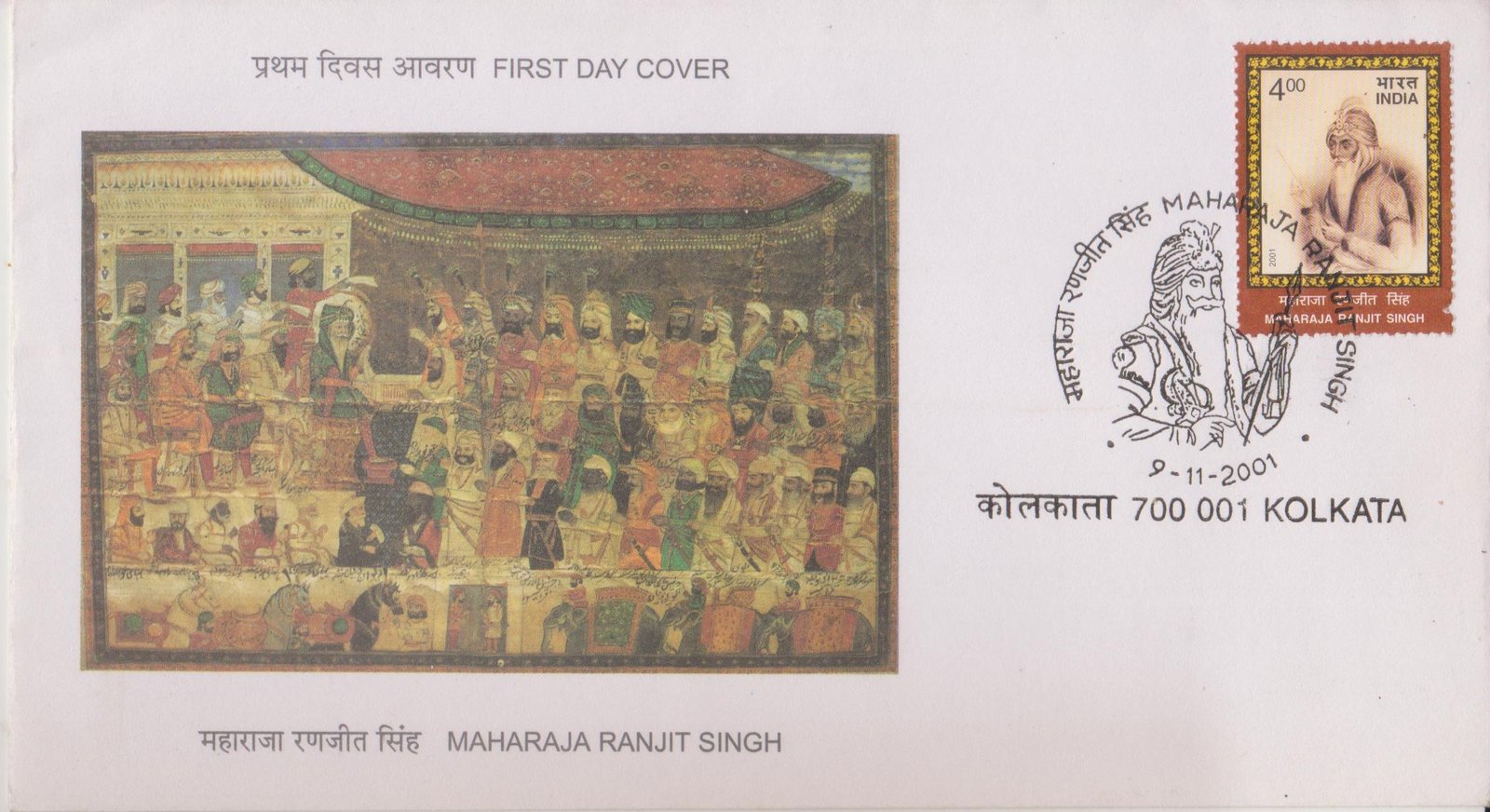
First Day Cover