
Maharaja Surajmal

Technical Data
| Date of Issue | December 29, 2009 |
|---|---|
| Denomination | Rs. 5 |
| Quantity | 400,000 |
| Perforation | 13½ |
| Printer | India Security Press, Nasik |
| Printing Process | Wet Offset |
| Watermark | No Watermark |
| Colors | Multicolor |
| Credit (Designed By) | Smt. Alka Sharma |
| Catalog Codes |
Michel IN 2455 Stamp Number IN 2393 Stanley Gibbons IN 2683 WADP Numbering System - WNS 108.2009 |
| Themes | Commemoration | Famous people | Men |
The Architect of Bharatpur’s Glory
Maharaja Suraj Mal was born on 13 February 1707 (Magh Mahina, Shukla Paksha Dashmi, Samvat 1763). He was the son of Maharaja Badan Singh and Rani Devaki. From an early age, he was deeply influenced by the sacrifices of Jat revolutionaries such as Veer Nandram Jat, Veer Gokul Singh, Veerdheer Rajaram, and Thakur Churaman, who had risen against the oppressive and forceful tax collection policies of Mughal rulers.
Establishment of Bharatpur State
Maharaja Surajmal established an independent Bharatpur State, transforming it into one of the most powerful kingdoms of his time. He undertook extensive construction activities and built magnificent temples, forts, and palaces in Bharatpur, Deeg, Kumher, Vair, and areas near Delhi. His vision combined military strength with architectural brilliance.
Military Achievements and Valor
Maharaja Surajmal displayed extraordinary courage from a young age. In 1747, he won the Chandros (Aiigarh) “Kaul” battle by defeating and killing Asad Khan.
On 20 August 1748, he played a decisive role in the historic Battle of Bagru near Jaipur, supporting Ishwari Singh. By defeating the combined forces of seven Rajas, he ensured Ishwari Singh’s ascension to the throne of Jaipur.
On 1 January 1750, he defeated the Mughal Mir Bakshi, forcing his army to flee from Faridabad and Ballabhgarh.
In 1753, he achieved victory in the Battle of Ghasera and defeated Nawab Gajrauddin on 10 May 1753. During the prolonged Jat–Maratha conflict, the Maratha siege of Kumher in 1754 lasted four months. Maharaja Surajmal emerged victorious, and Khanderao Holkar, son of the Indore ruler, was killed during the conflict.
On 12 June 1761, he captured Agra, and in 1763, he conquered Farrukhnagar after defeating the Baluch forces.
Administration and Cultural Patronage
Maharaja Surajmal was not only a fearless warrior but also a just and visionary ruler. He respected all religious sects and promoted harmony among communities. A patron of art and architecture, he constructed notable structures such as the Deeg Fort, Nawal Singh’s Haveli, and Jawahar Singh’s Chhatri in Agra Fort.
Under his leadership, the Bharatpur State expanded significantly, encompassing regions such as Dholpur, Agra, Etah, Etawah, Farrukhnagar, Mainpuri, Aligarh, Bulandshahr, Meerut, Kanpur, Rohtak, Jhajjar, Rewari, Alwar, Faridabad, Ballabhgarh, Mathura, and others—making it one of the largest and most powerful states of that era.
Martyrdom and Legacy
After a lifetime spent on battlefields where his valor became legendary, Maharaja Surajmal sacrificed his life on 25 December 1763 at Shahdara near Delhi. His legacy endures as a symbol of courage, statesmanship, and architectural brilliance.
Commemorative Postage Stamp
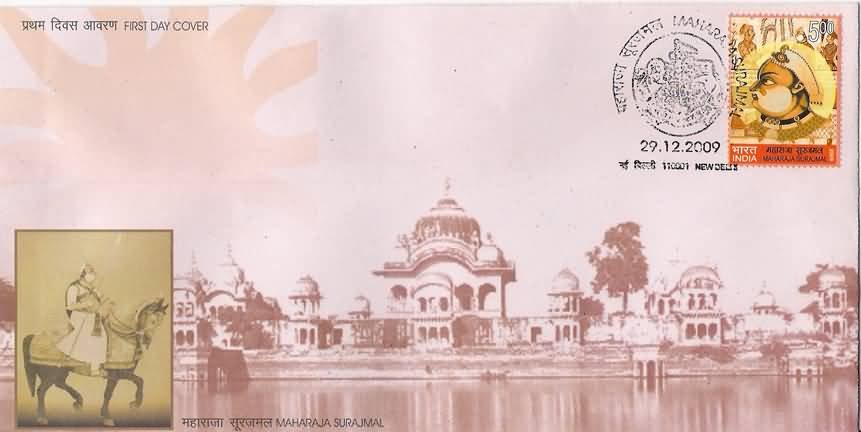
To honour his immense contribution to Indian history, the Department of Posts has issued a commemorative postage stamp on Maharaja Surajmal, celebrating the life and achievements of this great Jat ruler who shaped the destiny of Bharatpur and northern India
First Day Cover
Leave a Comment
You must be logged in to post a comment.