
Maharshi Patanjali
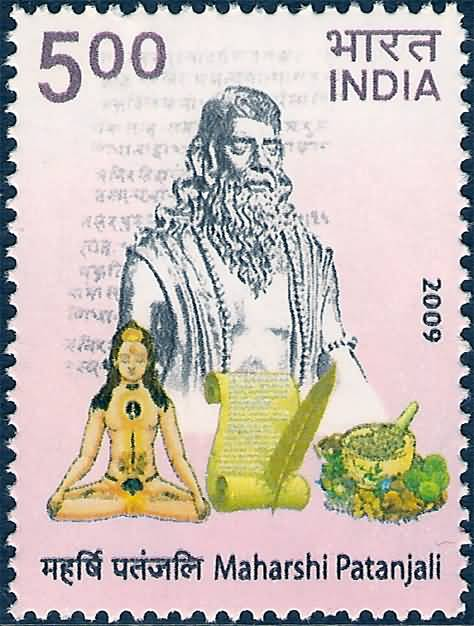
Technical Data
| Date of Issue | August 4, 2009 |
|---|---|
| Denomination | Rs. 5 |
| Quantity | 1,800,000 |
| Perforation | 13 |
| Printer | India Security Press, Nasik |
| Printing Process | Wet Offset |
| Watermark | No Watermark |
| Colors | Multicolor |
| Credit (Designed By) | Smt. Alka Sharma |
| Catalog Codes |
Michel IN 2396 Stamp Number IN 2336 Stanley Gibbons IN 2615 WADP Numbering System - WNS IN049.2009 |
| Themes | Commemoration | Famous people | Feathers | Men | Stationery |
Hinduism recognizes six classical systems of philosophy known as the Shad Darshanas: Vaisheshika, Nyaya, Sankhya, Yoga, Mimamsa, and Vedanta. The earliest exponents of these systems are traditionally identified as Kanada, Gotama, Kapila, Patanjali, Jaimini, and Vyasa respectively.
Though the exact dates of their origin are uncertain, these philosophical systems are believed to have been formulated prior to the time of the Buddha.
Common Features
Despite differences and mutual contradictions on certain philosophical issues, these six schools share fundamental beliefs:
- Acceptance of the authority of the Vedas.
- Faith in the Law of Karma (action and consequence).
- Belief in rebirth.
- Recognition of Moksha (liberation) as the highest goal of human life — the realization of the true self.
Patanjali – Compiler of the Yoga Sutras
Patanjali is one of the most revered sages in Indian spiritual tradition, best known for compiling the Yoga Sutras, a foundational collection of 196 aphorisms on yoga philosophy and practice. He is traditionally believed to be an incarnation of ‘Adisesha’, the divine serpent associated with Lord Vishnu.
Legendary Origin
According to popular legend, Patanjali was born to Sage Atri, one of the Saptarishis, and his virtuous wife Anusuya. It is said that the Trinity — Brahma, Vishnu, and Shiva — once tested Anusuya’s chastity. Through her purity and devotion, she transformed them into children and fed them. As a blessing, the divine beings were born to her.
Another tradition explains that desiring to teach yoga to humanity, Patanjali fell (pat) from heaven into the folded palms (anjali) of a woman in prayer, thus earning the name “Patanjali.”
The Yoga Sutras and the Philosophy of Yoga
The Yoga Sutras systematized the philosophy and practice of yoga and established it as a disciplined spiritual path. Yoga traditionally encompasses ethics, meditation, metaphysics, devotion, and inner contemplation.
Patanjali codified Raja Yoga as an eight-limbed system (Ashtanga Yoga), focusing on mastering the mind and attaining inner stillness. Yoga is defined as the cessation of mental fluctuations, enabling one-pointed concentration (ekagrata).
The Eight Limbs (Ashtanga Yoga)
- Yama – Ethical restraints and non-violence (ahimsa)
- Niyama – Personal discipline, purity, and asceticism
- Asana – Posture
- Pranayama – Regulation of breath
- Pratyahara – Withdrawal of the senses
- Dharana – Concentration
- Dhyana – Meditation
- Samadhi – Complete absorption and union with the divine
Through these progressive steps, the Yoga Sutras guide the seeker toward Moksha (liberation) — the ultimate realization of the true self.
Enduring Legacy
Patanjali is also counted among the eighteen Siddhas in Indian spiritual tradition. Beyond yoga and meditation, his influence extends to Indian classical arts, including dance, where yogic principles of discipline and harmony are reflected.
His contribution to yoga and meditation has had profound significance, not only in India but across the world, shaping spiritual practice and philosophical inquiry for centuries.
Commemorative Postage Stamp
The Department of Posts has issued a commemorative postage stamp on Maharishi Patanjali, revered as an Avatar of Adi Sesha and the compiler of the Yoga Sutras — a timeless collection of 196 sutras that continue to guide humanity on the path of self-realization and inner harmony.
First Day Cover

Leave a Comment
You must be logged in to post a comment.