
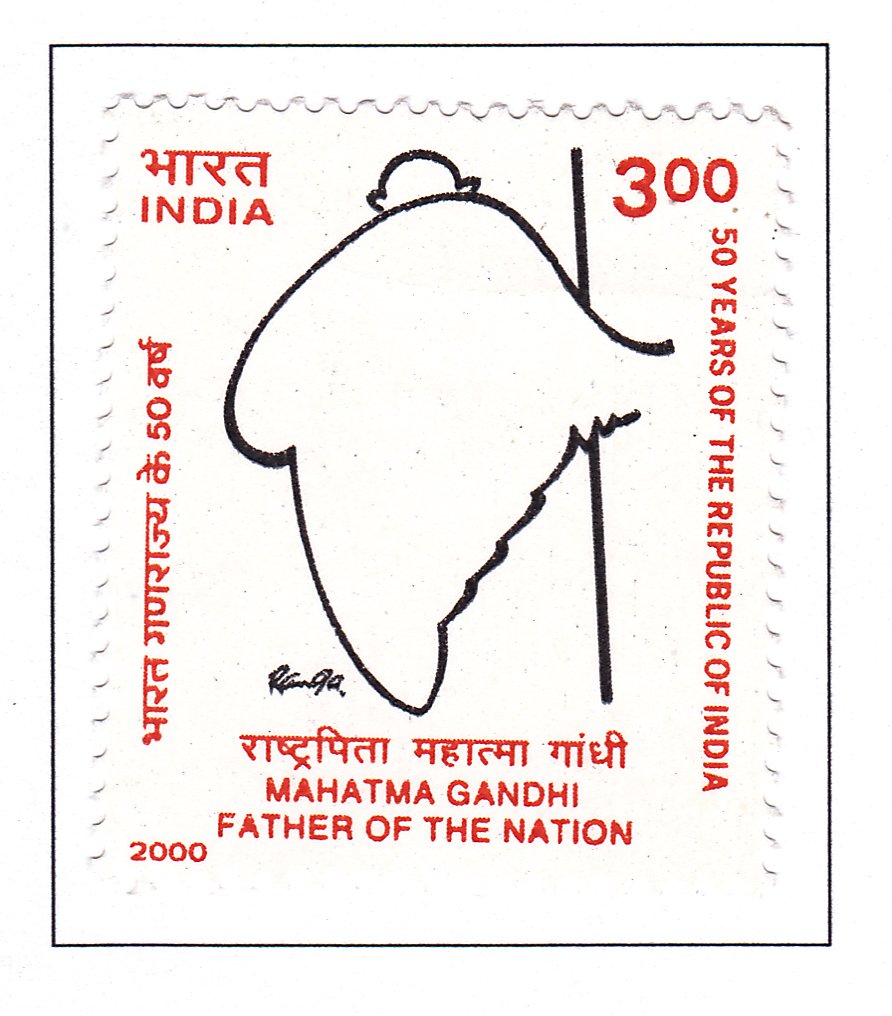
Mahatma Gandhi : Father of the Nation
Technical Data
| Date of Issue | January 27, 2000 |
|---|---|
| Denomination | Rs. 3 |
| Quantity | 1,400,000 |
| Perforation | comb 14 |
| Printer | Security Printing Press, Nashik |
| Printing Process | Photogravure |
| Watermark | No Watermark |
| Colors | Black | Red |
| Credit (Designed By) | Sh. Sankha Samanta |
| Catalog Codes |
Michel IN 1735 Stamp Number IN 1796 Yvert et Tellier IN 1501 Stanley Gibbons IN 1898 |
| Themes | Anniversaries and Jubilees | Famous people | Maps | Men | Politicians | Stylized Figures / Persons |
Formation of the Indian Constitution and 50 Years of the Republic of India
The Constituent Assembly of India, representing the will of the people, held its first session in December 1946. After India gained independence, the process of drafting the Constitution progressed rapidly.
A key role in shaping the Constitution was played by Dr. Bhimrao Ramji Ambedkar, the Chairman of the Drafting Committee. He presented the final draft to the Assembly on 26 November 1949. The Constitution was adopted the same day after Dr. Rajendra Prasad, President of the Assembly, put it to vote.
With inspiring words urging the nation to move forward with truth, non-violence, and confidence, Dr. Rajendra Prasad marked a historic moment. The Assembly, on behalf of the people of India, adopted and enacted the Constitution, establishing India as a Sovereign Democratic Republic.
Vision of Democracy: Political and Social Ideals
While addressing the Assembly on 26 November 1949, Dr. B.R. Ambedkar emphasized the importance of aligning political democracy with social democracy. He highlighted that true democracy must be rooted in the principles of liberty, equality, and fraternity—values essential for a just and inclusive society.
The Constitution not only laid down the framework of governance but also reflected the aspirations of the Indian people. It established a parliamentary system and aimed to promote social and economic transformation across the nation.
Adoption and Implementation of the Constitution
The Constitution of India came into effect on 26 January 1950, a date previously celebrated as Independence Day since 1930. On this historic occasion, Dr. Rajendra Prasad was sworn in as the first President of India amidst nationwide celebrations.
Commemorating 50 Years of the Republic of India
To mark the Golden Jubilee of the Republic, the India Post issued a special commemorative postage stamp honoring Mahatma Gandhi. Designed by renowned artist Shri Ranga, the stamp beautifully depicts various aspects of Gandhiji’s life and philosophy.
Over the years, India and many other countries have paid tribute to Mahatma Gandhi through commemorative stamps, recognizing his leadership in the freedom movement and his enduring influence on global peace and non-violence.
Tribute to Dr. B.R. Ambedkar
The First Day Cover design prominently features Dr. B.R. Ambedkar, widely regarded as the chief architect of the Indian Constitution. His leadership in drafting and guiding the Constitution remains a cornerstone of India’s democratic foundation.
Through this commemorative stamp on 50 Years of the Republic of India, the Department of Posts honors his immense contribution and celebrates the enduring legacy of India’s Constitution.