
Mahatma Gandhi – Salt Satyagraha
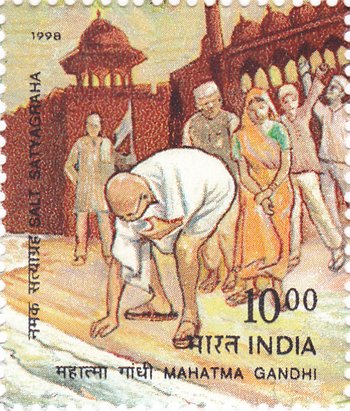
Technical Data
| Stamp Set | Mahatma Gandhi Memorial |
|---|---|
| Date of Issue | January 30, 1998 |
| Denomination | Rs. 10 |
| Quantity | 700,000 |
| Perforation | comb 14 |
| Printer | Security Printing Press, Nashik |
| Printing Process | Photogravure |
| Watermark | No Watermark |
| Colors | Multicolor |
| Credit (Designed By) | Sh. Sankha Samanta |
| Catalog Codes |
Michel IN 1613 Stamp Number IN 1673 Yvert et Tellier IN 1380 Yvert et Tellier IN 1777 |
| Themes | Anniversaries and Jubilees | Famous people | Human Rights | Independency Activists | Lawyers-Advocates | Men | Optical Instruments | Teachers |
A Landmark Movement Led by Mahatma Gandhi
The Salt Satyagraha was one of the most significant movements in India’s struggle for independence, led by Mahatma Gandhi in 1930. It was a powerful example of non-violent resistance (Satyagraha) against unjust British laws, particularly the salt tax imposed on Indian citizens.
This movement demonstrated how a simple issue like salt could unite millions and challenge an empire.
Background of the Salt Satyagraha
Under British rule, Indians were not allowed to produce or sell salt independently and were forced to pay a heavy tax on it. This law affected everyone, especially the poor, making salt—a basic necessity—expensive and inaccessible.
Mahatma Gandhi recognized this injustice and chose salt as a symbol to protest colonial exploitation. His approach reflected his belief in opposing what is morally unjustifiable through peaceful means.
The Dandi March: Beginning of the Movement
The Salt Satyagraha began on 12 March 1930, when Mahatma Gandhi started a historic march from Sabarmati Ashram to Dandi, a coastal village in Gujarat.
After a journey of about 240 miles, Gandhi reached Dandi on 6 April 1930 and symbolically broke the salt law by making salt from seawater. This simple act sparked a nationwide movement.
Impact on India’s Freedom Struggle
The Salt Satyagraha became a turning point in the Indian independence movement. It:
- Encouraged mass participation from all sections of society
- Strengthened the principle of non-violent protest
- Drew international attention to India’s struggle for freedom
Millions of Indians joined the movement by making salt and defying British laws, proving the power of unity and peaceful resistance.
Role in Social and Economic Awareness
Beyond political resistance, the Salt Satyagraha also highlighted issues of economic injustice and social inequality. It brought attention to the hardships faced by ordinary people under colonial rule.
Through this movement, Mahatma Gandhi reinforced the idea that true freedom must address the needs of the common people, especially the poor and marginalized.
Legacy of the Salt Satyagraha
The Salt Satyagraha remains one of the most iconic examples of civil disobedience in world history. It showcased how non-violence and moral courage can bring about significant political and social change.
The movement continues to inspire struggles for justice and equality across the world.
Conclusion
The Salt Satyagraha, led by Mahatma Gandhi, was not just a protest against a tax but a symbol of resistance, unity, and empowerment. It played a crucial role in India’s journey to independence and remains a timeless lesson in the power of peaceful protest.