
Mahatma Gandhi – Social Upliftment
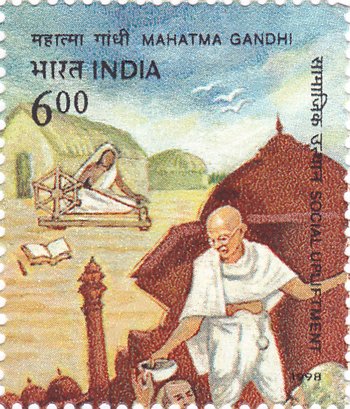
Technical Data
| Stamp Set | Mahatma Gandhi Memorial |
|---|---|
| Date of Issue | January 30, 1998 |
| Denomination | Rs. 6 |
| Quantity | 700,000 |
| Perforation | comb 14 |
| Printer | Security Printing Press, Nashik |
| Printing Process | Photogravure |
| Watermark | No Watermark |
| Colors | Multicolor |
| Credit (Designed By) | Sh. Sankha Samanta |
| Catalog Codes |
Michel IN 1612 Stamp Number IN 1672 Yvert et Tellier IN 1379 Stanley Gibbons IN 1776 |
| Themes | Anniversaries and Jubilees | Famous people | Human Rights | Independency Activists | Lawyers-Advocates | Men | Optical Instruments | Teachers |
Mahatma Gandhi’s Vision for an Equal Society
The idea of Social Upliftment in India is closely associated with the life and teachings of Mahatma Gandhi. He believed that true freedom was not just political independence but the overall improvement of society, especially the upliftment of the poor, marginalized, and oppressed sections.
For Gandhi, social progress meant ensuring dignity, equality, and justice for every individual, regardless of caste, religion, or economic status.
Gandhi’s Approach to Social Upliftment
Mahatma Gandhi viewed Social Upliftment as a holistic process that included moral, economic, and social transformation. His efforts were focused on:
- Eradicating poverty and improving rural livelihoods
- Promoting equality and human dignity
- Encouraging self-reliance and simple living
- Bridging social divisions based on caste and religion
He referred to the underprivileged as “children of God”, emphasizing compassion and inclusion in society.
Role in Empowering the Masses
Through movements like the Champaran Satyagraha (1917), Mahatma Gandhi empowered common people to stand against injustice. This marked a shift in India’s freedom struggle by bringing peasants, workers, and ordinary citizens into active participation.
Similarly, the Salt Satyagraha (1930) became a symbol of unity and mass resistance, encouraging people from all sections of society to join the movement.
These initiatives played a crucial role in raising social awareness and strengthening collective action, key elements of Social Upliftment.
Focus on Rural Development and Equality
Mahatma Gandhi strongly believed that “India lives in her villages.” His vision of Social Upliftment centered on improving the living conditions in rural areas.
He advocated:
- Development of village economies
- Reduction of economic inequalities
- Access to basic needs like food, shelter, and education
For Gandhi, the success of independence depended on the well-being of millions living in villages.
Promoting Communal Harmony
An essential aspect of Social Upliftment in Gandhi’s philosophy was unity among communities. During the violence following India’s partition, Mahatma Gandhi worked tirelessly to restore peace between Hindus and Muslims.
His efforts to eliminate fear, suspicion, and hatred were aimed at building a harmonious and inclusive society.
Lord Mountbatten even described him as the “one-man boundary force” for his role in maintaining peace.
Lasting Impact of Gandhi’s Social Ideals
The principles of Mahatma Gandhi continue to shape modern approaches to Social Upliftment in India. His ideas have influenced:
- Social justice movements
- Policies for poverty alleviation
- Programs for rural and community development
His emphasis on non-violence, equality, and human dignity remains relevant in addressing today’s social challenges.
Conclusion
Social Upliftment was at the heart of Mahatma Gandhi’s vision for India. He believed that real progress could only be achieved when the weakest sections of society were empowered and uplifted.
His legacy continues to inspire efforts toward building a just, inclusive, and compassionate society, where every individual has the opportunity to live with dignity and respect.