Mangroves of India

Technical Data
| Date of Issue | October 30, 2002 |
|---|---|
| Denomination | Rs. 30 |
| Perforation | Syncopated13 x 13¼ |
| Printer | Calcutta Security Printers Ltd |
| Printing Process | Offset Lithography |
| Watermark | No Watermark |
| Colors | Multicolor |
| Credit (Designed By) | Shri Kamleshwar Singh |
| Catalog Codes |
Michel IN BL14 Stanley Gibbons IN 1978a Yvert et Tellier IN BF13 Stanley Gibbons IN MS2094 |
| Themes | Conferences | Flowers | Forests | Landscapes | Plants (Flora) | Rivers | Trees | U.N.O. |
Stamps in this Miniature Sheet


Importance, Biodiversity, and Climate Change Significance
Mangroves are unique coastal ecosystems that play a vital role in maintaining ecological balance. They serve as spawning and nursery grounds for a wide variety of marine life, including fish, shrimps, crabs, oysters, and crocodiles. In addition, mangroves provide feeding and nesting habitats for numerous seabirds and support diverse wildlife.
These ecosystems are also valuable for human use, providing resources such as fuel, fodder, timber, charcoal, tannin, and paper pulp. Many communities depend directly or indirectly on mangroves for their livelihood.
Unique Features of Mangroves
Mangroves are considered a unique biological phenomenon because they can survive under extreme environmental conditions such as:
- Waterlogged soils
- Poor soil aeration
- High salinity
- High humidity
- Strong coastal winds
Their adaptability makes them crucial for coastal protection and environmental sustainability.
Mangroves in India
India is home to some of the most spectacular mangrove ecosystems in the world. These are found in the alluvial deltas of major rivers such as the Ganga River, Mahanadi River, Godavari River, Krishna River, and Cauvery River, as well as in the Andaman and Nicobar Islands.
The Sundarbans represent the largest mangrove forest in India. This region is rich in biodiversity and supports a wide range of species, including amphibians, reptiles, fish, and mammals such as tigers, dolphins, and porpoises.
In total, about 65 species of true mangroves and associated plants are found in India, and around 30 mangrove areas have been identified for conservation and management.
Mangroves and Climate Change
Mangroves play a significant role in combating climate change by acting as natural carbon sinks and protecting coastlines from erosion and extreme weather events.
Under the United Nations Framework Convention on Climate Change, developed countries are expected to reduce greenhouse gas emissions and support developing nations in addressing climate challenges.
India has shown strong commitment to sustainable development through:
- Energy efficiency and conservation
- Promotion of renewable energy
- Protection and expansion of forests and natural resources
COP-8 Conference in New Delhi
India hosted the COP-8 (Eighth Session of the Conference of the Parties) from 23 October to 1 November 2002 in New Delhi.
The conference focused on preventing dangerous human interference with the climate system by stabilizing greenhouse gas concentrations in the atmosphere. It reaffirmed India’s commitment to sustainable development and global climate action.
Philatelic Commemoration of Mangroves
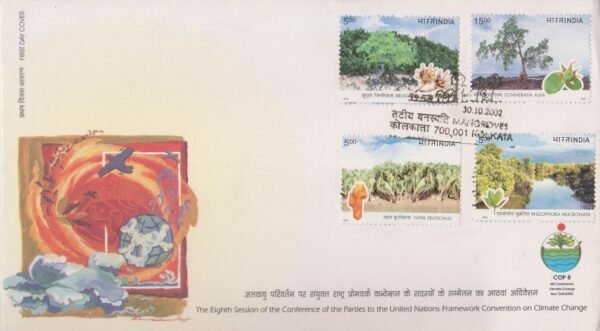
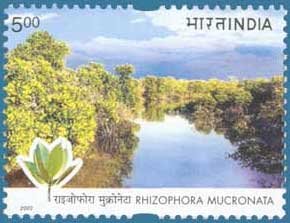
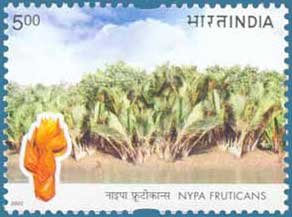
To mark the occasion of COP-8, India Post issued a Miniature sheet consisting of set of four commemorative postage stamps highlighting mangrove ecosystems, emphasizing their vulnerability to climate change.
The stamps feature four important mangrove species:
- Rhizophora mucronata
- Sonneratia alba
- Nypa fruticans
- Bruguiera gymnorrhiza
The First Day Cover includes an abstract artwork by Kamleshwar Singh, conveying the urgent need to change human behavior to prevent climate-related disasters. It also features the official conference logo.
Conclusion
Mangroves are essential for ecological balance, biodiversity conservation, and climate change mitigation. India’s rich mangrove ecosystems, especially the Sundarbans, highlight the importance of preserving these natural resources.
The COP-8 conference and the commemorative stamps issued by India Post serve as a reminder of the urgent need to protect mangroves and adopt sustainable practices to safeguard the environment for future generations.
First Day Cover