
Rath Bullock Cart
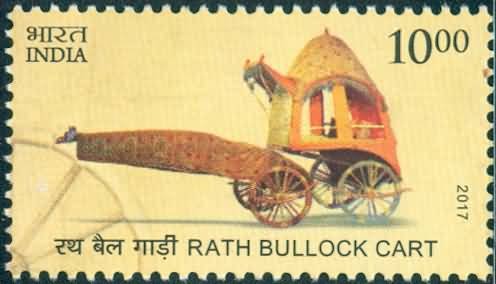
Technical Data
| Date of Issue | March 25, 2017 |
|---|---|
| Denomination | Rs. 10 |
| Quantity | 3,000 |
| Perforation | 13 |
| Printer | India Security Press, Nashik |
| Printing Process | Wet Offset |
| Watermark | No Watermark |
| Colors | Multicolor |
| Credit (Designed By) | Sh. Brahm Prakash |
| Catalog Codes |
Michel IN 3132 Yvert et Tellier IN 2823 Stanley Gibbons IN 3286 |
| Themes | Transport |
A Symbol of Tradition and Rural Mobility
Commemorative Stamp
Among India’s traditional modes of transport, the Rath Bullock Cart represents both cultural heritage and rural practicality. Long before mechanized vehicles transformed mobility, bullock carts formed the backbone of transportation across villages and trade routes. Honouring this enduring legacy, India Post issued a Commemorative Stamp as part of the Indian Transport series, celebrating the Rath Bullock Cart’s contribution to the nation’s progress.
Historical Background
The bullock cart, one of the oldest known vehicles in India, has been used since ancient times for carrying goods and passengers. The term Rath traditionally refers to a chariot, often associated with ceremonial or religious significance. Over time, the Rath Bullock Cart evolved as a decorated and sometimes ceremonial variant of the standard bullock cart, blending utility with cultural symbolism.
Pulled by a pair of oxen, these carts were widely used in rural India for transporting agricultural produce, grains, firewood, and other essential goods. They connected villages to nearby markets and towns, supporting the rural economy.
Design and Features
The Rath Bullock Cart was valued for its:
- Strong wooden framework
- Two or four large wheels for stability
- Decorative elements during festivals or ceremonies
- Dependable oxen suited for long-distance rural travel
Its sturdy construction made it suitable for rough village roads and unpaved pathways, where modern vehicles were not feasible.
Cultural and Social Significance
Beyond its economic role, the Rath Bullock Cart holds deep cultural meaning. It has been used in religious processions, temple festivals, and traditional celebrations. In many parts of India, decorated bullock carts continue to appear in fairs and ceremonial events, symbolizing agrarian heritage and community spirit.
Even today, in remote areas where infrastructure remains limited, bullock carts serve as an economical and eco-friendly means of transport.
Philatelic Tribute
The Commemorative Stamp on Rath Bullock Cart, included in the 20-stamp Indian Transport series, beautifully depicts this historic vehicle. Through this philatelic issue, India Post honours the humble yet vital role played by bullock carts in shaping India’s economic foundation and cultural traditions.
This stamp stands as a tribute to the enduring legacy of rural transport — a reminder that India’s journey toward modern mobility began with the steady wheels of the bullock cart.
Leave a Comment
You must be logged in to post a comment.