
Tonga
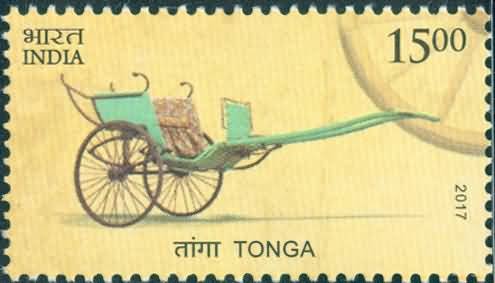
Technical Data
| Date of Issue | March 25, 2017 |
|---|---|
| Denomination | Rs. 15 |
| Quantity | 3,000 |
| Perforation | 13 |
| Printer | India Security Press, Nashik |
| Printing Process | Wet Offset |
| Watermark | No Watermark |
| Colors | Multicolor |
| Credit (Designed By) | Sh. Brahm Prakash |
| Catalog Codes |
Michel IN 3133 Yvert et Tellier IN 2824 Stanley Gibbons IN 3287 |
| Themes | Transport |
The Classic Horse-Drawn Carriage of India
Commemorative Stamp
Among the traditional modes of transport that shaped India’s mobility landscape, the Tonga holds a special place. As a light horse-drawn carriage widely used in towns and small cities, it played a crucial role in passenger transport before the arrival of motorized vehicles. Its historical and cultural importance is honoured through a Commemorative Stamp issued by India Post as part of the Indian Transport series.
Historical Background
With the expansion of trade routes and urban settlements, faster and more convenient means of passenger transport became necessary. The Tonga emerged as a practical solution — lighter and quicker than bullock carts, and well-suited to short and medium-distance travel.
Typically a two-wheeled carriage pulled by one or two horses, the Tonga became a common sight in marketplaces, railway stations, cantonment towns, and city streets across India. It served as an early form of organized public transport, connecting people to workplaces, markets, and social gatherings.
Design and Features
The Tonga was valued for its:
- Lightweight wooden structure
- Elevated passenger seating
- Faster mobility compared to ox-drawn vehicles
- Ability to navigate narrow urban roads
Its simple yet efficient design made it both economical and dependable. Drivers, known as tongawalas, were an integral part of the urban transport system.
Social and Cultural Significance
Beyond its practical use, the Tonga became woven into India’s social and cultural fabric. It was frequently used during weddings, festive occasions, and ceremonial events. In many regions, it symbolized charm and tradition.
Even after motorcars appeared in the late 19th and early 20th centuries, Tongas continued to operate in smaller towns where modern infrastructure was limited. Today, they survive mainly as heritage attractions or ceremonial vehicles, preserving a link to India’s transport past.
Philatelic Recognition
The Commemorative Stamp on Tonga, included in the Indian Transport series of 20 stamps, beautifully captures the elegance and simplicity of this iconic carriage. Through this philatelic tribute, India Post celebrates the Tonga’s contribution to the nation’s economic, social, and cultural development during the pre-motorized era.
The stamp stands as a reminder of a time when the rhythmic sound of horse hooves echoed through India’s streets, carrying people forward on the path of progress.
Leave a Comment
You must be logged in to post a comment.