
Hand Rickshaw
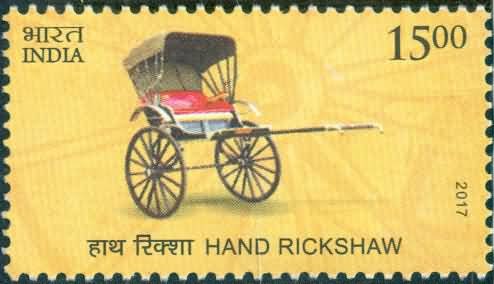
Technical Data
| Date of Issue | March 25, 2017 |
|---|---|
| Denomination | Rs. 15 |
| Quantity | 3,000 |
| Perforation | 13 |
| Printer | India Security Press, Nashik |
| Printing Process | Wet Offset |
| Watermark | No Watermark |
| Colors | Multicolor |
| Credit (Designed By) | Sh. Brahm Prakash |
| Catalog Codes |
Michel IN 3137 Yvert et Tellier IN 2828 Stanley Gibbons IN 3291 |
| Themes | Transport |
A Historic Mode of Urban Transport
Commemorative Postage Stamp Series
The story of India’s transport evolution is incomplete without mentioning the Hand Rickshaw, one of the earliest forms of urban passenger mobility. As part of the Indian Transport commemorative postage stamp series, the Department of Posts paid tribute to this distinctive and historically significant mode of conveyance.
Introduction in India
Rickshaws appeared in India around 1880, first seen in Shimla and later introduced in Kolkata about two decades afterward. Initially used by Chinese traders for transporting goods, the hand-pulled rickshaw soon became a practical solution for passenger travel in growing urban centres.
The term “rickshaw” was first recorded in 1887, and the vehicle quickly became associated with short-distance city transport.
Design and Function
The Hand Rickshaw is typically a two-wheeled cart designed to carry one passenger, pulled manually by a single individual. Its simple structure includes:
- A lightweight passenger seat
- Two large wheels for balance and mobility
- Long shafts used by the puller to draw the vehicle
This design allowed it to navigate narrow streets and congested urban areas with ease, making it especially suitable for crowded city environments.
Social and Economic Role
For many rural migrants arriving in cities during the late 19th and early 20th centuries, pulling a hand rickshaw became a primary source of livelihood. It required minimal investment and offered immediate employment opportunities.
The hand rickshaw also provided affordable transport to common citizens, connecting marketplaces, railway stations, and residential areas.
Although largely replaced today by cycle and auto rickshaws, hand-pulled rickshaws still survive in limited pockets, particularly in parts of Kolkata, where they remain both a cultural symbol and a subject of social discussion.
Philatelic Tribute
The Commemorative Postage Stamp on Hand Rickshaw, included in the 20-stamp Indian Transport series issued in five miniature sheets, beautifully captures this early urban transport vehicle.
Through this stamp, India Post commemorates not only a historic means of conveyance but also the human effort and resilience that powered India’s early city mobility. The hand rickshaw stands as a reminder of a transformative era in the nation’s transport history.
Leave a Comment
You must be logged in to post a comment.