
Medical Council of India

Technical Data
| Date of Issue | March 1, 2009 |
|---|---|
| Denomination | Rs. 5 |
| Quantity | 400,000 |
| Perforation | 13 |
| Printer | India Security Press, Nasik |
| Printing Process | Wet Offset |
| Watermark | No Watermark |
| Colors | Multicolor |
| Credit (Designed By) | Sh. Brahm Prakash |
| Catalog Codes |
Michel IN 2360 Stamp Number IN 2317 Yvert et Tellier IN 2119 Stanley Gibbons IN 2579 WADP Numbering System - WNS IN016.2009 |
| Themes | Anniversaries and Jubilees | Buildings | Healthcare |
75 Years as the Custodian of Medical Education Standards
The Medical Council of India (MCI) was established in 1934 under the Indian Medical Council Act, 1933 with the primary objective of maintaining uniform standards of higher qualifications in modern medicine and ensuring their recognition in India and abroad.
Legislative Evolution
With the rapid expansion of medical colleges after Independence, the original Act was found inadequate to meet emerging challenges in medical education. Consequently, the Indian Medical Council Act, 1956 replaced the earlier Act. It was subsequently amended in 1964, 1993, and 2001 to strengthen regulatory mechanisms and align medical education with national needs.
Objectives and Core Functions
The Medical Council of India was entrusted with the responsibility to:
- Maintain uniform standards of undergraduate and postgraduate medical education
- Recommend permission for starting new medical colleges and courses
- Approve increases in student intake capacity
- Grant, recognize, or de-recognize medical qualifications (Indian and foreign)
- Provide permanent and provisional registration to qualified doctors
- Maintain the All India Medical Register
- Ensure compliance with professional conduct and ethics regulations
- Establish reciprocity agreements with foreign countries for mutual recognition of qualifications
- Prescribe and regulate minimum standards for teaching faculty, infrastructure, and clinical material in medical colleges
To fulfill these objectives, MCI conducted inspections and visitations of medical institutions, renewed permissions, recognized qualifications, and functioned as an appellate authority over State Medical Councils.
Regulatory Framework
Under Section 33 of the 1956 Act, MCI framed and periodically updated key regulations, including:
- Graduate Medical Education Regulations
- Postgraduate Medical Education Regulations
- Minimum Standard Requirements for MBBS Admissions (50/100/150 intake)
- Minimum Qualifications for Teachers in Medical Institutions Regulations
- Professional Conduct, Etiquette, and Ethics Regulations
These regulations ensured that medical education remained relevant, timely, and aligned with evolving healthcare standards.
Leadership and Legacy
The Council was first headed by Bidhan Chandra Roy, an eminent physician and statesman who played a pivotal role in shaping modern medical education in India.
Over 75 years, MCI emerged as the statutory custodian of medical education standards in India. By regulating medical institutions and ensuring quality training of healthcare professionals, it contributed significantly to the development of India’s healthcare delivery system. Its work supported the realization of the constitutional vision of a welfare state through accessible and effective healthcare services.
Platinum Jubilee Commemoration
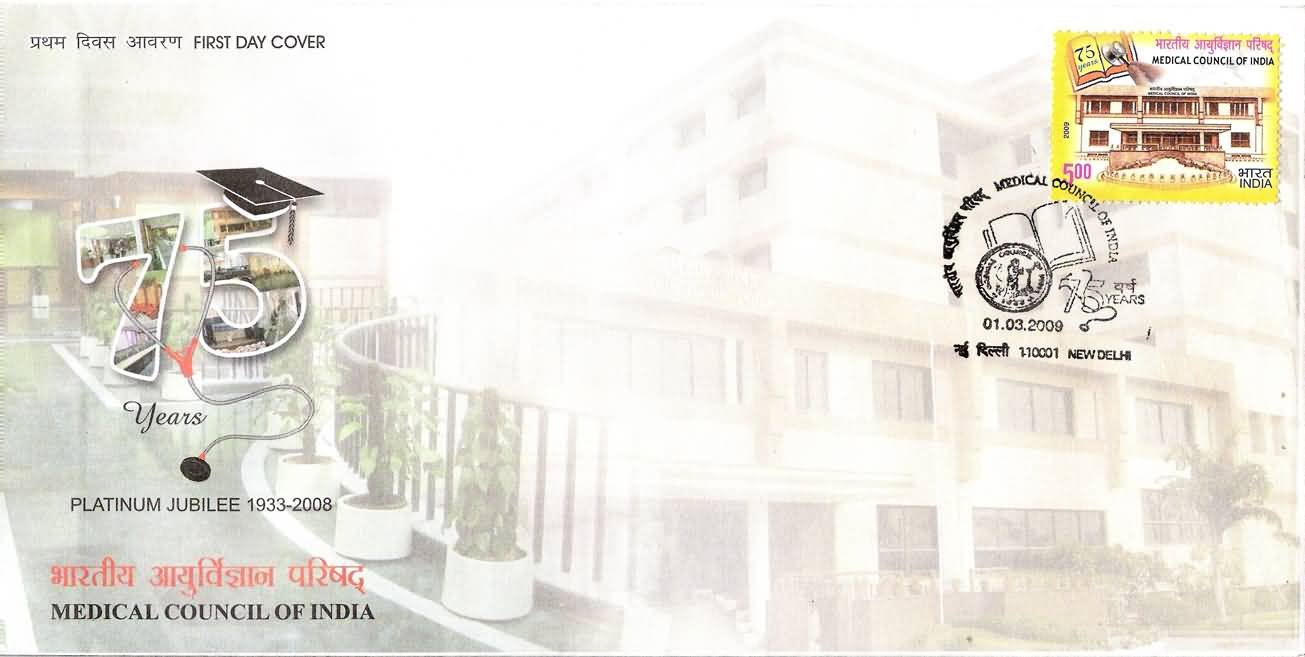
Marking 75 years since its establishment in 1934, India Post issued a commemorative postage stamp celebrating the Platinum Jubilee of the Medical Council of India — recognizing its enduring contribution to strengthening medical education and public health in the country.
First Day Cover
Leave a Comment
You must be logged in to post a comment.