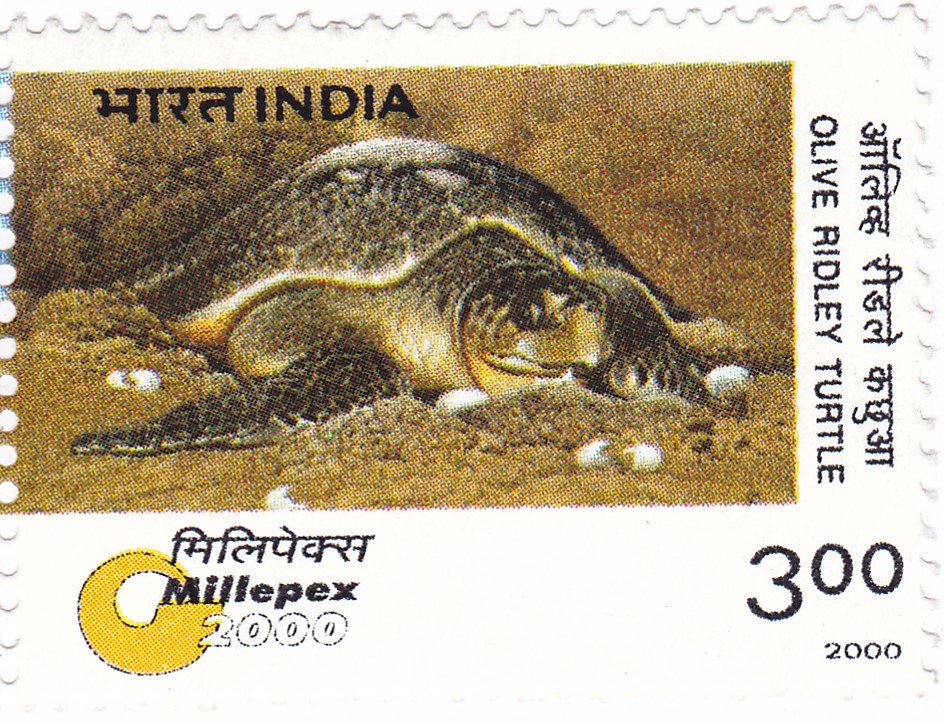
Olive Ridley Sea Turtle (Lepidochelys olivacea)
Technical Data
| Date of Issue | January 29, 2000 |
|---|---|
| Denomination | Rs. 3 |
| Quantity | 1,000,000 |
| Perforation | comb 13½ |
| Printer | Security Printing Press, Nashik |
| Printing Process | Photogravure |
| Watermark | No Watermark |
| Colors | Multicolor |
| Credit (Designed By) | Sh. Ramesh Sukumar |
| Catalog Codes |
Michel IN 1742 Stamp Number IN 1803 Yvert et Tellier IN 1507 Stanley Gibbons IN 1905 |
| Themes | Animals (Fauna) | Reptiles | Sea Life | Turtles |
Habitat, Characteristics, and Conservation
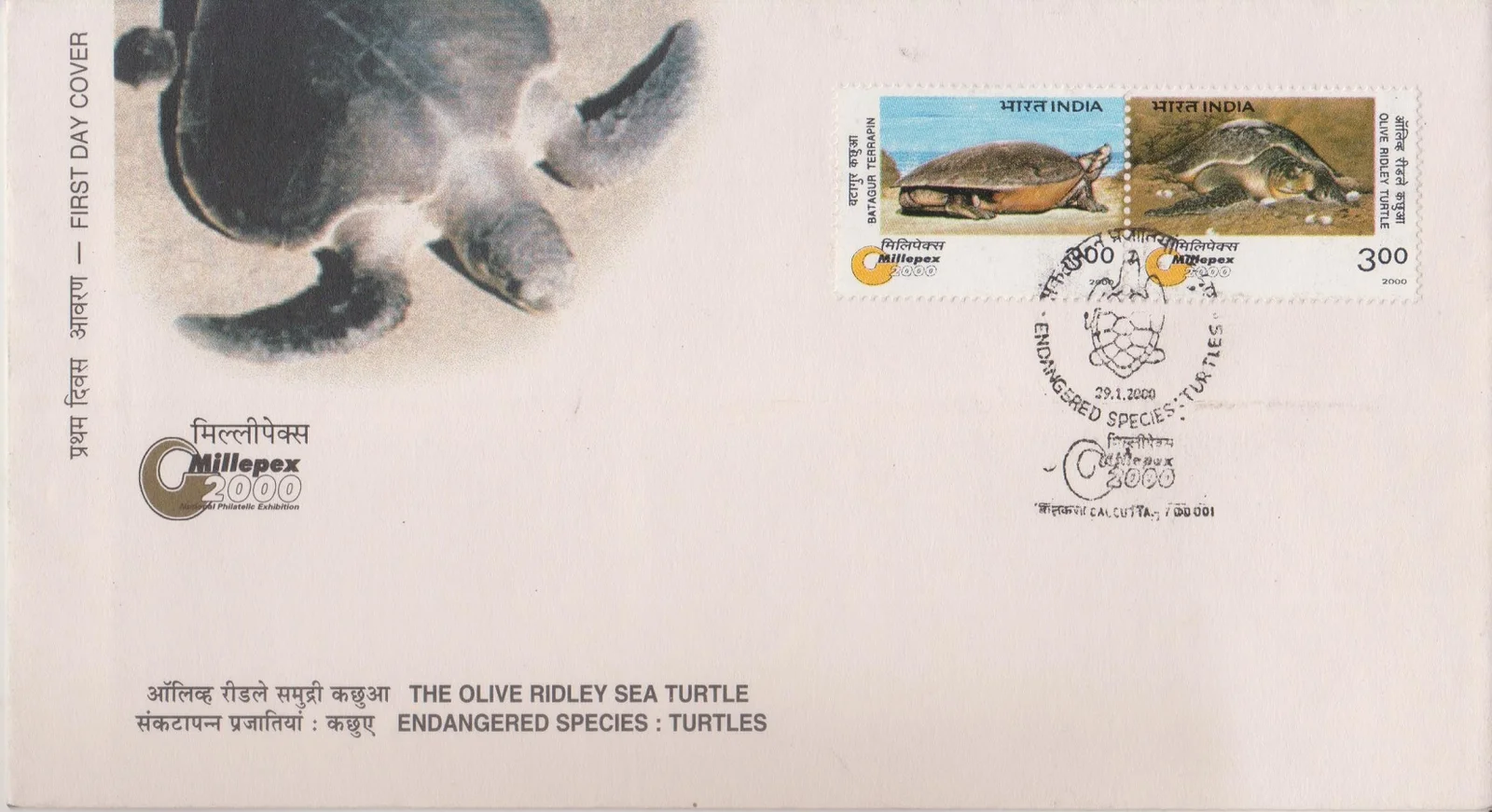
The Olive Ridley Turtle is one of the most widely distributed sea turtles found in the Indian subcontinent. Although relatively common, it is considered endangered due to increasing environmental threats. This species has also been featured on a commemorative postage stamp titled “Endangered Species: Lepidochelys olivacea (Olive Ridley Turtle)”, issued during the Millepex 2000.
Habitat and Distribution
Olive Ridley turtles inhabit warm tropical waters and are commonly found along the Indian coastline, including the Gulf of Kutch, coastal regions of Kerala and Tamil Nadu, the Odisha coast, and the Andaman Islands. They prefer shallow coastal waters but are known for long-distance oceanic migrations.
Physical Characteristics
This species is the smallest of all sea turtles. It has an olive-brown carapace (shell) and a yellowish underside. A key identifying feature is the presence of five or more pairs of costal shields on its shell.
Feeding Behavior
Olive Ridley turtles are omnivorous, feeding mainly on fish, crabs, molluscs, and jellyfish. They can dive to depths of up to 150 meters, enabling them to forage efficiently in marine environments.
Mass Nesting (Arribada)
A unique characteristic of the Olive Ridley turtle is its mass nesting behavior, known as “arribada,” where thousands of females come ashore simultaneously to lay eggs. In India, the most significant nesting sites are located along the Odisha coast, especially at Gahirmatha Beach, as well as at the river mouths of Devi and Rushikulya.
In recent years, mass nesting has become largely restricted to specific areas, increasing the importance of conservation efforts.
Conservation Status and Threats
The Olive Ridley turtle is protected under Schedule I of the Wildlife Protection Act 1972, the highest level of legal protection in India. However, it continues to face threats such as:
- Coastal pollution
- Habitat destruction due to development
- Fishing activities and marine debris
- Human disturbance during nesting
Conclusion
The Olive Ridley Sea Turtle plays a crucial role in maintaining marine ecosystem balance. The issuance of the commemorative stamp “Endangered Species: Lepidochelys olivacea (Olive Ridley Turtle)” highlights the need for awareness and conservation. Protecting this species requires sustained efforts to preserve its habitat and reduce human impact.
First Day Cover