
M.S. Swaminathan

Technical Data
| Date of Issue | August 7, 2025 |
|---|---|
| Denomination | Rs. 5 |
| Quantity | 303,225 |
| Printer | Security Printing Press, Hyderabad |
| Printing Process | Wet Offset |
| Colors | Multicolor |
| Credit (Designed By) | Ms. Gulistaan |
| Catalog Codes |
Colnect codes IN 2025.08.07-01 |
| Themes | Famous people | Men | Scientists |
Architect of India’s Green Revolution
Early Life and Education
Professor Monkombu Sambasivan Swaminathan, globally honoured as the Father of India’s Green Revolution, was born on August 7, 1925, in Tamil Nadu, India. He completed his higher education at Travancore and Madras Universities and later earned his Ph.D. in Genetics from the University of Cambridge in 1952. Over his lifetime, he received 85 honorary doctorates from prestigious universities across the world, reflecting his immense global impact.
Pioneering Contributions to Indian Agriculture
Dr. Swaminathan’s scientific journey gained momentum at the Indian Agricultural Research Institute (IARI), where he served from 1954 to 1972. It was here that he led the dwarf wheat breeding programme, paving the way for genetic innovation, improved crop varieties and increased agricultural productivity. His leadership was instrumental in transforming India from a food-deficit nation to one achieving self-sufficiency in food grains.
Leadership in Agricultural Research and Policy
From 1972 to 1979, Dr. Swaminathan served as Director General of the Indian Council of Agricultural Research (ICAR). During this tenure, he conceptualised and launched the Agricultural Research Services (ARS)—a milestone initiative that enabled scientists to build lifelong careers dedicated to agricultural research, thereby strengthening India’s scientific talent pool. He simultaneously served as Secretary of the Department of Agricultural Research and Education.
He later held key roles in the Government of India, including:
- Principal Secretary, Ministry of Agriculture and Irrigation (1979–1980), where he successfully managed the severe 1979 drought
- Member, Planning Commission of India (1980–1982), focusing on agriculture and rural development
Global Leadership and International Impact
Dr. Swaminathan’s influence extended far beyond India. He played significant leadership roles in international organisations, such as:
- Director General, International Rice Research Institute (IRRI) (1982–1988) – promoted sustainable rice production with equity at its core
- Chairman, UN Advisory Committee on Science and Technology for Development (1981–1984)
- Independent Chairman, FAO Council (1981–1985)
- President, International Union for Conservation of Nature (IUCN) (1984–1990)
- President, WWF-India (1989–1996)
- President, Pugwash Conferences on Science and World Affairs (2002–2007)
He also founded key organisations such as the International Council for Research on Agro-Forestry (ICRAF) and the Society for the Promotion of Wasteland Development (SPWD).
Scientific Achievements and Publications
Dr. Swaminathan authored hundreds of research papers and numerous books, including:
- Building a National Food Security System (1981)
- Science and Integrated Rural Development (1982)
He devoted over six decades to advancing basic and applied research in plant genetics, biodiversity conservation, and sustainable agricultural development.
Champion of Biodiversity and Rural Knowledge Systems
Dr. Swaminathan was a strong advocate for recognising the role of tribal and rural communities in conserving and nurturing plant genetic resources. He helped develop transparent mechanisms to acknowledge their intellectual contributions and traditional knowledge.
He chaired multiple expert committees on poverty alleviation, health, environment, eco-development of key Indian regions, and the drafting of the National Population Policy and National Biodiversity Act.
Awards, Honours and Distinctions
Among the countless awards he received, some of the most prominent include:
- Ramon Magsaysay Award (1971)
- Padma Shri (1967), Padma Bhushan (1972) and Padma Vibhushan (1989)
- Albert Einstein World Award of Science (1986)
- World Food Prize (1987) – becoming the first-ever laureate
In 1996, UNESCO named him UNESCO-Cousteau Professor in Ecotechnology for Asia.
He was a Fellow of several national and international science academies, including the Indian National Science Academy, Royal Society of London, and academies of the USA, Sweden, Italy, USSR, and China. He was also a Founder Fellow of the Third World Academy of Sciences.
National Service and Enduring Legacy
As Chairman of the National Commission on Farmers (2004–2006), he produced landmark recommendations that shaped India’s National Policy for Farmers (2007). He later served as a Member of Parliament (Rajya Sabha) from 2007 to 2013 and chaired the High-Level Panel of Experts on Food Security for the UN Committee on World Food Security (2010–2013).
A Tribute to a Visionary
Dr. M.S. Swaminathan passed away on September 28, 2023, in Chennai. His life’s work not only strengthened India’s food security but also inspired global action on sustainable agriculture, biodiversity, and farmer welfare.
Commemorative Postage Stamp
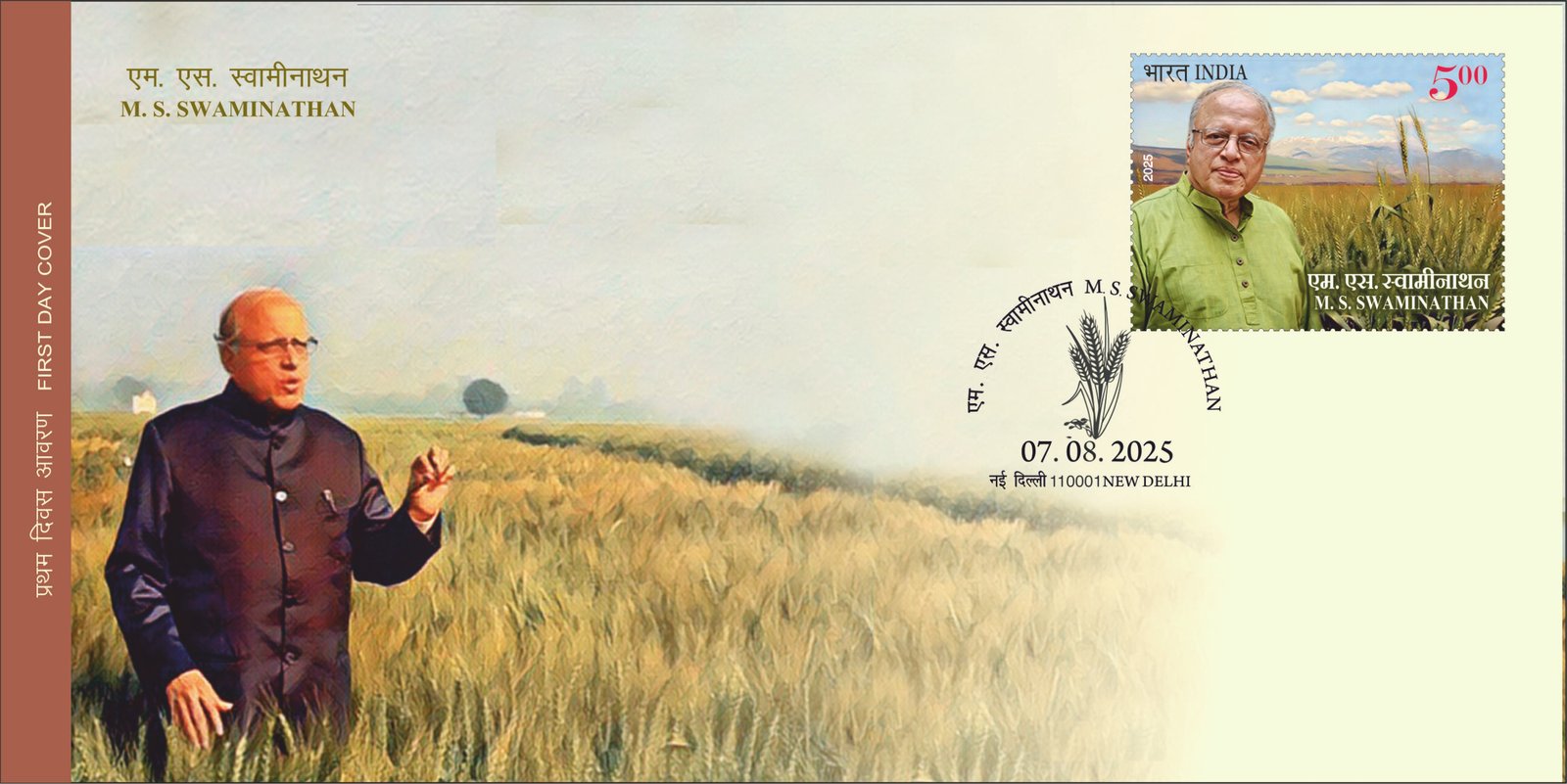
The Department of Posts proudly releases this Commemorative Postage Stamp in honour of Dr. M.S. Swaminathan, celebrating his visionary leadership, scientific excellence, and extraordinary contribution to India and the world.
First Day Cover
Leave a Comment
You must be logged in to post a comment.