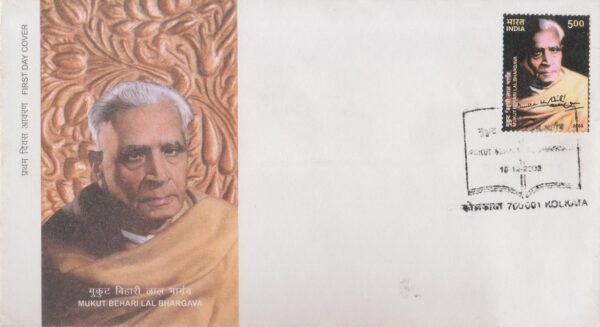
Mukut Behari Lal Bhargava (1903-1980)

Technical Data
| Date of Issue | December 18, 2003 |
|---|---|
| Denomination | Rs. 5 |
| Quantity | 400,000 |
| Perforation | comb 13½ |
| Printer | Security Printing Press, Nashik |
| Printing Process | Photogravure |
| Watermark | No Watermark |
| Colors | Multicolor |
| Credit (Designed By) | Sh. Bharati Mirchandani Smt. Alka Sharma |
| Catalog Codes |
Michel IN 2006 Stamp Number IN 2044 Yvert et Tellier IN 1771 Stanley Gibbons IN 2182 WADP Numbering System - WNS IN063.03 |
| Themes | Anniversaries and Jubilees | Famous people | Lawyers-Advocates | Men | Politicians |
Lawyer, Freedom Fighter and Parliamentarian
Introduction
Mukut Behari Lal Bhargava was a distinguished lawyer, nationalist leader and social reformer who made remarkable contributions to India’s political and legal life. Known for his resilience, eloquence and commitment to justice, he played an important role in the freedom movement and later in shaping democratic governance in India.
Early Life and Education
Mukut Behari Lal Bhargava was born in 1903 in Shahpura, located in the Bhilwara district of Rajasthan. He was later adopted by Vinodi Lal Bhargava of Beawar, near Ajmer.
He pursued higher education at University of Allahabad, where he earned a Master’s degree in History and a Bachelor’s degree in Law. After completing his education, he began his legal practice in Beawar in 1927.
Entry into Public Life
Bhargava soon became actively involved in public affairs. His political and civic activities centered around Ajmer–Merwara, which became the focal point of his work.
In the same year that he began practicing law, he was elected as a member of the Beawar Municipality, marking the beginning of his public career. His legal expertise and leadership qualities also led him to serve as the President of the Bar Association in Beawar and later as the Chairman of the Rajasthan Bar Council.
Role in the Freedom Movement
In 1930, Bhargava joined the Indian National Congress and became deeply involved in the struggle for India’s independence. He worked tirelessly to promote democratic administration in Ajmer–Merwara and advocated similar reforms in the princely states of Rajputana and Central India.
He actively participated in the nationalist movement and was arrested in 1941 for taking part in Individual Satyagraha, a campaign inspired by Mahatma Gandhi. During the Quit India Movement, he was again imprisoned. During his detention, he tragically lost his eyesight, yet this hardship did not weaken his determination or dedication to public service.
Political Career and Public Service
In 1945, Bhargava was elected to the Central Legislative Assembly, marking the beginning of his national political career. Later, he became a member of the Constituent Assembly of India, which played a historic role in framing the Constitution of India.
After independence, he continued to serve the nation in parliamentary politics. The people of Ajmer elected him three times as their representative to Parliament. In the First Lok Sabha, he represented the Ajmer South constituency.
Advocacy for Social Justice
Bhargava was widely respected for his fearless and eloquent advocacy. Often offering legal assistance free of cost, he championed causes that promoted justice and equality. His work supported:
- Rights of farmers and labourers
- Welfare of weaker sections of society
- Women’s education
- Removal of untouchability
- Promotion of Hindi as an official language
- Communal harmony and national unity
His legal acumen also earned him recognition even in the Supreme Court of India.
Legacy and Contributions
Even after retiring from active politics, Bhargava remained deeply committed to social and national causes. His nationalism extended beyond politics into education, culture and social welfare. He worked tirelessly for the upliftment of educational institutions and social organizations, addressing issues ranging from widow rehabilitation to food rationing.
His legacy continues through his private collection of legal literature and a welfare fund he established for the benefit of lawyers.
Commemorative Postage Stamp
To honour his remarkable contributions, India Post issued a commemorative postage stamp on the birth centenary of Mukut Behari Lal Bhargava. This tribute recognizes him as a towering personality who stood at the intersection of India’s legal, political and nationalist movements.
First Day Cover