
Nanda Devi and Valley of Flowers National Parks
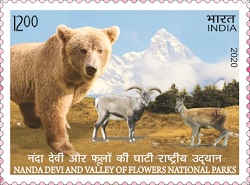
Technical Data
| Stamp Set | UNESCO World Heritage Sites in India - II |
|---|---|
| Date of Issue | March 16, 2020 |
| Denomination | Rs. 12 |
| Quantity | 500,000 |
| Perforation | 13¼ x 13¾ |
| Printer | Security Printing Press, Hyderabad |
| Printing Process | Wet Offset |
| Watermark | No Watermark |
| Colors | Multicolor |
| Credit (Designed By) | Sh. Brahm Prakash Sh. Pallab Bose |
| Catalog Codes |
Michel IN IN 3665A Stamp Number IN IN 3216 Yvert et Tellier IN IN 3342 Stanley Gibbons IN N 3735 Phila-India IN IN 3702 |
| Themes | Animals (Fauna) | Bears | Mammals | National Parks | UNESCO World Heritage Sites |
Introduction
Nanda Devi & Valley of Flowers National Parks together form one of the most spectacular natural landscapes of India. Located in the Himalayan region of Uttarakhand, these parks are renowned for their pristine beauty, rich biodiversity and ecological importance, representing a unique transition between major Himalayan mountain ranges.
Location and Setting
The Nanda Devi National Park, established in 1982, is situated around the majestic Nanda Devi peak (7,816 m) in northern India. The adjoining Valley of Flowers National Park lies nearby and is known for its gentle terrain and colourful alpine meadows. Together, these parks encompass a transition zone between the Zanskar and Great Himalayan ranges.
UNESCO World Heritage Status
In recognition of their outstanding natural value, Nanda Devi & Valley of Flowers National Parks were inscribed as a UNESCO World Heritage Site in 1988. The inscription highlights their exceptional biodiversity, unique ecosystems and scenic grandeur.
Flora and Fauna of Nanda Devi National Park
Nanda Devi National Park supports a remarkable variety of flora and fauna. Around 312 floral species, including 17 rare species, have been recorded here. The dominant vegetation includes fir, birch, rhododendron and juniper.
The park is home to several notable mammals such as the Himalayan Musk Deer, Mainland Serow and Himalayan Tahr, while carnivores include the elusive Snow Leopard, Himalayan Black Bear and possibly the Brown Bear.
Valley of Flowers – A Floral Paradise
The Valley of Flowers National Park is one of the most picturesque natural sights in India. Famous for its vibrant alpine flower meadows, it is interlaced with flowing streams and set against a dramatic mountain backdrop. According to legend, it is believed to be the place from where Hanuman collected the Sanjeevani herb to save Lakshman. The valley was declared a national park in 1982 and later gained global recognition as part of the UNESCO World Heritage Site.
Ecological and Cultural Significance
Together, Nanda Devi and the Valley of Flowers represent an outstanding example of high-altitude Himalayan ecosystems. Their isolation and protection have preserved rare species and fragile habitats, making them invaluable for scientific research and conservation.
Conservation Importance
These national parks stand as symbols of India’s commitment to protecting its natural heritage. Sustained conservation efforts ensure the preservation of their unique biodiversity and natural beauty for future generations.
Commemorative Postage Stamps
To celebrate their global importance, the Department of Posts is pleased to issue Commemorative Postage Stamps featuring Nanda Devi & Valley of Flowers National Parks, highlighting India’s rich natural legacy and its UNESCO World Heritage Sites.
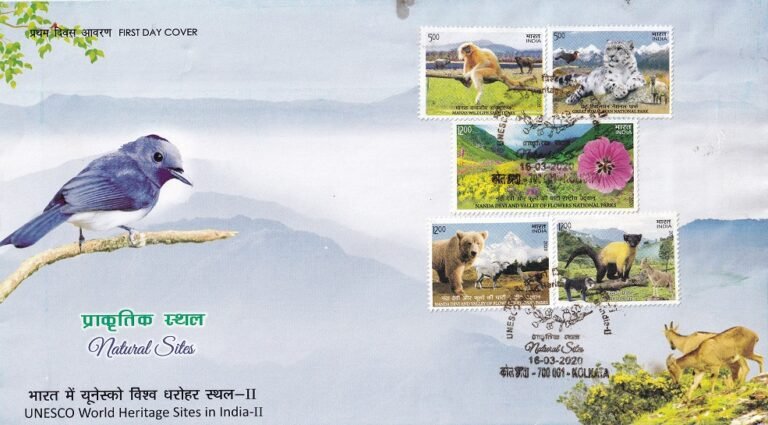
First Day Cover
Leave a Comment
You must be logged in to post a comment.