
National Girl Child Day

Technical Data
| Date of Issue | February 5, 2009 |
|---|---|
| Denomination | Rs. 5 |
| Quantity | 800,000 |
| Perforation | 13 |
| Printer | India Security Press, Nasik |
| Printing Process | Photo Gravure |
| Watermark | No Watermark |
| Colors | Multicolor |
| Credit (Designed By) | Mr. Suresh Kumar |
| Catalog Codes |
Michel IN 2348 Stamp Number IN 2311 Yvert et Tellier IN 2113 Stanley Gibbons IN 2573 WADP Numbering System - WNS IN010.2009 |
| Themes | Children |
The life of a disadvantaged girl child in India often reflects persistent discrimination from birth, beginning with a high incidence of foeticide. Those who survive face restricted access to education, nutrition, health care, and other essential services. They remain vulnerable to abuse, including sexual exploitation, domestic labor, trafficking, child marriage, early motherhood, and frequent pregnancies.
The poor status of the girl child is reflected in human development indicators: the Child Sex Ratio declined from 945 girls per 1000 boys in 1991 to 927 in 2001; 44.5% of girls are married before the age of 18; and the gross enrolment ratio for girls in higher classes drops to 57% for grades 6–8 and 34% for grades 9–12. Dropout rates for girls, particularly in secondary school, are estimated at 65%.
Legislative and Policy Measures
To address these challenges, the government has enacted several laws:
- Immoral Traffic (Prevention) Act, 1956
- Prohibition of Child Marriage Act, 2006
- Pre-Conception and Pre-Natal Diagnostic Techniques (Prohibition of Sex Selection) Act, 1994 (PC & PNDT Act)
Key policy frameworks also focus on girl child welfare:
- National Policy for Children, 1974 – the State assumes responsibility for the well-being of children before and after birth.
- National Charter for Children, 2003 – emphasizes the rights and dignity of girl children.
- National Common Minimum Programme – pledges special care and protection for the girl child.
- National Plan of Action for Children, 2005 – accords specific priority to the girl child.
Government Schemes for Girl Child Welfare
Several programs and schemes have been launched to improve the survival, education, and empowerment of the girl child:
- Dhanalakshmi – Conditional Cash Transfer Scheme (launched 4th December 2007)
- Provides staggered financial incentives to families to retain and educate girls.
- Includes insurance (maturity) cover at birth, ensuring a lump sum at age 18 if the girl is unmarried.
- Kishori Shakti Yojana – empowers adolescent girls through education, health, and skills development.
- Integrated Child Protection Scheme – establishes Palna (Cradle) Centers for safe surrender of unwanted female babies.
- Ujjawala Scheme – focuses on prevention of trafficking and rehabilitation of victims of commercial sexual exploitation, providing economic and social support to rescued girls.
National Girl Child Day
To highlight the challenges faced by girls and promote their welfare, 24th January has been declared National Girl Child Day, commemorating the day when Late Indira Gandhi was sworn in as India’s first woman Prime Minister.
The day aims to raise awareness on women empowerment and the welfare of girl children at the grassroots level.
Commemorative Stamp
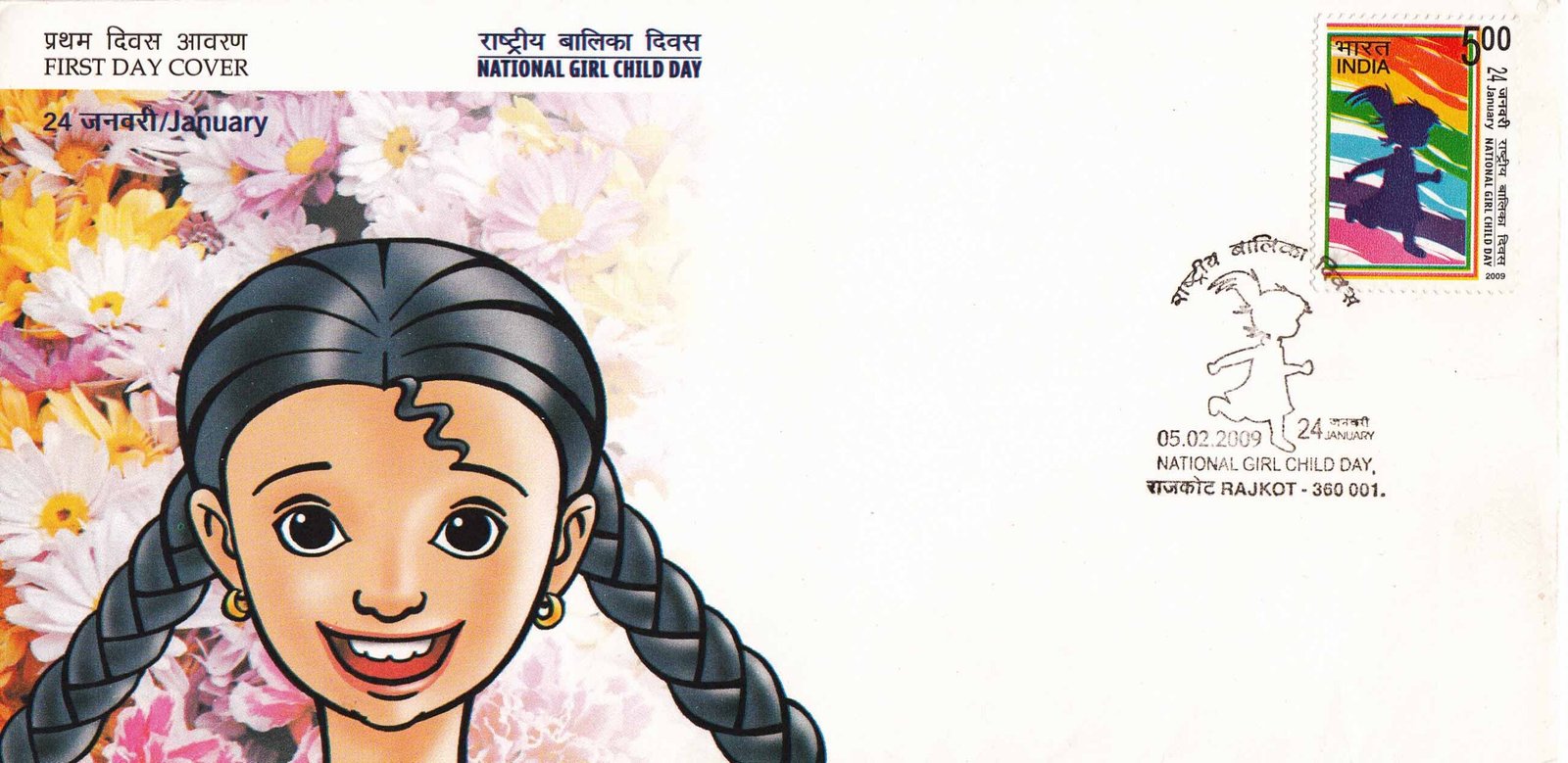
India Post joins this campaign by issuing a commemorative postage stamp on National Girl Child Day (24th January), celebrating the rights, dignity, and empowerment of the girl child.
First Day Cover
Leave a Comment
You must be logged in to post a comment.