
National Mathematics Day
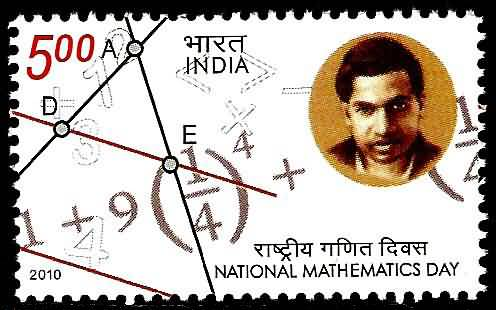
Technical Data
| Date of Issue | December 22, 2012 |
|---|---|
| Denomination | Rs. 5 |
| Quantity | 300,000 |
| Perforation | 13 x 13¼ |
| Printer | India Security Press, Nashik |
| Printing Process | Wet Offset |
| Watermark | No Watermark |
| Colors | Multicolor |
| Credit (Designed By) | Smt. Alka Sharma |
| Catalog Codes |
Michel IN 2686 Stamp Number IN 2610 Stanley Gibbons IN 2905 WADP Numbering System - WNS IN045.2012 |
| Themes | Anniversaries and Jubilees | Famous people | Mathematicians | Mathematics | Men |
Mathematics can be described as the study of quantity, numbers, and space. In many ways, it is regarded as the mother of all sciences. Mathematics serves as an essential tool across diverse fields such as natural sciences, engineering, medicine, and social sciences. Applied mathematics, which focuses on applying mathematical knowledge to areas like physics, economics, and biology, not only utilizes mathematical discoveries but also inspires new ones. This has led to the development of entirely new disciplines such as statistics and game theory.
National Mathematics Day
The National Workshop on Ancient Indian Mathematics, with special reference to Vedic Mathematics and Astronomy, passed a resolution on 25th September, 2010, recommending that 22nd December—the birth anniversary of the legendary mathematician Srinivasa Ramanujan—be observed as National Mathematics Day every year. The Government of India accepted this recommendation to promote awareness and appreciation of mathematics education and its applications throughout the country.
Srinivasa Ramanujan: The Mathematical Genius
National Mathematics Day is dedicated to Srinivasa Ramanujan (22nd December, 1887 – 26th April, 1920), an extraordinary Indian mathematician and autodidact. Despite having little formal training in pure mathematics, Ramanujan made groundbreaking contributions to mathematical analysis, number theory, infinite series, and continued fractions. His genius places him among the greatest mathematicians in history, alongside Euler, Gauss, Newton, and Archimedes.
Early Life and Mathematical Brilliance
Born and raised in Erode, Tamil Nadu, Ramanujan displayed remarkable mathematical talent from a young age. He encountered formal mathematics at the age of ten and quickly mastered advanced trigonometry. By seventeen, he had begun independent research on Bernoulli numbers and the Euler–Mascheroni constant, discovering several original theorems.
Recognition and Cambridge Years
Between 1912 and 1913, Ramanujan sent samples of his work to three scholars at the University of Cambridge. Among them, G. H. Hardy alone recognized the exceptional brilliance of his results and invited Ramanujan to Cambridge to collaborate. This partnership brought Ramanujan’s genius to the global mathematical community.
Contributions and Global Impact
During his short lifetime, Ramanujan independently compiled nearly 3,900 results, many of which were highly original and unconventional. Concepts such as the Ramanujan Prime and the Ramanujan Theta Function have inspired extensive research. In modern times, his formulae have found applications in advanced fields such as crystallography and string theory. To honour his influence, The Ramanujan Journal, an international mathematics journal, was established to publish research inspired by his work.
125th Birth Anniversary and National Mathematical Year
The celebrations marking Ramanujan’s 125th birth anniversary commenced on 22nd December, 2011 and concluded on 22nd December, 2012. The year 2012 was declared the National Mathematical Year, emphasizing the importance of mathematics in national development. Observing National Mathematics Day each year serves to connect Ramanujan’s life and legacy with the people of India, inspiring generations of young minds.
Commemorative Postage Stamp
To honour his unparalleled contributions, the Department of Posts issued a commemorative postage stamp on the occasion of the 125th Birth Anniversary of Srinivasa Ramanujan, the great Indian mathematician from Tamil Nadu.
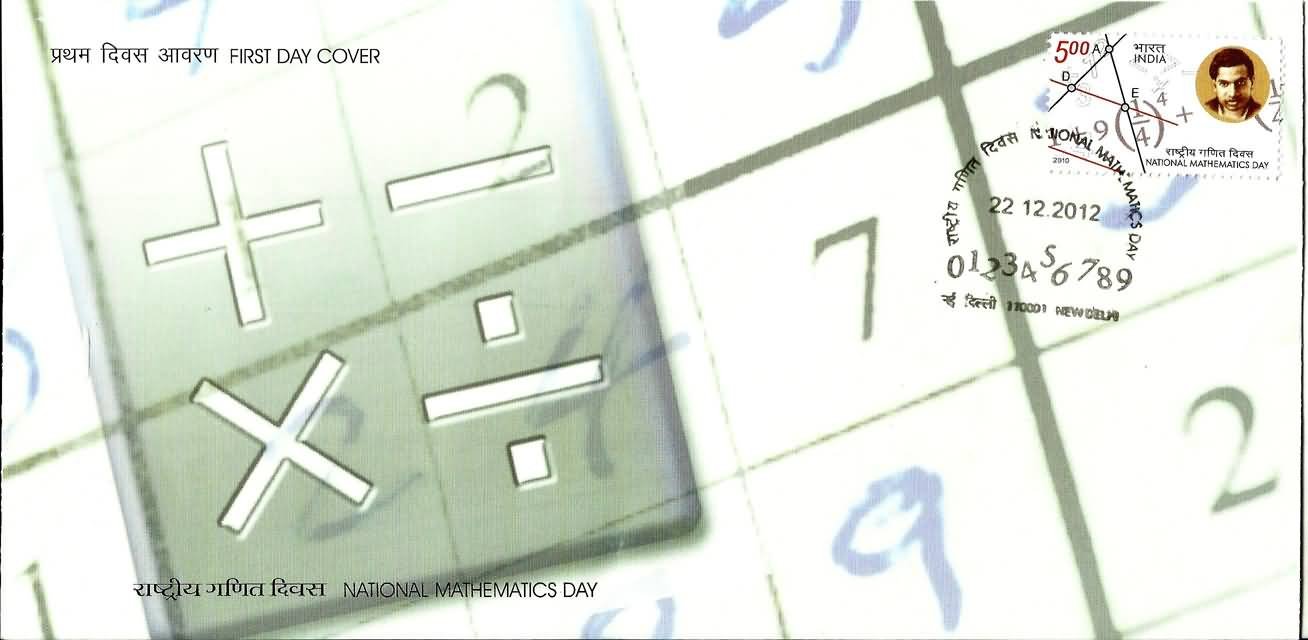
First Day Cover
Leave a Comment
You must be logged in to post a comment.